
If you’ve found yourself googling “why is my beagle doing X” more than once this week, you’re not alone. Beagles have a reputation. Neighbours mention the howling. Guests get jumped on. The garden looks like something went through it.
Here’s the thing though. Your beagle isn’t badly behaved. They’re breed-appropriate.
Every problem in this guide has roots in what the beagle was built to do. These are dogs that tracked prey over miles, worked in packs, communicated constantly, and used their nose to make decisions their handler couldn’t even perceive. That’s not a recipe for a dog that sits quietly on a mat.
Understanding the instinct behind each behaviour is the first step to actually changing it. So that’s where we start.
Why Beagles Get a Reputation for “Bad” Behaviour
Beagles were bred over centuries to track scent independently, work in packs, and vocalise loudly on a trail. None of those traits were problems in a hunting context. In a family home, the same traits look like stubbornness, disobedience, and destruction. They’re not. They’re a scent hound doing exactly what a scent hound does.
A study cited by Wikipedia tested scenting ability across breeds by placing a mouse in a one-acre field. Beagles found it in under a minute. Fox Terriers took 15 minutes. Scottish Terriers failed entirely. That nose is extraordinary, and it drives almost every behaviour problem beagle owners encounter.
The other factor is independence. Beagles were bred to lead the chase without waiting for instructions. They’re not wired to look to their owner for every decision the way a labrador or border collie might. That independence is part of what makes them challenging to train and easy to misread as wilfully disobedient.
Keep both of those things in mind as you read through each behaviour below.
Barking and Howling
Beagles bark and howl because they were bred to. A beagle on a trail would howl to signal the rest of the pack that they’d found something. That instinct doesn’t switch off at home. It gets triggered by scents, sounds, other dogs, boredom, and being left alone. You can reduce excessive barking with training. You won’t eliminate it entirely, and trying to will only frustrate you both.
Beagles actually make three distinct sounds: a standard bark, a bay (the classic hunting call), and a howl. Each one signals something slightly different. Baying tends to happen when they’ve found a scent or spot something exciting. Howling is often loneliness or distress. Regular barking covers everything from alerting to attention-seeking to boredom.
The most practical training fix for excessive barking is the “quiet” command. You wait for a natural pause in the barking, mark it with “quiet,” and reward with a high-value treat. Over time your beagle learns that silence, not noise, gets the good things. It takes weeks of consistent work, not days.
Environment management helps alongside training. If your beagle barks at the window all day, blocking visual access to the trigger removes a lot of the rehearsal. The less a behaviour gets practised, the weaker it becomes.
The full breakdown of causes, triggers, and fixes is here: Beagle Barking: How to Stop It
Digging
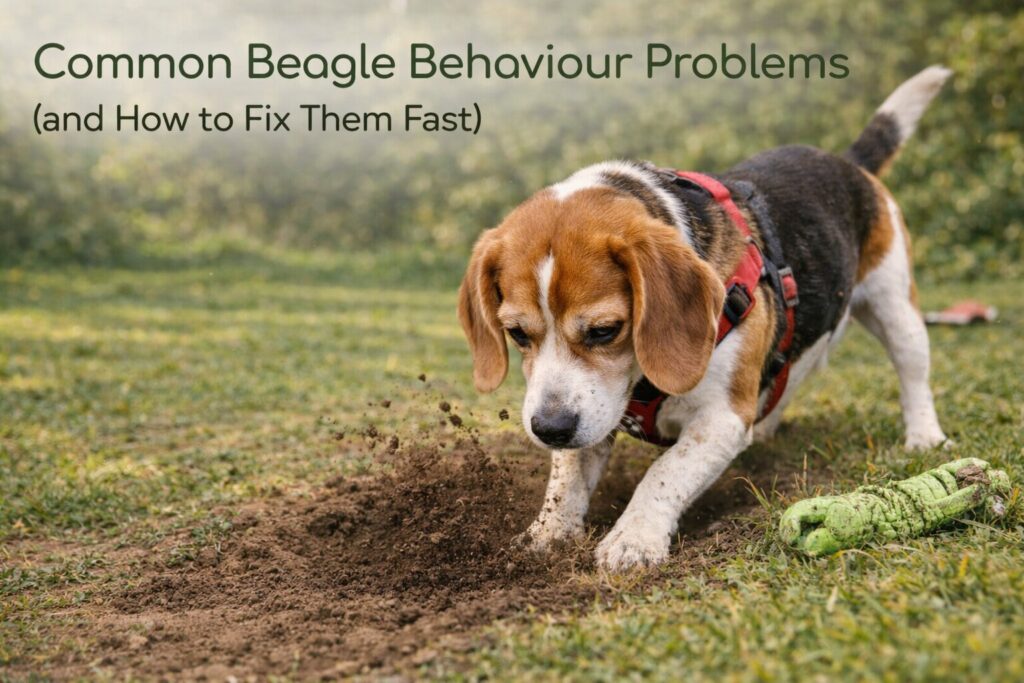
Hunting dogs dig because prey goes underground. Beagles follow scent into soil the same way they follow it across a field: with complete commitment. At home, that translates into craters in the garden, holes along the fence line, and a beagle that looks very satisfied with themselves.
Digging also happens for other reasons. Beagles dig to create cool spots in hot weather, to bury food or toys they want to protect, and as a straight release of pent-up energy when they haven’t had enough exercise or mental stimulation.
The fix isn’t stopping digging entirely. That’s fighting a deeply ingrained instinct and you’ll lose. The fix is redirecting it. Designate a dig zone in your garden, a specific patch of loose soil where digging is allowed. Bury treats or toys there to make it appealing. Use a firm “no” to redirect them away from off-limits spots, and reward them when they dig in the right place.
If digging is focused along the fence line, that’s usually escape-motivated. We cover that separately below.
For a full guide: Beagle Digging: Causes and Fixes
Destructive Chewing
Chewing is natural in all dogs, but beagles that chew destructively are almost always telling you something. Puppies chew because they’re teething. Adult beagles chew because they’re bored, under-exercised, or anxious. The chewing itself isn’t the problem. The trigger is.
The teething phase runs roughly from four months to nine months, sometimes up to a year. During this time, a beagle puppy will chew anything they can reach. This isn’t misbehaviour. It’s physical discomfort. The job is to make sure they have appropriate outlets and can’t access the things you don’t want destroyed.
Adult chewing is a different signal. According to Upperpawside, adult beagles chew on furniture and household items as a way to cope with boredom, frustration, or anxiety. If your adult beagle is chewing things they weren’t chewing before, something has changed in their routine, exercise level, or emotional state.
The practical fix has two parts. First, manage the environment: limit access to temptation, use a pen or gated room when you can’t supervise, and remove anything valuable from floor level. Second, provide legitimate outlets: durable chews, stuffed Kongs, and toys that take time and effort to work through.
What doesn’t work is telling a beagle off after the fact. By the time you’ve found the chewed chair leg, they’ve completely forgotten the act. Catch it happening, redirect calmly, reward the redirect.
Deeper guide here: Fix Destructive Chewing in Beagles
Jumping Up
Beagles jump to greet. It’s pure excitement, not dominance or aggression. They want to get closer to your face, which is where greetings happen between dogs. The problem is it doesn’t stop on its own. Every time jumping goes uncorrected, the behaviour gets reinforced.
The most consistent fix is the turn-away method. The moment your beagle jumps, turn your back, cross your arms, and give zero attention: no eye contact, no pushing them down, no verbal correction. Any attention, even negative attention, tells them the jumping worked. When all four paws are on the floor, turn back and reward calmly.
The key word here is consistent. This only works if everyone in the house does it every single time. One person who lets the jumping happen because it’s cute undoes the training for everyone else.
Teaching a default sit for greetings helps a lot. If your beagle learns that sitting when someone arrives is what earns attention and treats, jumping becomes less appealing. You’re replacing the unwanted behaviour rather than just suppressing it.
More on this: How to Stop Jumping in Beagles
Hyperactivity
Beagles were built for long days in the field. A dog that covered miles of terrain tracking prey doesn’t naturally settle on a sofa by mid-morning. Hyperactivity in beagles is almost always a symptom of unmet physical or mental needs, not a personality defect. Meet those needs and the hyperactivity reduces. Leave them unmet and it escalates.
The AKC notes that beagles require at least an hour of exercise daily. That’s a baseline, not a ceiling. For young beagles between four months and eighteen months, that number often needs to go higher, and physical exercise alone isn’t always enough.
Beagles need mental work as well as physical work. A dog that’s been walked for an hour but hasn’t used their brain is still a dog with energy to burn. Scent games, short training sessions, puzzle feeders, and tracking activities tap into the instinct that physical exercise alone doesn’t reach. A beagle that’s done twenty minutes of nose work is genuinely more tired than one that’s done forty minutes of walking.
Age matters here too. Most beagle owners find the hyperactivity peaks between four and eighteen months and genuinely improves after two years. If your beagle is currently in that window, the honest answer is: meet their needs consistently and wait it out.
Full guide: Hyperactive Beagle: What to Do
Territorial Marking
Marking is how dogs communicate in the absence of language. Urine carries a huge amount of information: identity, reproductive status, presence. When your beagle marks indoors, they’re not confused about house training. They’re leaving messages for other dogs, real or recently scented, that this space is claimed.
It’s more common in unneutered males, but VCA Animal Hospitals notes that both male and female dogs mark, and spayed or neutered dogs still mark, just less frequently. Neutering reduces the hormonal drive behind marking significantly but doesn’t eliminate it in dogs that have already established the habit.
Indoor marking is usually triggered by one of three things: the scent of another animal in the home, the presence of a new dog outside that the beagle has detected, or incomplete house training that the owner has mistaken for a fully trained dog. If marking starts suddenly in a dog that was previously clean, rule out a urinary tract infection before assuming it’s behavioural.
The practical response is the same as house training: supervise closely, interrupt and redirect calmly when you catch it, clean marked spots thoroughly with an enzymatic cleaner (anything else leaves scent residue that invites re-marking), and reduce access to trigger areas while you work on it.
Deeper guide here: Territorial Marking in Beagles
Why Beagles Hide Toys or Food
If you’ve found a chew buried under sofa cushions or a toy wedged behind the garden fence, your beagle isn’t being odd. They’re caching. Wild canines buried surplus food to protect it from competitors and retrieve it later. Your beagle stashing their favourite treat is that same behaviour playing out in a living room.
It’s instinctive, harmless, and usually nothing to intervene in. Beagles hide things they value: food, chews, toys that smell of a previous meal. The hiding itself isn’t a problem.
Where it becomes worth addressing is when it tips into resource guarding: growling, snapping, or stiff body language when you approach a hidden item. That’s a different issue and one to deal with early. Most beagles don’t reach that point, but if yours is showing guarding behaviour around cached items, redirect their attention before they settle, swap the item for a high-value treat, and avoid reaching directly for things they’re guarding until you’ve built the foundation for a reliable “drop it” command.
More on this behaviour: Why Beagles Hide Toys or Food
Beagle Behaviour During Walks
A walk for a beagle is nothing like a walk for most other breeds. Their nose hits the ground within ten seconds and everything else stops mattering. Pulling, zigzagging, freezing on a scent, ignoring you completely: this is all normal beagle walk behaviour. It’s not bad manners. It’s a scent hound doing what it was built to do.
The pulling usually comes from scent-chasing rather than dominance. Your beagle isn’t trying to lead. They’ve caught something interesting and their entire body is trying to get to it faster than you can walk. Understanding this changes how you approach it. You’re not correcting a power struggle. You’re teaching a highly motivated nose to work within limits.
The most effective approach is structured sniff time rather than sniff suppression. Give your beagle designated moments on the walk where they’re free to sniff fully, on a longer lead or in a safe area. Then use a cue like “let’s go” to signal it’s time to move again, rewarding the transition with treats. Sniffing on cue is more achievable than no sniffing at all, and it actually reduces pulling because your beagle knows the sniff opportunity is coming.
Freezing mid-walk on a scent is common and frustrating. The fix is carrying high-value treats that can compete with whatever’s on the ground, calling your beagle’s name and rewarding the look-up, then moving. Pulling them physically when they’re locked onto a scent tends to result in more pulling, not less.
Full guide: Beagle Behaviour During Walks
Escaping
A beagle that escapes isn’t trying to leave you. They’ve caught a scent and their breeding is telling them to follow it. Beagles can pick up a scent from over a mile away. Once they’re on a trail, recall often stops working entirely. The beagle isn’t being disobedient. They’re physiologically locked onto something their brain considers a priority.
This is why prevention matters more than training for escaping. No amount of recall practice is fully reliable against a strong scent drive in an unsecured environment. That’s not a failure of training. It’s biology.
Fencing needs to be higher than you think (six feet minimum) and it needs to address the ground as well as the height. Beagles that can’t jump will dig under. Burying wire mesh or paving slabs along the fence line addresses this. Check the fence regularly for gaps, weak points, and areas where soil erosion has created a gap at the base.
Gates are often the weak point. Beagles learn very quickly that humans operate gates, and they’ll wait for the opportunity. Self-closing latches, double-gate systems, and training your beagle to sit and wait before any gate opens all reduce the risk.
Recall training is still worth doing, not because it will work every time against a live scent, but because a strong recall buys you a safety margin in lower-distraction situations. Build it carefully, reward it generously, and never scold a beagle that comes back to you, even if they ran in the first place. Scolding the return teaches them that coming back leads to something bad. That’s the last lesson you want them to learn.
Full guide: Preventing Escapes in Beagles
Conclusion
Every behaviour in this guide has something in common: it makes sense for the dog the beagle was bred to be. That doesn’t mean you have to live with all of it. It means you’ll get further by working with the instinct than by fighting it.
A beagle that gets its scent drive satisfied through nose work is easier to redirect when it’s sniffing the wrong things. A beagle that gets enough exercise and mental stimulation is less likely to chew, dig, or bark from boredom. A beagle whose needs are consistently met is a genuinely manageable dog.
Pick the problem that’s most pressing right now and start with the guide below. You don’t have to fix everything at once.
- Beagle Barking: How to Stop It
- Beagle Digging: Causes and Fixes
- Fix Destructive Chewing in Beagles
- How to Stop Jumping in Beagles
- Hyperactive Beagle: What to Do
- Territorial Marking in Beagles
- Why Beagles Hide Toys or Food
- Beagle Behaviour During Walks
- Preventing Escapes in Beagles
Frequently Asked Questions
Why do beagles misbehave so much compared to other dogs?
Beagles don’t misbehave more than other dogs. They just misbehave in ways that are particularly visible: loud vocalisation, obvious destruction, and a complete inability to look apologetic about it. Most of their problem behaviours trace directly to hunting instincts that were bred into them over centuries. A beagle digging or howling isn’t a badly behaved dog. It’s a scent hound in a domestic context, doing what scent hounds do.
At what age do beagles calm down?
Most beagle owners notice a real shift around eighteen months to two years. The peak hyperactivity phase is roughly four months to eighteen months, when the dog has significant physical energy but not the emotional maturity to regulate it well. By two years, most beagles are considerably more settled, as long as their exercise and mental stimulation needs are being met consistently.
Is it too late to fix behaviour problems in an adult beagle?
No. Adult beagles learn well with consistent positive reinforcement training. Some behaviours that have been practised for a long time take longer to shift because the dog has a reinforcement history with them, but none of the problems in this guide are beyond fixing in an adult dog. Patience and consistency matter more than the age you start.
Do all beagles have these behaviour problems?
Not all beagles display all of these behaviours, and the severity varies a lot between individual dogs. A well-exercised beagle with plenty of mental stimulation and consistent training will show far fewer problem behaviours than one whose needs aren’t being met. Breed predisposition sets a tendency, not a certainty. How you manage and train your beagle shapes how those tendencies actually play out.
Will neutering help with beagle behaviour problems?
Neutering reduces hormone-driven behaviours, most notably territorial marking in males, roaming to find a mate, and some forms of mounting. It won’t fix behaviours that are driven by instinct, boredom, or lack of training: barking, digging, chewing, and jumping are the same in neutered and unneutered dogs. Neutering is worth considering for health and population reasons, but it’s not a behaviour solution on its own.