
Beagle Behaviour During Walks: How to Fix Pulling, Freezing, and Zigzagging
Walking a beagle is nothing like walking other dogs. The nose hits the ground in the first ten seconds and everything else stops mattering. Pulling, freezing mid-step, and zigzagging are all normal beagle walk behaviours. They come from scent-hound instinct, not bad manners. This guide covers why each one happens and what actually works to manage them without fighting your dog the whole time.
The moment I clip Tyler’s leash on, his nose is already moving. Before we’ve even hit the sidewalk, he’s sniffing the door frame, the step, the concrete. By the time we’re ten feet from the house, I’ve already had to stop twice.
If your walks look anything like that, you’re in the right place.
A lot of owners get frustrated with beagle walk behaviour because it seems random. One minute they’re pulling hard. Next minute they’ve frozen completely and won’t budge. Then they’re zigzagging across the path like something’s wrong. Nothing is wrong. That’s just a beagle doing what it was built to do.
This guide focuses on the three most common walk problems and the fixes that actually make a difference. If you’re dealing with other behaviour issues at home too, the common beagle behaviour problems guide has the full picture.
Why Do Beagles Behave So Differently on Walks?
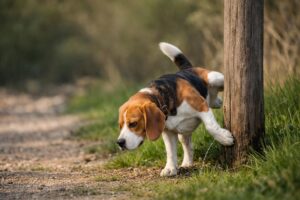
A beagle’s walk is almost entirely a nose experience. They’re reading the environment scent by scent — who walked here, what they were carrying, what animal crossed the path three hours ago. Beagles were bred as scent hounds to track independently, without constant direction from a person. When the nose is engaged, the brain is fully occupied. That’s the whole explanation for every frustrating walk behaviour in this guide.
Research from LECOM found that beagles have around 225 million olfactory receptors compared to 5 million in humans. That’s not a dog that smells things a little better than you. It’s a dog receiving an entirely different level of information from every square inch of ground.
This matters because it changes how you approach the problems. You’re not dealing with a dog that’s being difficult. You’re dealing with a dog that’s highly motivated to do what its brain is telling it to do. Work with that and you’ll make progress. Fight it and you’ll both be miserable every single walk.
Why Is My Beagle Pulling on the Leash?
Beagle leash pulling comes from two things: the scent pull and the opposition reflex. Your beagle catches something interesting and their whole body tries to get to it faster than you can walk. When you pull back, they naturally lean forward harder. It’s a physical reflex, not attitude. And because pulling keeps the walk moving, the dog has no reason to stop.
The opposition reflex is worth understanding. When pressure comes from behind, dogs instinctively brace forward. It’s the same reflex that makes sled dogs useful. Every time you tug back on the leash, you’re physically triggering the pull, not correcting it.
Beagle pulling is almost never about dominance either. Your beagle isn’t trying to lead. They just caught a scent and their whole body wants to get to it. Once you stop reading it as a power struggle, the fix gets a lot clearer.
How to Fix Beagle Leash Pulling
The stop-and-stand method is the most reliable approach. The second the leash goes tight, you stop. Don’t pull back, don’t say anything, don’t move. You wait. The moment you see a J-shape in the leash again, take one step forward and hand over a treat.
The AKC recommends waiting for your dog to turn their attention back to you before starting again. That part matters. The treat rewards the check-in, not just the slack leash.
Your walk will basically go nowhere for the first few sessions. That’s expected. The point isn’t the distance. It’s teaching your beagle that a tight leash stops everything and a loose leash keeps the walk going.
- Dry kibble won’t compete with real outdoor smells. Use something smelly and high-value: cooked chicken, cheese, or hot dogs.
- Treat every five to ten seconds when your beagle is walking nicely by your side.
- Not at the end of the walk. Right then, as it’s happening. Timing is everything.
When they really lock onto something and start pulling hard, try the direction change. Don’t jerk the leash. Just turn around calmly and start walking the other way. Your beagle can either come with you or stand there. Most of the time they’ll follow, and that choice to follow with you is exactly what you want to be rewarding.
Consistency matters more than technique here. One person in the house letting the pulling slide undoes everything. Everyone who walks the dog needs to follow the same rules on every single walk.
Why Does My Beagle Freeze Mid-Walk?
When a beagle hits a strong scent, the brain can put everything else on hold. They lock on and the world stops. This is scent-locking. It’s not stubbornness. The nose found something so compelling that moving forward stopped being the priority. Dragging the dog out of it physically almost always makes it worse, not better.
Scent-locking looks different from fear-based freezing. A scared dog shows other signs: ears flat, tail tucked, crouched low, sometimes panting or lip-licking. A scent-locked beagle looks focused. Nose down, tail level or raised, completely absorbed. They’re not anxious. They’re occupied.
Tyler does this at the park. There’s one patch of grass near the main gate that gets him every single time. I’ll be mid-walk and the leash suddenly goes stiff. He’s just gone. I can call his name, rattle the treat pouch, nothing works for about ten seconds. The more I used to pull, the more he braced. I eventually figured out that waiting it out worked a lot better than fighting it.
How to Handle the Mid-Walk Freeze
High-value treats are the only thing that reliably competes with a strong scent. Regular treats don’t cut it in this situation. The treat needs to be smelly enough to register over whatever’s on the ground. Cooked chicken, cheese, hot dogs.
Say your beagle’s name once, calmly. If they look up, treat immediately and start moving. Don’t wait. The treat marks that exact moment of disengagement. That’s the behaviour you’re building.
If they don’t respond to the name, just stand still. Don’t pull. Give it five to ten seconds. Most beagles will come up for air on their own. The moment you see them start to lift their nose, call the name and move. Reward when they come.
- Use the same phrase every time you transition from a sniff stop to walking.
- Over weeks, your beagle learns that phrase means something good happens if they disengage and move with you.
- It takes time to build but it really does work. Pick a phrase and use it every single time.
One thing I’d add from experience: don’t repeat their name over and over when they’re scent-locked. It teaches them that their name is background noise. One call, treat if they respond, wait calmly if they don’t.
Why Is My Beagle Zigzagging and Sniffing Everything?
Zigzagging is your beagle following a scent trail. The trail doesn’t run straight down the path. It veers left where a dog stopped yesterday, cuts right where a cat crossed this morning. Your beagle is tracking it accurately. The zigzag is the route, not random behaviour. And the sniffing that comes with it is actually doing something useful for their brain.
Animal Humane Society makes a point that a lot of owners miss: sniffing releases dopamine and lowers a dog’s heart rate. A 20-minute walk where your beagle gets real sniff time will leave them more settled than a 40-minute walk where they got pulled along the whole way.
PetMD’s research on scent walks confirms that the mental energy used during sniffing tires dogs out the same way physical exercise does. If you’re dealing with a restless beagle at home, sniff time on walks is one of your best tools.
The problem isn’t the sniffing. It’s unstructured sniffing that bleeds into pulling, zigzagging across other people’s paths, and general chaos. That part is fixable.
If your beagle is also restless and hyperactive at home, read the hyperactive beagle guide alongside this one. Sniff deprivation on walks often shows up as energy at home.
How to Structure Walks So the Sniffing Works for You
The move is separating the walk into two modes: structured walking and sniff time. You’re not taking sniffing away. You’re making it something that happens on your terms.
Pick a release cue for sniff time. “Go sniff” or “free” both work. When you say it, loosen the leash and let their nose lead. When you’re ready to move, say “let’s go” and start walking. Treat them for keeping up with you.
Then use sniff breaks as a reward for loose leash walking. Walk nicely for thirty seconds, you get a “go sniff.” That reframes the whole dynamic. The sniffing isn’t something you’re fighting. It’s the reward for doing what you want. Beagles figure that out pretty quickly.
Animal Humane Society also notes that scent hound breeds have a stronger drive for sniffing than most other dogs. When Tyler gets proper sniff time on walks, the digging in the garden settles down and he’s noticeably calmer at home. It all connects.
Beagles that dig obsessively in the garden are often under-stimulated on walks. The beagle digging guide covers that connection in detail.
The One Gear Change That Actually Helps
If you’re walking with a back-clip harness, it’s working against you. Best Friends Animal Society explains that back-clip harnesses let dogs use their full chest muscles to pull directly forward. That’s basically sled dog setup. You’re not going to out-muscle a motivated beagle.
A front-clip harness attaches at the chest. When your beagle pulls, the leash redirects them sideways instead of letting them lean straight forward. PetMD explains that this uses the dog’s own momentum to steer them back toward you. You’re not fighting the pull. The harness handles the mechanics while your training handles the habit.
Make sure the fit is right. A poorly fitted front-clip harness causes chafing on the front legs. Use it alongside the stop-and-stand training, not instead of it.
- Retractable leashes teach pulling because the leash extends whenever the dog moves forward.
- Your beagle learns that pulling gets more freedom. Use a standard 4-to-6-foot leash instead.
- Once your beagle has solid loose leash manners, a retractable can work for relaxed sniff walks in safe open areas. Not before.
Conclusion
Beagle walks get better when you stop treating the nose as the problem. The pulling, freezing, and zigzagging all come back to the same thing: a dog bred to follow scent, doing exactly what it was designed to do.
Stop-and-stand for the pulling. One calm name call and a high-value treat for the freeze. Structured sniff breaks so the nose gets what it needs without taking over the whole walk. And a front-clip harness to manage the pulling while the training takes hold.
It takes a few weeks to start clicking. The walks improve in stages, not overnight. But they do get better.
If barking on walks is also something you deal with, the beagle barking guide covers that specifically. And for the full range of behaviour challenges in one place, the common beagle behaviour problems guide is a good next stop.
Frequently Asked Questions
How long does it take to train a beagle to stop pulling on the leash?
Realistically, a few weeks of consistent work before you see real improvement, and a few months before it becomes reliable. The stop-and-stand method works, but it needs to happen on every walk, with everyone who walks the dog. Young beagles under eighteen months take longer because their impulse control is still developing. Build the behaviour in lower-distraction environments first and extend gradually from there.
Should I let my beagle sniff on every walk?
Yes, at some point on every walk. Not the whole walk, but designated sniff time on each one. Animal Humane Society is clear that sniffing is genuine mental enrichment for dogs. Denying it completely tends to produce a more frustrated, harder-to-manage dog. Build it in as a scheduled part of the walk rather than something you’re constantly fighting against.
Why does my beagle listen perfectly at home but ignore me completely on walks?
Outside, everything competing for their attention is real and immediate. Your voice at home is the most interesting thing in the room. On a walk, it’s competing against fresh scent trails, other dogs, movement, and sound all at once. You need higher-value treats than you’d use at home and you need to build the behaviour gradually in low-distraction environments before expecting it in high-distraction ones like a busy street.
Is a retractable leash okay for a beagle?
Not during training. Retractable leashes teach pulling because the leash extends whenever the dog moves forward. Your beagle learns that pulling forward gets more freedom. That’s the opposite of what you’re working toward. Once your beagle has solid loose leash manners on a standard leash, a retractable can work for relaxed sniff walks in safe, open areas.
My beagle freezes completely on walks and won’t move at all. What do I do?
First figure out whether it’s scent-locking (focused, nose down, tail level or raised) or fear-based (tail tucked, low posture, avoiding something specific). For scent-locking, stand still with a high-value treat ready, call the name once, and reward the moment they disengage. For fear-based freezing, identify the specific trigger and work on gradual desensitisation rather than pushing your beagle through it. If it happens at the same spot every time, pay attention to what’s there.