
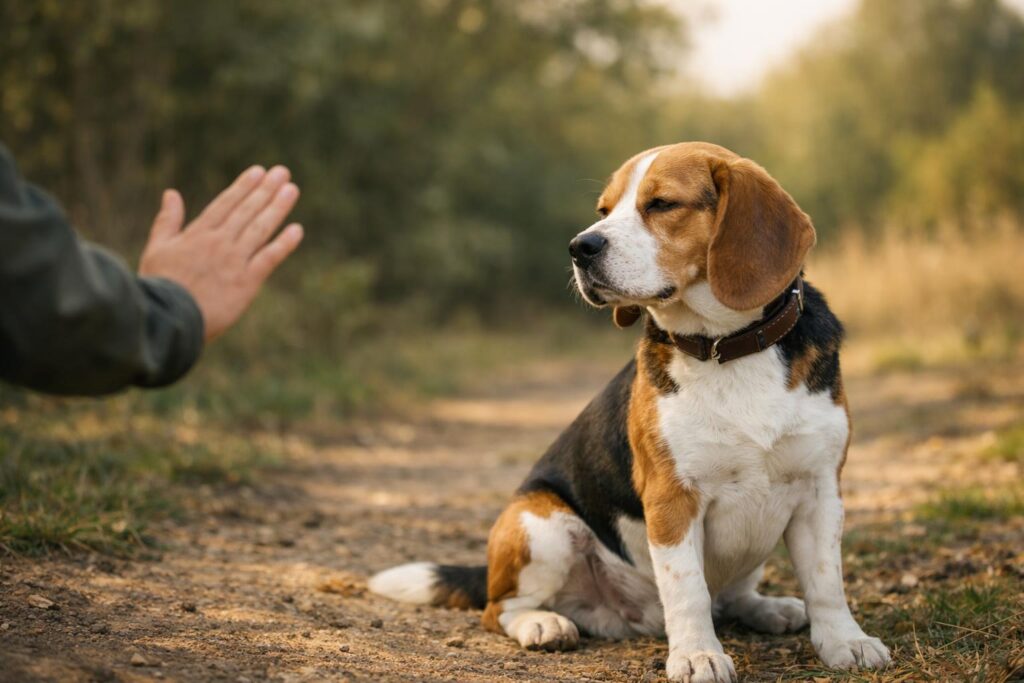
Tyler once stood ten feet away from me in the park, nose buried in a patch of grass, completely ignoring my existence. I called his name four times. Nothing. I moved closer. He shuffled two inches to the left and kept sniffing.
If you own a beagle, you’ve had this moment. You’re not imagining it, and you’re not doing everything wrong. Beagle stubbornness is one of the most common frustrations owners talk about. But here’s the thing: what looks like stubbornness is usually something else entirely. Once you understand what’s actually going on, the whole thing becomes a lot less personal and a lot more fixable.
In this post I’m going to walk you through why beagles act this way, the mistakes most owners (including me) make, and the practical fixes that have actually helped with Tyler.
Why Are Beagles So Stubborn?
Beagles aren’t stubborn out of attitude. They were bred as scent hounds to track rabbits and small game independently, and that independent thinking is literally in their DNA. When they pick up a scent, their brain is wired to follow it, not to stop and wait for instructions.
Beagles were bred to work independently in the field, making decisions on their own without waiting for a hunter’s command. That’s the opposite of breeds like herding or protection dogs, which were bred to stay tuned into their owner. So when your beagle checks out and follows a scent instead of listening to you, they’re doing exactly what centuries of selective breeding prepared them to do.
Beagles have around 220 million scent receptors compared to about 5 million in humans. When they catch a trail, their brain prioritizes that smell above almost everything else, including your voice. They’re not ignoring you to be difficult. Their nose is just louder than you are right now.
There’s also a personality piece to this. Beagles are smart dogs. Experienced beagle owners often say the breed’s attitude is basically: “What’s in it for me?” They’re not eager-to-please dogs the way some breeds are. They need a reason to listen. That’s not a flaw. It’s just who they are.
Is Your Beagle Actually Stubborn or Just Distracted?
There’s a real difference between a beagle that won’t listen and a beagle that can’t listen right now, and that difference matters a lot for how you respond.
A distracted beagle has locked onto something. A scent, a sound, another dog, a squirrel. In that moment, you’re competing with a biological drive that’s been thousands of years in the making. No amount of repeating their name is going to cut through that. The beagle isn’t choosing to ignore you. They’re just fully occupied.
A stubborn beagle, on the other hand, knows what you’re asking and is deciding not to do it. This is more common when a beagle hasn’t been trained consistently, or when they’ve learned that ignoring you has no real consequences.
With Tyler, the park is almost always a distraction problem, not a defiance problem. He checks out the moment we arrive. His nose hits the ground and I basically stop existing. I used to take it personally. Now I understand that the park is a sensory overload situation for him and I plan for it instead of getting frustrated.
When a beagle is distracted outdoors, the most effective response is to either remove the distraction or move your beagle away from it entirely and start over, rather than repeating commands that aren’t landing.
Common Mistakes That Make Beagle Stubbornness Worse
Most of us make these mistakes early on. I know I did. The problem is that some of them actually train your beagle to ignore you more, not less.
Repeating commands over and over. If you say “come, come, COME, Tyler, come here, COME” without any real consequence, you’re teaching your beagle that the word “come” is just background noise. Say it once, clearly. If nothing happens, go get them or redirect rather than repeating yourself.
Chasing your beagle. This is a big one. If your beagle runs off and you chase after them, you’ve just turned their escape into a fun game. Running away from your beagle, not toward them, actually triggers their chase instinct and gets them moving back in your direction. It feels counterintuitive but it works.
Giving in to the stubbornness. One of the biggest mistakes beagle owners make is accidentally rewarding stubborn behavior by giving the dog what it wants when it refuses to comply. If your beagle refuses to come inside and you eventually go out and carry them in while giving them attention, they’ve learned that stubbornness gets results.
Punishing them for not listening. Beagles don’t respond well to harsh correction. Shouting at a stubborn beagle tends to make them more anxious, not more obedient. An anxious beagle is less likely to listen, not more. You want them to obey because they trust you, not because they’re scared of you.
Training sessions that go on too long. Beagles have a short attention span, especially around distractions. A 45-minute training session isn’t four times as effective as a 10-minute one. It’s usually worse. They zone out, you get frustrated, and the session ends on a bad note.
How to Get a Stubborn Beagle to Listen: 5 Fixes That Actually Work
These aren’t quick fixes. But they’re the things that have actually moved the needle with Tyler and that come up again and again in real beagle owner communities.
1. Use high-value treats, not just kibble. When you’re training outdoors, the treat needs to smell stronger than whatever your beagle is currently sniffing. Small pieces of cooked chicken, cheese, or hot dog work well. Regular dry kibble often doesn’t compete. This sounds simple but it makes a big difference.
2. Keep sessions short. Training your beagle for 5 to 10 minutes two or three times a day gets better results than one long session. Short sessions keep your beagle engaged. Always end on something they can succeed at so they associate training with positive feelings.
3. Exercise your beagle before you train. An unexercised beagle is more reactive, more distractible, and harder to train. A tired beagle is far more likely to focus on you. This was a game-changer for me. I used to try training Tyler right when we arrived at the park. Now I let him run around for a bit first, then we work on commands.
4. Keep your commands simple and consistent. One or two word commands like “sit,” “stay,” and “come” work best for beagles. Everyone in your household needs to use the same words. If one person says “come here” and another says “come” and another says “Tyler, come here now please,” your beagle gets confused.
5. Build a routine and stick to it. Beagles do much better when feeding, walking, and training happen on a predictable schedule. Routine reduces anxiety and helps them stay more focused. It also makes training feel like a normal part of the day rather than an event they have to gear up for.
How to Improve Recall When Your Beagle Ignores You Outdoors
Recall is the one skill that matters most, especially in the park. It’s also the hardest one to build with a beagle. Here’s the honest truth: you have to earn reliable recall. You can’t just expect it.
The key is to build up to outdoor recall slowly, starting in a place with zero distractions and gradually adding more over time. Jumping straight to calling your beagle back in a busy park when they haven’t mastered it at home is like skipping every grade in school and going straight to a final exam.
Start recall training indoors, then move to a fenced yard, and only then progress to a more challenging environment like a park. At each stage, your beagle needs to be reliably coming back before you move on.
A long training leash (20 to 30 feet) is your best friend during this process. It gives your beagle some freedom while keeping them safely attached. If they don’t respond to the recall command, you can gently guide them back without having to chase them.
One tip that helped Tyler a lot: don’t only call your beagle back when it’s time to go home. If recall always means the fun stops, your beagle learns to ignore it. Call them back several times during a walk, reward them, and then let them go play again. Recall becomes a good thing instead of a signal that the party’s over.
No matter how long it takes, always reward your beagle when they come back to you. Even if it took five minutes. Even if you’re frustrated. Never punish a beagle for eventually returning. If you do, they’ll associate coming back with something bad, and your recall will get worse, not better.
Some owners also swear by a whistle. A whistle cuts through background noise better than a voice and gives a consistent signal your beagle can learn to recognize. Pair it with a treat every single time at home first, and eventually the whistle itself becomes exciting.
How Long Does It Take to Train a Stubborn Beagle?
Months, not weeks. I want to be straight with you on this because a lot of training content glosses over it.
Beagles take longer to train than many other breeds. That’s just a fact. Because beagles take longer to train than average, starting as early as possible matters a lot. But even adult beagles can learn. Old dogs absolutely can learn new tricks. It just requires more repetition and more patience.
There’s also an adolescent phase to watch out for. The teenage stage in beagles is when they start pushing limits and testing boundaries all over again, even if they seemed to have things figured out. This is normal. Stay consistent and it passes.
The owners who see real progress are the ones who train a little bit every single day, keep their expectations realistic, and celebrate small wins. Tyler still loses his mind in the park sometimes. But compared to where we started, we’ve come a long way. That’s what counts.
Final Thoughts
Beagle stubbornness is real, but it’s not a character flaw. It’s biology. These dogs were built to follow their nose and think for themselves. Expecting them to behave like a breed that was wired to please humans is setting yourself up for frustration.
Work with the instincts instead of against them. Use treats that smell good. Keep sessions short. Build recall slowly. Be patient when you’re in the park and your beagle checks out completely, because that’s just what beagles do.
It does get better. Tyler is proof of that.
If you want to keep building on this, check out my post on teaching basic commands to your beagle, which covers the step-by-step process for sit, stay, come, and down in a way that actually works for this breed.
Frequently Asked Questions
Why does my beagle ignore me when we’re outside?
Your beagle is most likely distracted by a scent, not deliberately ignoring you. Beagles have around 220 million scent receptors, and when they pick up a trail outdoors, their brain focuses almost entirely on that smell. The park or yard is simply a lot more stimulating than your living room. This is why recall training needs to be built up gradually in outdoor environments rather than expected right away.
What treats work best for training a stubborn beagle?
High-value, smelly treats tend to work best. Small pieces of cooked chicken, cheese, or hot dogs are popular choices because the smell competes with whatever your beagle is sniffing. Regular dry kibble often isn’t motivating enough in a distracting environment. Keep training treats small, about the size of a pea, so your beagle doesn’t fill up fast and lose interest.
Can an older beagle learn to listen better?
Yes, absolutely. Adult and older beagles can definitely learn new behaviors. It may take more repetition than it would with a puppy, but the same principles apply: short sessions, consistent commands, and high-value rewards. Patience matters even more with an older dog who may have had years of reinforcing their own habits.
Should I let my beagle off-leash in the park?
Only if your beagle has a reliable recall in that specific environment. Most experts recommend keeping beagles on a leash or long line in open public spaces unless their recall is extremely solid. Beagles are fast, determined trackers, and once they’re on a scent they can cover a lot of ground quickly. A fenced dog park is a safer place to practice off-leash training while you build up their recall.
Is it okay to punish a beagle for not listening?
No. Punishment-based training tends to backfire with beagles. It can create anxiety, which actually makes them less likely to listen, not more. More importantly, if you punish a beagle when they finally come back to you (after taking their time), they’ll associate returning with something bad. Always reward a beagle that comes back, even if it took a while. Positive reinforcement is the method with the most evidence behind it for this breed.