
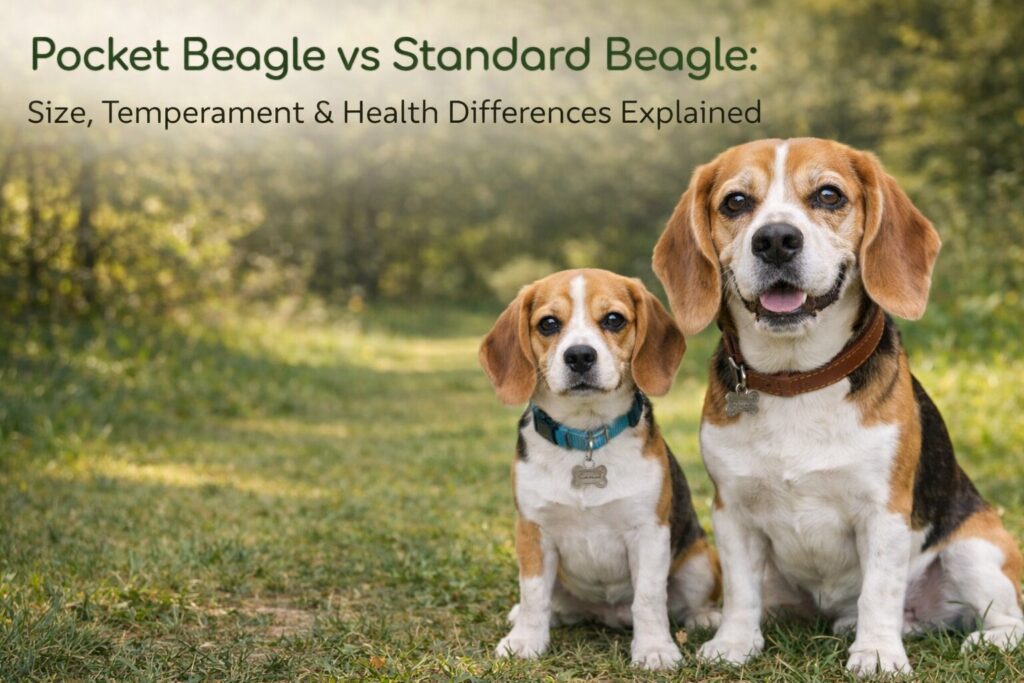
TL;DR: Pocket beagles are smaller versions of the standard beagle, but they are not a separate recognised breed. The AKC does not recognise them. In terms of personality and temperament they are almost identical to regular beagles, but their smaller size often comes with real health trade-offs depending on how they were bred. If you are considering a pocket beagle, understanding how they are produced is the most important thing to look into before you commit.
Tyler is a standard beagle. Somewhere around 14 inches at the shoulder, built exactly the way a beagle is supposed to be built. He is not a small dog and not a large one. Just a beagle.
When people ask me about pocket beagles, the first thing I tell them is that the name is doing a lot of marketing work. It sounds like a specific breed. It is not. And understanding what it actually means changes the conversation considerably.
What Is a Pocket Beagle?
A pocket beagle is simply a beagle that is smaller than the standard size. Kazuri Beagles is direct about this: there is no recognised breed or variety of the purebred beagle called the Pocket Beagle. The AKC recognises two size varieties of beagle: the 13-inch class (under 13 inches at the shoulder) and the 15-inch class (between 13 and 15 inches). Pocket beagles fall below both.
The term has a genuine historical root. Hepper notes that Queen Elizabeth I kept packs of tiny 6 to 9-inch beagles in the 16th century, small enough to fit in a saddlebag and used to flush prey out of dense undergrowth during hunts. Those bloodlines died out entirely by 1901. The pocket beagles being bred and sold today have no genetic connection to those historical dogs.
What modern pocket beagles are instead is the result of breeders deliberately producing unusually small dogs, using one of two methods. Both are worth understanding.
How Pocket Beagles Are Bred and Why It Matters
The first method is crossbreeding with a smaller dog breed. This preserves some genetic diversity and produces a dog that is genuinely mixed rather than a pure beagle. Hepper explains that this approach at least allows for a broader gene pool. The trade-off is that the dog’s temperament and health profile may reflect the other breed as much as the beagle.
The second method is more concerning. Hepper describes it clearly: breeders select two dogs that were both the runt of their own litters and breed them together. This passes on the dwarfism gene but also concentrates the genetic defects and elevated illness rates that come with being a runt. The puppies inherit both the small size and the health vulnerabilities of both parents.
This is not a detail that belongs at the bottom of an article. It is the most important thing to know before buying a pocket beagle from any breeder who cannot clearly explain how their dogs are produced.
Size: The Obvious Difference
A standard beagle stands 13 to 15 inches at the shoulder and weighs between 20 and 30 pounds, depending on height. A pocket beagle typically stands 7 to 12 inches and weighs between 7 and 15 pounds. Dogster puts it plainly: pocket beagles are roughly half the height and weight of standard beagles.
Beyond the raw measurements, the physical differences go a bit further. Dogster notes that pocket beagles sometimes have narrower muzzles, wider heads, more prominent eyes, and a body shape that can appear disproportionate, with a larger head relative to the body. These traits are a consequence of the dwarfism gene and are not present in standard beagles.
Temperament: Almost Identical
This is where pocket beagle owners get genuine good news. The personality of a pocket beagle is essentially the same as a standard beagle. Curious, friendly, food-motivated, sociable, vocal, and prone to following their nose wherever it leads. A-Z Animals notes one minor difference: pocket beagles may have a slightly lower prey drive because their size makes chasing and catching prey less practical, but the instinct is still there.
Both types share the same potential challenges: they can be stubborn during training, they will howl when bored or anxious, and they do not do well left alone for long periods. The pocket beagle is not a more manageable or easier version of the breed on a behavioural level. It is simply a smaller one.
One practical consideration: Dogster notes that the pocket beagle’s smaller frame makes them more physically fragile, which is worth thinking about in households with young children or larger dogs who play boisterously. The temperament is fine; the body is more vulnerable to accidental injury.
Health: The Real Difference
Standard beagles have their own breed-specific health considerations, including epilepsy, ear infections due to their floppy ears, and a tendency toward weight gain. Pocket beagles share all of these and add more.
Puppy Simply lists the elevated health risks that come with the pocket beagle’s smaller size: patellar luxation (kneecap dislocation), intervertebral disc disease (IVDD), and a higher incidence of the genetic conditions associated with dwarfism. These are not rare edge cases. They are documented consequences of breeding for extreme smallness, and they translate into higher veterinary costs and more medical management over the dog’s lifetime.
Ear care applies equally to both. The long, floppy ears that are one of the beagle’s most recognisable features restrict airflow and create warm, moist conditions that bacteria and yeast thrive in. Weekly ear checks and regular cleaning are important for both the standard and pocket version of the breed. The pocket beagle’s smaller ear canal can make infections harder to spot early, which is one more reason for consistent monitoring.
Weight management is another shared concern. Both types of beagle are famously food-motivated and prone to overeating if given the opportunity. In a pocket beagle, excess weight puts proportionally more strain on already vulnerable joints, so keeping them lean is a more active priority than it might be for a standard beagle.
A pocket beagle from a reputable breeder who health-tests their dogs and prioritises conformation over size will be in a meaningfully better position than one from a breeder who is simply chasing the smallest dog possible. DogTime recommends exercising real caution, doing thorough research, and seeking breeders who prioritise health and temperament over size when considering a pocket beagle. When visiting a breeder, ask to see health clearances for both parents and ask directly how they achieve the smaller size. The answer tells you a great deal.
Exercise and Daily Life
Standard beagles need around an hour of exercise per day. Tyler gets a long morning walk and a shorter one in the evening, with time to sniff and explore rather than just march on a lead. That sniff time matters for the breed’s mental stimulation just as much as the physical activity.
Pocket beagles need roughly 30 to 45 minutes of daily exercise, split across shorter sessions. Their smaller legs tire more quickly and high-impact play needs to be managed more carefully to protect their joints, particularly given the elevated risk of patellar luxation. Two 20-minute walks rather than one long one is a sensible approach.
The nose-driven temperament is identical in both. A pocket beagle left without mental stimulation will express the same frustration as a standard beagle: howling, destructive chewing, or escape attempts. Scent games and puzzle feeders help both versions of the breed manage boredom.
On a practical level, the smaller size genuinely changes daily logistics. A pocket beagle fits more comfortably into smaller living spaces, travels more easily, and is physically lighter to handle on a lead when they catch an interesting scent and decide to follow it. These are real, tangible benefits. For someone in a flat, or who travels frequently with their dog, they are worth considering honestly alongside everything else.
Which One Is Right for You?
If you want a beagle and are drawn to the smaller size for genuine practical reasons, a pocket beagle from a responsible, health-focused breeder is a legitimate choice. The temperament is essentially the same as Tyler’s, the personality is the same, and the day-to-day experience of owning one is similar in most respects.
The standard beagle makes more sense if you want a dog whose breed standard has been refined over centuries for health, function, and predictable conformation. Tyler is exactly the size the breed was designed to be. There are no special structural vulnerabilities to manage and no ambiguity about how he was bred.
A few honest questions worth sitting with before you decide:
Why do you want a smaller beagle specifically? If it is because you live in a smaller space or travel frequently, those are legitimate reasons that a pocket beagle addresses well. If it is primarily because they look like a perpetual puppy, that is worth examining a bit more carefully against the health context.
Can you ask the breeder how the size is achieved? If the answer is vague, or if the breeder seems unfamiliar with the question, look elsewhere. A responsible breeder should be able to explain their breeding programme clearly and provide health clearances for both parents.
Are you prepared for potentially higher veterinary costs? The elevated risk of joint problems and genetic conditions associated with dwarfism is not a reason to avoid pocket beagles entirely, but it is a reason to budget honestly and consider pet insurance from the start.
There is no inferior version of the breed in terms of the dog’s character and capacity for companionship. But there is a version that requires more careful vetting before you bring one home, and that version is the pocket beagle.
For more on what makes beagles tick as a breed, the beagle training and behaviour guide is a good next read.
Quick Comparison: Pocket Beagle vs Standard Beagle
| Standard Beagle | Pocket Beagle | |
|---|---|---|
| Height | 13 to 15 inches | 7 to 12 inches |
| Weight | 20 to 30 lbs | 7 to 15 lbs |
| AKC recognised | Yes | No |
| Temperament | Friendly, curious, vocal, scent-driven | Same |
| Exercise needed | ~60 mins/day | ~30 to 45 mins/day |
| Health risks | Epilepsy, ear infections, weight gain | Same, plus patellar luxation, IVDD, dwarfism-related conditions |
| Good for small spaces | Manageable | Yes |
| Fragility with children | Low | Higher |
Frequently Asked Questions
Is a pocket beagle a real breed?
No. The AKC does not recognise a breed or variety called the Pocket Beagle. The term is used by breeders and sellers to describe unusually small beagles, but there is no breed standard, no official registry, and no genetic line that distinguishes a pocket beagle from a standard beagle beyond size. The National Beagle Club of America recognises them simply as smaller beagles, not as a separate breed type.
Are pocket beagles harder to train than standard beagles?
Not significantly. Both share the same stubborn, scent-driven temperament that makes beagle training rewarding but requires consistency and patience. The pocket beagle is not a more biddable or easier version of the breed just because it is smaller. The same approach applies: short positive sessions, food rewards, and early socialisation.
Do pocket beagles live as long as standard beagles?
Standard beagles typically live 12 to 15 years. Pocket beagles have a similar range, but their elevated health risks mean that achieving the upper end of that lifespan often requires more active health management. A pocket beagle from health-tested parents, kept at a healthy weight and seen regularly by a vet, has a good chance of a full life. One from a breeder who prioritised size over health may face more challenges.