
TL;DR
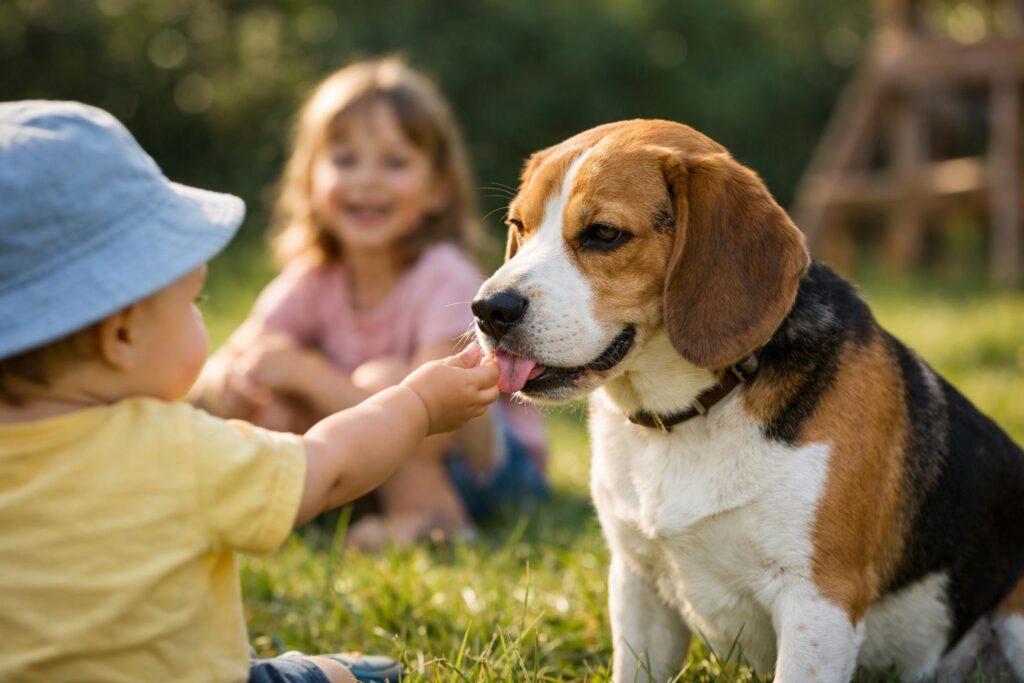
Yes, beagles are actually good with children. They’re pack dogs by nature, so they treat kids like family from day one. They match a child’s energy, they’re sturdy enough for rough play, and they’re not naturally aggressive. That said, toddlers need close supervision, early training matters a lot, and beagles left alone all day develop problems. If your kids are school-age and your family stays active, a beagle is a solid fit.
I’ll be honest. When my son first started rough-housing with Tyler, I held my breath a little. Kids don’t always handle dogs the way you’d want them to. My son would grab Tyler’s ears, bump into him, and once he even stepped on Tyler’s leg by accident. Tyler just looked up, maybe gave a little shake, and went right back to wagging his tail.
That told me more about beagles and kids than any article could.
It wasn’t a fluke either. Tyler has been around kids of different ages, and he’s consistently calm, patient, and happy to be around them. But I also know that’s not the whole story. There are real things parents need to understand before bringing a beagle into a home with children, and I want to cover all of it here.
Are Beagles Good with Children?
Yes, beagles are good with children. The AKC describes the beagle as “happy-go-lucky,” bred to hunt in packs, and generally easygoing with people of all ages. Their pack-dog history is the main reason they fit so naturally into family life. They weren’t bred to guard a single person. They were bred to work alongside others, dogs and humans both.
The National Beagle Club of America describes them as excellent family companions with an affectionate yet independent temperament. That combination works well with kids. They’re loving without being clingy, and they’re playful without being aggressive.
Beagles have consistently ranked in the top 10 most popular breeds in the US. That popularity isn’t just about their looks. It’s because they actually work well in family settings.
- Bred as pack dogs — they naturally include kids in their social world
- 13 to 15 inches tall, 20 to 30 lbs — sturdy but not overwhelming
- Low aggression — not prone to snapping or guarding behavior
- High energy — matches a child’s activity level perfectly
- AKC rating: good with young children and other dogs
Why Beagles and Kids Are Such a Natural Match
The size is one of the first things I noticed. At 13 to 15 inches tall and around 20 to 30 pounds, beagles sit in a sweet spot that most family dogs don’t. They’re large enough that a small child can’t accidentally crush them, but small enough that they’re not going to knock a five-year-old flat with one excited leap.
They’re also built solid. Tyler isn’t a delicate dog. He can handle kids grabbing at him, running circles around him, or flopping next to him on the floor.
The energy match is real too. Kids are high-energy. So are beagles. A child who wants to run around the backyard for an hour has found the perfect dog. By evening, both the kid and the beagle are usually out cold, which is a real win.
The biggest thing, though, is how beagles see the people around them. Because they’re pack animals, they naturally include the kids in their social world. Killarney Animal Hospital notes that beagles form strong bonds with all family members regardless of age. Tyler doesn’t treat my son differently from any adult in the house. He plays with him, follows him around, and checks on him. That’s just how beagles are wired.
I’ve accidentally stepped on Tyler’s leg. He didn’t growl. He didn’t snap. He just looked at me and moved. That kind of patience is not common in every breed. With beagles, it tends to come naturally.
Do Beagles Get Along with Toddlers?
Beagles can do well with toddlers, but this age group needs the most supervision of all. Toddlers move unpredictably, they can’t read a dog’s body language, and they don’t understand that pulling ears hurts. Even the most patient beagle has a limit.
Beagle Welfare UK puts it plainly: you should never leave a child and dog together unsupervised, no matter how friendly the dog has been in the past. That’s true even with Tyler, who is as calm as they come. It’s not about the dog being bad. It’s just about reducing risk when a toddler does something unpredictable.
There’s also the noise issue. Beagles bay. They have loud, deep voices that carry through the house. If you have an infant on a nap schedule, a beagle that goes off every time the mailman walks by is going to make life hard. This is worth thinking through before you bring one home.
The good news is that a beagle raised from puppyhood in a home with toddlers usually adjusts well over time. The key is giving the beagle a safe spot to go when things get too loud or too chaotic. A crate or a specific bed that the kids know is off-limits. Every dog needs somewhere to decompress, and toddlers aren’t always aware of that.
What Parents Should Teach Kids Before Bringing a Beagle Home
This part matters just as much as anything the beagle does. Kids need a few ground rules before the dog comes home.
- No pulling on the ears or tail. Beagles have long, floppy ears that kids love to grab. It’s uncomfortable for the dog and it’s an easy way to trigger a stress response. Teach your kids to pet the dog’s back with an open hand instead.
- Let the beagle come to them. Encourage kids to sit calm and low and let the dog approach on its own. A beagle that chooses to walk over is a comfortable beagle. One that gets cornered is not.
- Don’t bother the dog when it’s eating or sleeping. This applies to every breed, not just beagles. Feed the dog in a separate area if needed, and make it clear to kids that the dog’s bed is its own space.
Kids around six and older can actually take part in basic training, which is a great way to build the bond between them and the dog. Having your child be the one to put down the food bowl or give the “sit” command before meals teaches the beagle that the child has a role in the household too.
If you have other pets at home alongside your beagle, the same respect rules apply there. I’ve written about how beagles do with other dogs if that’s something you’re navigating.
Does a Beagle’s Stubbornness Cause Problems Around Kids?
It can if training is skipped early on. Beagles aren’t stubborn for the sake of it. They follow their nose over your voice, which can make them seem like they’re ignoring you. That’s not a behavior problem. It’s just how they’re built.
The key is starting early. According to the AKC, the critical socialization window for puppies is between 8 and 16 weeks. That’s when they need to meet different people, experience different sounds, and learn what normal life looks and feels like. A beagle that grows up around kids during that window is going to be far more relaxed around them as an adult.
Training sessions don’t need to be long. Short 5 to 10 minute sessions a few times a day work better than one long daily session. Beagles are food-motivated almost to a fault, which makes positive reinforcement the easiest tool you have. Treats work. Praise works. Harsh corrections don’t.
One thing I learned with Tyler: everyone in the house needs to use the same commands and the same rules. If one person lets him jump on the couch and another corrects him for it, he gets confused fast. Kids included. If the dog isn’t allowed to jump on your child, that needs to be consistent from day one.
When a Beagle Might Not Be Right for Your Family
This is where I want to be straight with you.
Beagles need about an hour of exercise every day. When Tyler doesn’t get that, he finds ways to entertain himself, and none of them involve things I want chewed or knocked over. If your family doesn’t have time for daily walks and outdoor play, a beagle is going to be a frustrating fit.
They also don’t do well alone for long stretches. Beagles left alone for 8 to 10 hours a day tend to develop separation anxiety, excessive barking, and destructive behavior. That’s not a character flaw. They’re pack animals. Isolation goes against everything they’re wired for.
If you have a newborn at home right now, it might be worth waiting a year or two before adding a beagle to the mix. The baying can really disrupt an infant’s sleep schedule, and managing a new puppy alongside a newborn is a lot to take on at once. Hills Pet notes that beagles top the list for excessive barking in some owner surveys, which is worth knowing upfront.
- You have a newborn at home right now
- No one is home for more than 8 hours a day
- Your family can’t commit to 1 hour of exercise daily
- Very young toddlers won’t have consistent adult supervision
- You live in a thin-walled apartment where baying will be a problem
Also, if your children are very young and won’t have consistent adult supervision during dog interactions, that’s a real concern regardless of how gentle the beagle is. Supervision isn’t about distrust. It’s just good management.
If you’re still deciding between beagle types, I’d also suggest reading about Pocket Beagle vs Standard Beagle before you commit. The size difference affects how they interact with young children.
Wrapping Up
Here’s what I keep coming back to after years with Tyler: beagles are one of the better fits for families with kids. They’re not aggressive, they love company, and they match a child’s energy in a way that a lot of breeds just don’t.
But three things make the difference. First, early socialization during that 8 to 16 week window sets the tone for everything. Second, kids need to learn how to treat the dog, not just the other way around. Third, the beagle needs daily exercise and time with the family, not hours alone.
If those three things are in place, a beagle and a child can grow up side by side and be good for each other.
Tyler proved that to me the day my son stepped on his leg and Tyler just wagged his tail and moved on. That’s a good dog.