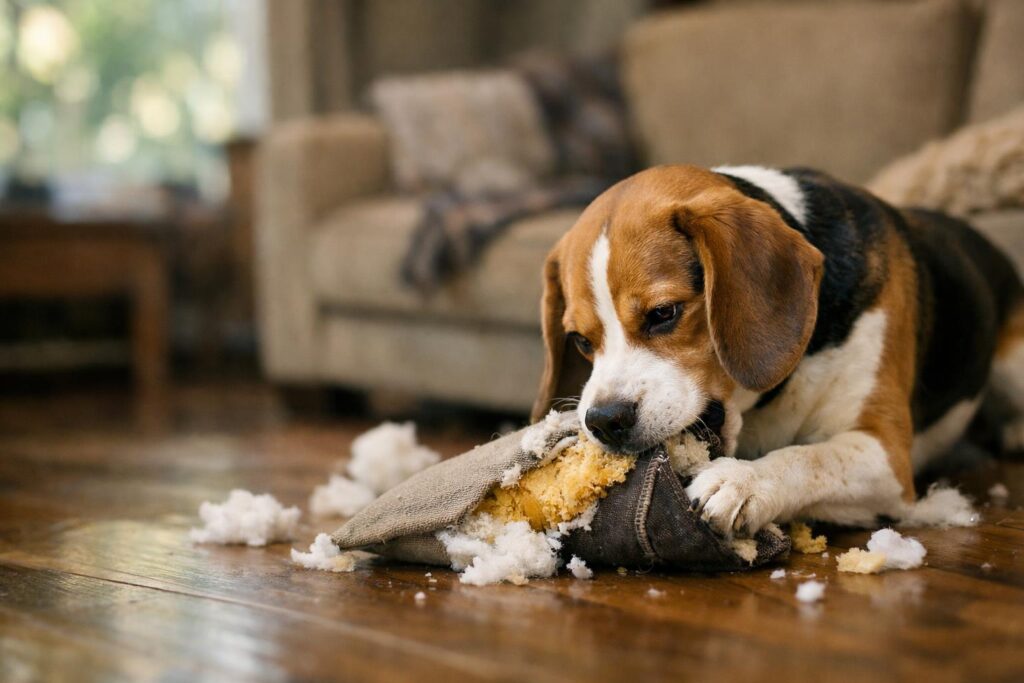
I have a baby at home. And for a while, Tyler had a better time with the baby toys than the actual baby did.
It started with a soft fabric cube. Then a teething ring. Then a crinkle book that apparently smelled too interesting to leave alone. Tyler wasn’t being spiteful. He genuinely could not tell the difference between his toys and theirs. To him, anything soft and on the floor was fair game.
That period taught me more about destructive chewing in beagles than anything else. The problem wasn’t Tyler. The problem was that his needs weren’t being met, and he was filling the gap with whatever was within reach. Once I understood that, everything else got easier.
Chewing is a natural beagle behavior. What turns it destructive is always a trigger. This guide covers the main ones and what actually fixes each of them. If you want the broader picture of behaviour problems that come with the breed, this guide to common beagle behaviour problems is worth bookmarking too.
Why Do Beagles Chew Destructively?
Beagles chew destructively because of teething, boredom, anxiety, or a lack of exercise. The chewing itself is completely normal. What pushes it from a toy to your sofa, your shoes, or your baby’s crinkle book is a need that isn’t being met. Find the trigger first, and you’re already halfway to fixing the problem.
Chewing is one of the most natural things a dog can do. It feels good, releases calming endorphins, and gives them something to focus on. For beagles specifically, this drive can be especially strong.
The trouble is that beagles don’t come pre-loaded with a list of acceptable chew targets. They explore the world with their mouths. Anything within reach is worth investigating.
All About Beagles notes that prolonged or destructive chewing is often a sign that a beagle is trying to self-soothe. Stress, frustration, boredom, and anxiety can all push a beagle toward chewing things they shouldn’t. The chewing isn’t the problem. It’s the symptom.
Puppy Chewing vs. Adult Chewing: They’re Not the Same Problem
These two look similar on the surface. Both result in chewed furniture and a beagle who won’t quite meet your eyes. But they come from completely different places, and that changes how you handle them.
Puppy chewing is almost always about teething. Beagle puppies start teething around three to four months old, when baby teeth begin falling out and adult teeth push through. This process runs until around seven to nine months, though some puppies go right up to twelve months. During this time, the urge to chew is physical. Their gums hurt, and chewing brings relief.
It’s not misbehavior. It’s discomfort. Your job during this phase is to make sure appropriate things are within reach and that off-limits items aren’t. You won’t train a teething puppy out of chewing. You just redirect it.
Adult chewing is a different signal entirely. Adult beagles chew on household items as a way to cope with boredom, frustration, or anxiety. If your adult beagle starts chewing things they weren’t chewing before, something has changed in their routine, their exercise level, or their emotional state.
That shift is worth paying attention to. It’s telling you something.
With Tyler, I noticed that his worst chewing phases always lined up with weeks where I’d been busier than usual. Shorter walks. Less time playing in the yard. The connection was hard to ignore. The baby toy phase was a perfect example. New arrival, disrupted routine, less one-on-one time with him. Of course he was filling the gap with whatever was interesting.
Is Your Beagle Chewing Because of Anxiety?
If your beagle chews mostly when you’re gone and tends to target things that smell like you, like shoes, clothes, or bags near the door, anxiety is likely the cause. Boredom chewing is random. Anxiety chewing has a pattern. Knowing the difference changes how you fix it.
This matters because boredom and anxiety need different solutions. More exercise fixes boredom. Separation anxiety needs a different approach: gradual alone-time training and building your beagle’s confidence on their own.
Common signs that chewing is anxiety-driven include chewing right near exits like doors or windows, targeting items with your scent, and the destruction only happening when you’re gone. If your beagle chews whether you’re home or not, that leans more toward boredom or habit.
With Tyler, I noticed that when he got into the baby toys, it was almost always on days when the house had been busier and noisier than usual, and he’d had less calm time with me. The motivation wasn’t hunger or boredom in the usual sense. It was a bit of stress-driven comfort seeking.
This instinct to fixate on certain objects also shows up in other ways. If you’ve ever noticed your beagle hoarding or hiding specific items, that behavior comes from the same instinct-driven place. Worth reading if yours does both.
What doesn’t work with anxiety chewing is punishing your beagle when you come home. By the time you’ve found the chewed item, the connection between the act and the correction is completely gone. You’re not teaching them anything except that your return sometimes comes with tension.
How to Actually Redirect a Chewing Beagle
Redirecting works when you catch it happening. Get their attention, immediately offer something better, and then reward the switch. Punishing after the fact achieves nothing. Beagles don’t connect a correction made hours later to something they chewed earlier.
This is the part most owners get wrong. I got it wrong too for a while. I’d come home, find a chewed toy or a dismantled baby rattle, and react. Tyler would look guilty. Nothing changed.
Victoria Stilwell at Positively.com breaks it down clearly: get your dog’s attention, redirect them to an appropriate chew toy, and be patient because you may need to repeat this many times. The goal is to show them what to do, not just what not to do.
Here’s how the redirect works in practice:
- Get their attention. A firm “no” works for some dogs. If Tyler had been ignoring that, I’d clap once, loud, to break his focus.
- Offer something better immediately. The replacement needs to be more appealing than what they were chewing, not just any toy. A treat-stuffed KONG or a chew they love works better than a random squeaky toy.
- Reward the switch. When they take the approved item, give calm praise. They’ve just done the right thing. That deserves acknowledgment.
One mistake worth avoiding: don’t offer old shoes or worn socks as redirect toys. It seems logical since they’re already interested in shoes. But it just teaches them that shoes are fair game. There’s no way for them to tell the difference between an old shoe and a new one.
Teaching a “leave it” command is also worth the effort. It gives you a tool to use before the chewing starts if you catch them sniffing around something off-limits.
The Right Chew Toys Make a Big Difference
Not all chew toys are built for a beagle’s chewing style. Soft plush toys don’t hold up under serious chewing and don’t provide enough resistance to redirect a dog who’s in a strong chewing state. You need something durable, interesting, and worth chewing on.
Here’s what I’ve found works well:
KONG Classic: The most reliable option I’ve tried. KONGs are color-coded by chew strength: pink and blue for puppies, red for standard adult chewers, and black for strong chewers. Fill them with kibble mixed with peanut butter, freeze them overnight, and they keep a beagle busy for a long time. The black one has survived Tyler for years.
GoughNuts: Made from thick two-layer rubber, with a red inner layer that shows if your dog has chewed all the way through. If they reach the red, the company offers a free replacement (just pay shipping). Great for beagles who destroy most toys quickly.
Nylabone Power Chew: A solid nylon chew that holds up well and comes in different flavors. Good for strong chewers who need something harder to work through.
Yak milk chews: A natural option with no artificial ingredients. These are a healthier long-lasting alternative and work well as an occasional supervised chew.
One note if you go with any natural chew: always supervise your beagle with anything that could be bitten off in large chunks. Beagles are strong chewers, and pieces big enough to swallow are a real risk.
The American Kennel Club notes that dogs tend to prefer toys that smell like food, make noise, or can be worked apart in some way. Treat-dispensing toys hit all three. That’s why a stuffed KONG tends to outlast a plain rubber ball in your beagle’s interest level.
Exercise and Mental Stimulation: The Underrated Fix
A beagle that gets 60 minutes of exercise a day and some regular brain work is a much calmer chewer. Most destructive chewing happens because energy has nowhere to go. Tire them out physically and mentally and the urge to destroy things drops sharply.
This was the single biggest change I made with Tyler. I’d been doing two short walks a day and calling it done. When I shifted to one longer morning walk and added some nose work or a puzzle feeder in the evening, the random destructive chewing dropped noticeably within about two weeks.
Beagles generally need around 60 minutes of exercise daily. That doesn’t mean 60 minutes of running. It can be a combination of walks, time in the yard, fetch, or scent-based games. Beagles are scent hounds, so activities that engage their nose count as both physical and mental exercise.
For mental stimulation on lower-energy days, Beagle Welfare UK recommends things like scatter feeding dinner in the yard, treat trails, puzzle toys, and 10-minute brain game sessions. Snuffle mats are another low-effort option that keeps Tyler occupied while I’m getting ready in the morning.
If the chewing gets worse when you leave the house, leaving a stuffed KONG before your departure can help. It gives them something to focus on during the transition from you being home to you being gone, which is often the most anxious part of the separation for them.
Dog-Proofing Your Space While You Train
Training takes time. Dog-proofing is what protects your stuff in the meantime.
This step is easy to skip because it feels too obvious. But it works. If Tyler can’t reach the baby toys, he won’t chew the baby toys. That’s not a training win. That’s just good setup. After the first few incidents with Tyler, everything soft went up on a shelf or behind a closed door. Problem solved while we worked on the actual training.
Here’s what’s worth doing while training is still in progress:
- Remove temptation. Shoes, bags, loose cables, kids’ toys. If it’s on the floor and you don’t want it chewed, pick it up. Beagle owners know the rule: anything left on the floor is fair game.
- Use baby gates or a playpen. If your beagle can’t be supervised, give them a defined space where you’ve already controlled what they can access. This limits damage without punishing them for something you didn’t catch in time.
- Try bitter apple spray. A deterrent spray you apply to furniture or items your beagle keeps targeting. It doesn’t work for every dog and some beagles build a tolerance to it. But it can be useful on specific problem areas while you work on training.
- Manage pee pads separately. If your beagle is shredding pee pads, move them to a hard-to-reach corner or switch to a flat interlocking grass-style mat that’s harder to pull up.
Management isn’t a permanent solution. The goal is still to train the behavior. But there’s no point letting your beagle practice the wrong thing all day while training happens at a pace. Limit the opportunity and the habit has less chance to stick.
Putting It All Together
Destructive chewing in beagles comes down to a few things working against each other: strong natural instincts, unmet needs, and a breed that has absolutely no concept of what’s “yours” versus “theirs.” Tyler made that very clear with the baby toys.
The fix isn’t one thing. It’s a combination: figure out the trigger, reduce the opportunity, give them something better to chew, and redirect calmly the moment you catch it happening.
Punishing after the fact, raising your voice, or taking things away without offering anything better are the approaches that don’t work. Not because beagles are stubborn (though Tyler certainly has his moments). But because none of those approaches actually teach the dog what you want them to do instead.
Here’s the short version: catch it in the act, redirect to something approved, reward that switch every time, and make sure the underlying need for exercise, attention, and mental stimulation is actually being met. Do those things consistently and you’ll see a real change.
For more on the behaviour patterns behind this, the full guide to common beagle behaviour problems covers the bigger picture worth reading if chewing isn’t the only thing you’re working on.
Frequently Asked Questions
At what age do beagles stop destructive chewing?
Puppy chewing from teething typically settles between seven and nine months, when adult teeth are fully in. Some beagles go right up to twelve months. Adult destructive chewing is a different issue and won’t resolve on its own. It needs to be addressed through exercise, mental stimulation, and redirected behavior, not just time.
Why does my beagle only chew things when I leave the house?
This is a strong sign of separation anxiety. Beagles are pack-oriented dogs and being left alone triggers real stress for many of them. Chewing items with your scent, like shoes or clothes, is a coping response. The fix involves gradually building their confidence with alone time, making sure they’re well-exercised before you leave, and giving them something engaging to focus on like a stuffed KONG.
Does bitter apple spray actually work on beagles?
It works for some beagles and not others. It can be useful on specific furniture or items your beagle keeps targeting, especially while training is still in progress. Some dogs build up a tolerance to it over time. It’s a useful management tool but it doesn’t replace training or address the underlying reason for the chewing.
Is it okay to crate my beagle to stop them from chewing?
Crating can be a helpful management tool while you work on training, especially for puppies. But if your beagle is showing signs of separation anxiety, crating may make things worse. Dogs with real separation anxiety can injure themselves trying to escape a crate. If anxiety is the issue, gradual alone-time training is a better route than confining them.
My beagle destroys every chew toy. What actually lasts?
For strong chewers, black KONGs are one of the most durable options available. GoughNuts, made in the USA from thick double-layer rubber, hold up well and come with a replacement guarantee if your dog chews through to the inner layer. Nylabone Power Chew is another solid choice. Avoid soft plush or thin rubber toys with seams. They won’t last and small pieces are a swallowing risk.