TL;DR: Recall training is one of the most important things you can teach a beagle, and one of the hardest. Beagles are scent hounds, which means a strong smell can override your voice no matter how much training you’ve done. That doesn’t mean you can’t build a reliable recall. It means you have to build it the right way, in the right order, with the right expectations. This guide walks you through every step from scratch.
Anyone who has owned a beagle knows the feeling. You call your dog. They’re ten feet away. They look at you for half a second, then go right back to sniffing the ground like you don’t exist.
I’ve been working on recall training for beagles with Tyler for a while now. Indoors, it’s solid. Outdoors, it’s a different story. The moment he catches something interesting on the breeze, the rest of the world stops existing for him. That includes me. It’s not that he’s being difficult. His nose just takes over completely.
If that sounds familiar, this guide is for you. Recall training for beagles takes longer than most people expect, and it needs to be built in a specific order. But even an imperfect recall is far better than none, and the work you put in now can genuinely make a difference to how much freedom and safety your dog has for the rest of their life.
Why Recall Is Harder for Beagles Than Most Other Dogs
Beagles are harder to recall than most breeds because their brain is wired to follow a scent trail, not your voice. When a strong smell hits, their hearing and visual focus genuinely switch off. This isn’t selective listening. It’s what they were bred to do.
Beagles were developed as scent hounds to track small game independently for long stretches of time. The whole point was for them to stay focused on a trail without needing guidance from a hunter. That independence made them excellent working dogs. For recall training, it’s the main challenge you’re up against.
Understanding this matters because it changes how you think about training. You’re not correcting a bad habit. You’re working against thousands of years of selective breeding. A beagle that ignores you outdoors isn’t being stubborn or poorly trained. Their instincts are just very, very strong.
This is also why you can’t skip steps with a beagle the way you might with other breeds. Every stage of recall training has to be genuinely solid before you move to the next one. Rushing it leads to a recall that falls apart exactly when you need it most.
Before You Start: What You Need and What to Expect
Before your first training session, get a few things in order.
High-value treats. Small, soft, and something your beagle goes crazy for. Cooked chicken, cheese, or small pieces of hot dog work well. Regular kibble won’t cut it when you’re competing with an interesting smell outdoors. The treat needs to be worth more to your dog than whatever their nose is telling them.
A long line. A flat leash around 20 to 30 feet long. You’ll use this for outdoor practice once indoor recall is solid. Not a retractable leash. A proper flat long line that lies on the ground and gives your dog freedom to move without creating tension.
One recall word, chosen before you start. Pick a word you don’t use in normal conversation. “Come” works. So does “here.” What matters is that you pick one and stick with it. PetMD recommends not using your dog’s name as the recall word, since you say it all the time and the recall cue needs to stay special.
Realistic expectations on timing. Building solid recall in a range of environments can take anywhere from a few weeks to a few months. Every new location resets the difficulty. That’s normal. Progress with recall is not a straight line, and that’s especially true with beagles.
One more thing before you start: if you already use a clicker for training, it’s a great tool for marking the exact moment your dog turns toward you during recall. If you’re not familiar with clicker training yet, take a look at the beginner’s guide to clicker training for beagles before working through this one.
Step 1: Start Indoors With Zero Distractions
Every recall starts in the house. Not the yard, not the park. The house, with no distractions, where your beagle is already comfortable and focused.
The reason is simple. Indoors is the easiest possible environment. You want your dog to succeed repeatedly so the recall word builds a strong positive association before you ever take it outside. Starting in a harder environment sets both of you up to fail.
Begin with the name game. The AKC recommends starting here because before you can recall a dog, they need to understand that their name means “pay attention to me.” Say your dog’s name in a happy voice. The moment they look at you, mark it with a click or “yes” and give a treat. Repeat until they’re snapping their head toward you every time they hear it.
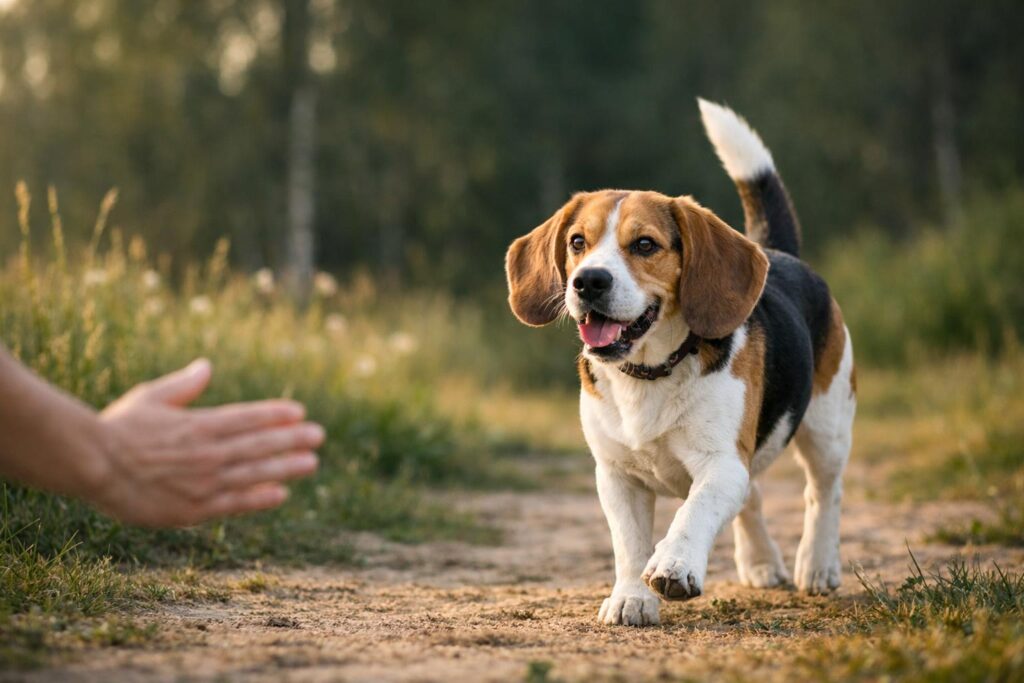
Once that’s solid, introduce the recall cue. Say your dog’s name followed by “come” in an upbeat tone. The moment they start moving toward you, praise them warmly. When they reach you, reward with a high-value treat and make it a celebration. Every single time, no exceptions.
Two rules that apply from day one. First, only say the cue once. If your beagle doesn’t come, don’t repeat it. Make yourself more interesting by clapping, crouching, or running a few steps away from them. Repeating the word over and over teaches them they can ignore the first several times you say it. Second, never call your dog and then do something they don’t like. The SF SPCA is clear on this: every recall needs to result in something good. The moment it doesn’t, the word starts losing its power.
Work in short sessions of five to ten minutes. Practice calling your dog from different rooms. Call them from upstairs. Call them when they’re facing the other way. The more varied the indoor practice, the stronger the foundation.
Step 2: Take It Outside on a Leash, Then a Long Line
Once your beagle comes to you reliably anywhere in the house, it’s time to go outside. But don’t let the dog off the leash yet. Not even close.
Outdoors is a completely different world for a beagle. Smells, sounds, and movement compete with everything you’ve built indoors. The AKC puts it plainly: even if your dog comes 100% of the time indoors, outdoors is a whole new challenge. Start on a regular six-foot leash in a quiet outdoor space with few distractions. Practice the same recall you’ve been doing inside. Expect it to be harder. That’s normal.
Once that’s reliable, move to a long line. Let the line go slack and give your dog freedom to sniff and explore. When you call, reward heavily if they come. If they don’t come, calmly gather the line and walk toward them. Don’t drag them in. Don’t repeat the cue. Just collect the line, go to them, and try again in a less distracting spot.
The long line is the single most important outdoor tool in recall training. It lets your beagle practice being more independent while keeping you in control if things go wrong. Use it consistently for weeks or even months before you consider any off-leash work. The RSPCA recommends that your dog’s recall should be at least 80% reliable on a long line in high-distraction environments before you attempt off-leash training in a public space.
If you want more detail on how the long line fits into the bigger picture of giving your beagle outdoor freedom, the off-leash training guide for beagles covers that in full.
What a Poisoned Recall Cue Is (And How to Avoid It)
A poisoned recall cue is when the word you use to call your dog has lost its meaning or taken on a negative association. Your dog hears it, but doesn’t respond, or responds slowly and reluctantly. It’s one of the most common recall problems, and beagle owners run into it constantly.
It usually happens in one of two ways. The first is overuse: saying “come, come, COME, Tyler, come here” repeatedly until your dog eventually wanders over. The AKC explains that when you repeat a cue without your dog responding, they learn that the word only matters the fourth or fifth time you say it. Eventually it stops meaning anything at all.
The second way is more subtle. If you always call your dog right before something they don’t enjoy, the recall word gets linked to that unpleasant thing. Preventive Vet identifies the most common example: calling your dog to end the walk, clip on the leash, and go home. After enough repetitions, “come” starts to mean “fun is over.” A beagle who picks up on that pattern will start avoiding the word.
The fix for an overused or weakened cue is to change the word and start fresh. Pick something new, like “here” or “this way,” and treat it like a brand new behavior from day one. Karen Pryor Clicker Training emphasizes that from that point forward, every single recall must result in something good. Practice recalls throughout your walks and then release your dog back to exploring. Never only call your dog when the session is ending. Balance the times fun stops with several recalls where nothing changes and your dog gets rewarded and released.
Recall Games That Speed Things Up
Drilling the same recall over and over in the same spot gets old for a beagle quickly. These three games build speed and enthusiasm into the behavior in a way that straightforward repetition alone doesn’t.
Hot Potato. Get two or more family members together with high-value treats. Stand apart and take turns calling the dog. Each person rewards every time the dog comes to them. The AKC recommends this game because it builds the association that every person in the household is worth coming to, not just one. Start indoors and gradually take it to the yard as recall improves.
Hide and Seek. One person holds the dog while another hides in a different room or behind something in the yard. The hidden person calls the dog. When the dog finds them, make it a big celebration with treats and praise. This taps into a beagle’s natural nose-driven curiosity and makes the recall feel like a game with a reward at the end of it.
Catch Me. While your dog is near you on the long line, get their attention and then turn and run a few steps in the other direction. Call your recall word as you run. When they chase you, stop and reward heavily. The AKC notes that running away from your dog turns the recall into a chase, which is naturally fun for most dogs. With a beagle, this works especially well because their prey instinct kicks in and suddenly you’re the most interesting thing in the environment.
All three games can be done in short sessions of five to ten minutes. Rotate between them to keep training fresh and your beagle engaged.
Conclusion
Recall training for beagles is a long game, but it’s one of the most valuable things you can work on. The work you put in early pays off in ways you’ll notice for years: a dog that checks in with you more often, a safer walk outdoors, and a clearer line of communication between you and your dog.
Three things to take with you. Start indoors and don’t rush the move outdoors. Never say the recall word more than once and never call your dog to something they won’t enjoy. And treat recall as a lifelong skill you maintain, not a box you tick once.
Tyler still has days outdoors where his nose wins. That’s beagle ownership. But compared to where we started, the difference in how he responds is real. Consistent, patient training does move the needle, even if it moves slowly.
For a complete picture of beagle training beyond recall, including essential commands and how to fix common behavior problems, take a look at the Beagle Training Guide: Essential Commands and Fixes for Common Behavior Problems.
Frequently Asked Questions
How long does recall training take for a beagle?
Building a solid recall that holds up in varied outdoor environments typically takes anywhere from a few weeks to several months, depending on how consistent your practice is and how much distraction you’re working in. Indoor recall usually comes together faster. Outdoor recall in high-distraction areas takes much longer. Expect the process to be gradual and nonlinear. Recall also needs to be maintained over your dog’s lifetime, not just trained once.
My beagle comes when called inside but ignores me outdoors. Why?
Indoor recall and outdoor recall are two different behaviors in your dog’s brain. Outside, your beagle is competing with a huge amount of sensory information including smells, sounds, and movement that are far more stimulating than anything indoors. Your dog isn’t ignoring you on purpose. The environment is just too distracting for where their training currently is. Go back to practicing on a regular leash in a quiet outdoor spot and build up gradually from there before trying in higher-distraction areas.
What word should I use for recall?
Pick a short, clear word you don’t use in everyday conversation. “Come” and “here” are the most common. Avoid using your dog’s name alone as the recall word since you say it constantly and the recall cue needs to stay meaningful. Whatever word you choose, make sure everyone in your household uses the same one consistently. If your dog has already learned to ignore your current recall word, changing to a new word and starting fresh is often the simplest fix.
Can I use a whistle instead of a verbal cue for recall?
Yes, and for beagles it can actually work well. A whistle produces a consistent sound that doesn’t change based on your mood, tone, or energy the way your voice does. It also carries further outdoors, which is useful for a breed that can disappear quickly on a scent trail. Introduce the whistle the same way you would a verbal cue: blow it once and immediately reward your dog. Build the association before expecting them to respond to it in a distracting environment.
What do I do if my beagle ignores the recall completely?
If your dog is not responding at all, the most likely reason is one of three things: the environment is too distracting for their current training level, the recall word has been overused and lost its meaning, or the reward isn’t high enough to compete with what their nose is offering. Don’t keep repeating the cue. Instead, go back to basics indoors, rebuild the association with a new word if needed, and use higher value treats like cooked chicken or cheese. Only ask for a recall when you’re confident your dog will succeed, and build up difficulty from there.