TL;DR: Off-leash training is one of the hardest things you’ll work on with a beagle. A strong scent can override even a well-trained recall in seconds. That doesn’t mean you can’t make progress. It means your expectations have to be realistic and your approach has to be patient and consistent. This guide covers why it’s so hard, how to build real off-leash skills step by step, and what to do when full off-leash isn’t a safe option yet.
I’ll be straight with you. Off-leash training for beagles is one of the hardest things I’ve worked on with Tyler, and honestly, it’s still a work in progress. Even after consistent training, I don’t have full confidence taking him off-leash outdoors. The reason is simple: the moment Tyler picks up an interesting smell, everything else disappears. I stop existing. The world stops existing. There’s just the scent and wherever it leads.
If that sounds familiar, you’re not alone. Off-leash training for beagles is genuinely difficult, and it’s not because your dog is badly behaved or because you’re doing something wrong. It comes down to what beagles were built to do.
That said, there’s a lot you can do. This guide gives you the honest picture first, then walks you through what actually works, step by step.
Why Off-Leash Is Especially Hard for Beagles
Beagles are harder to train off-leash than most other breeds because their entire brain is organized around smell. When a strong scent hits, their focus locks in completely and your voice becomes background noise. This isn’t stubbornness. It’s biology.
Beagles were bred as scent hounds, developed over generations to track small game independently for hours at a time. That independence was the whole point. Hunters needed a dog that would stay on a trail without constant direction. The result is a dog that is hardwired to follow its nose, not your commands, once a smell takes hold.
The numbers make this even clearer. Research from the Lake Erie College of Osteopathic Medicine notes that beagles have around 225 million olfactory receptors compared to just 5 million in humans. According to Wikipedia’s overview of dog olfaction, dogs have roughly 40 times more smell-sensitive receptors than we do, and scent hound breeds were specifically developed for the highest olfactory sensitivity.
What this means in practice: when your beagle’s nose locks onto something, their hearing and visual focus actually switch off. They are not choosing to ignore you. Their brain has been taken over by the scent. Understanding this matters because it changes how you approach training. You are not trying to train out a bad habit. You are working against thousands of years of selective breeding.
The First Rule: Build a Solid Recall Before Anything Else
Recall is the foundation of all off-leash work. Without a reliable recall, you have no off-leash training. You just have a dog running free.
The American Kennel Club defines reliable recall as being 99.9% confident your dog will come when called. For a beagle, that number is worth pausing on. Even if you get to 95% reliability, that 5% gap can mean your dog bolts across a road or disappears into the woods following a scent trail.
Most owners run into trouble because they skip steps. Recall works beautifully in the kitchen. They take the dog to a park and call them. The dog ignores them. They’re frustrated and confused. What happened is simple: recall was never trained to work in a high-distraction environment. Every new environment is a new challenge for a dog.
The progression has to go in order. Indoors with no distractions first. Then the yard. Then a quiet outdoor space on a regular leash. Then a long line in a more open area. Only then, a fenced space off-leash. Each stage needs to be solid before you move to the next one. There are no shortcuts with beagles.
How to Build Recall Step by Step
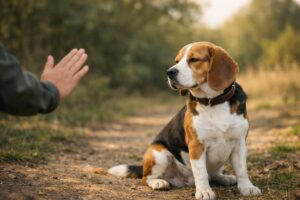
Start inside your house with no distractions. Say your recall word once, in a happy and upbeat voice. Use a word you don’t say in everyday conversation. “Come” works. So does “here.” Pick one and stick to it. The moment your beagle moves toward you, reward them heavily with a high-value treat and lots of praise.
The AKC recommends using the name game first: say your dog’s name, and the moment they look at you, mark it and reward. This builds the habit of checking in with you, which is the foundation of any recall.
Two rules that apply from day one and never change.
First, never call your dog and then do something they don’t like. Karen Pryor Clicker Training calls this poisoning the recall cue. If every time you call your beagle you then leash them up and leave the park, they will start to learn that “come” means fun is over. They’ll avoid it. Practice recalls throughout a walk, reward, and then let them go again. Coming to you should feel like a good deal every single time.
Second, never punish a recall. The SF SPCA puts it clearly: if your dog doesn’t come when called, they aren’t trying to annoy you. They simply haven’t been trained enough for that level of distraction yet. Scolding makes the next recall less likely. Always praise the dog for coming, even if it took longer than you wanted.
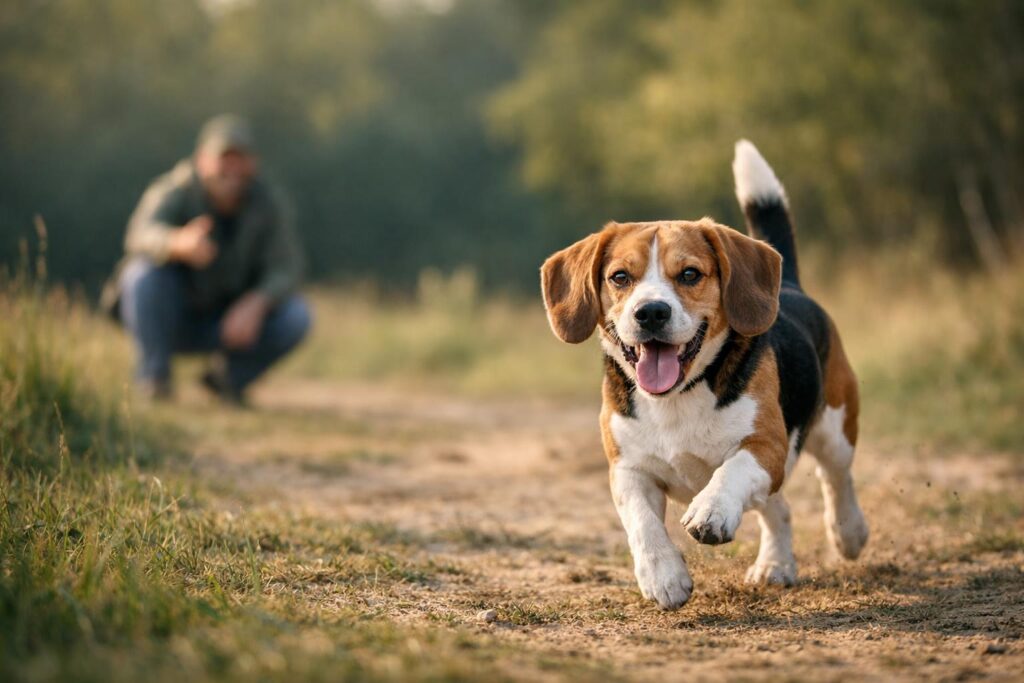
Once indoor recall is solid, take it to the yard. Then try a quiet outdoor space on a regular leash. Then move to a long line. Two good games that help speed this up are Hot Potato and Hide and Seek. For Hot Potato, two or more family members stand apart and take turns calling the dog. Each person rewards every single recall. For Hide and Seek, one person holds the dog while another hides, then calls them. When the dog finds you, make it a celebration. Both games build speed and enthusiasm into the recall in a way that regular repetition alone doesn’t.
Use a Long Line Before You Try Anything Off-Leash
A long line is a lightweight leash, usually 20 to 30 feet long, that gives your beagle more freedom to explore while keeping you in control. It is not a retractable leash. It lies flat on the ground and doesn’t create constant tension. Think of it as a safety net while your beagle practices being more independent.
The long line is the single most important training tool for building off-leash skills in a beagle. It bridges the gap between on-leash and fully off-leash. Your dog gets to move, sniff, and explore in a way that feels more natural. You get to practice recalls in a bigger space without the risk of your dog disappearing.
The AKC suggests starting with a 6-foot leash outdoors and gradually moving to a 20 to 30 foot line as your dog becomes more reliable. The line isn’t there to reel your dog in if they ignore you. It’s there to control the situation so your dog can’t practice the wrong behavior. If your beagle gets distracted and doesn’t come, you calmly gather the line and walk toward them rather than repeating the cue.
The RSPCA recommends that your dog’s recall should be at least 80% reliable on a long line in high-distraction situations before you consider off-leash training in a public space. That’s a high bar, and it takes time. For most beagles, spending several months on the long line before moving to off-leash work is the right call.
Use the long line on every outdoor training walk until you have genuine confidence in the recall. There’s no timeline for this. You move forward when the behavior earns it, not when a calendar says so.
The Habits That Quietly Kill Your Recall Training
Most people make the same few mistakes with off-leash and recall training. Knowing them ahead of time saves a lot of frustration and lost ground.
Repeating the recall cue more than once. If you say “come, come, come, Tyler, come here, come,” your beagle learns that the first few times you say it don’t really mean anything. The SF SPCA recommends saying the cue once, then making yourself interesting with a cheerful voice, clapping, or running the other direction to encourage them. Repetition teaches selective hearing.
Only recalling when it’s time to leave. If “come” always means the walk ends, your beagle will start avoiding it. Recall multiple times during every outing, reward, and release them again. Keep them guessing about what “come” leads to.
Moving to off-leash too fast. Indoor recall is not the same as outdoor recall. Outdoor recall in a quiet park is not the same as outdoor recall near a smell your beagle has never encountered. Every new environment resets the difficulty. The AKC notes that if you have to repeat the recall cue, the environment is probably too distracting for where your dog is in training right now.
Using the recall word when you know your dog won’t come. Preventive Vet describes this as creating a poisoned cue. Every time you say “come” and nothing happens, the word loses meaning. Only use the cue when you are confident your dog will respond at their current training level. If you’re not sure, don’t call. Go get them instead.
Scolding a slow recall. Your beagle took two minutes to come back, and you’re frustrated. Showing that frustration the moment they arrive teaches them that coming to you leads to a bad experience. Karen Pryor Clicker Training is clear on this: always reinforce the recall, no matter how long it took.
When Full Off-Leash Isn’t the Right Goal
Here’s the honest truth that a lot of training guides skip: some beagles, even well-trained ones, are never going to be safe fully off-leash in an unfenced area. That’s not a failure of training or of ownership. It’s the breed.
I don’t fully trust Tyler off-leash outdoors, and I’ve accepted that. The risk isn’t worth it. The moment a strong smell crosses his path, recall becomes unreliable no matter how much work we’ve put in. That’s just the reality of living with a scent hound.
AKC Reunite makes this point directly: when a dog is off leash, you have no control. Some dogs are so focused on their nose that keeping them in an unfenced area off-leash is genuinely dangerous regardless of training.
That doesn’t mean your beagle can’t have freedom and mental stimulation. Fenced parks give full off-leash time in a safe environment. Long-line walks give your beagle the feeling of freedom and plenty of nose time without the risk. Structured sniff walks, where you let your beagle lead and follow their nose at their own pace, give them real mental exercise. The RSPCA also notes that you should never walk your dog off-leash near a road or other dangerous area no matter how strong their recall is, because you can’t control the environment.
A beagle who sniffs, explores, plays in a fenced yard, and walks on a long line is a happy and well-exercised dog. You don’t need full off-leash to give your beagle a great life.
Conclusion
Off-leash training for beagles is a long game. It takes honest expectations, consistent practice, and a willingness to stay at a step longer than you want to.
Three things to take away from this guide. Recall is everything, and it has to be built in stages. The long line is your best training tool for months before you ever consider true off-leash work. And if full off-leash in an open area never becomes safe for your beagle, that is okay. You can still give your dog a rich, active, and stimulating life with other options.
Tyler and I are still working on this. Some days the recall is great. Other days a smell hits and he’s gone in his head. That’s just part of owning this breed, and I’ve made peace with it. The goal isn’t perfection. The goal is progress and keeping your dog safe while you get there.
For more on beagle training, including how to handle common behavior problems and build a full training plan, take a look at the Beagle Training Guide: Essential Commands and Fixes for Common Behavior Problems.
Frequently Asked Questions
Can beagles ever be trusted fully off-leash?
Some beagles can be trusted off-leash in fenced, controlled areas after extensive recall training. Very few can be trusted fully off-leash in open, unfenced areas where new smells are unpredictable. Even well-trained beagles can lock onto a scent and stop responding to commands. Most experienced beagle owners keep their dogs on a long line or leash in open spaces as a rule rather than a limitation. The risk of a beagle running into traffic or disappearing is real, and no level of training completely removes it.
What is a long line and how do I use it?
A long line is a flat leash, usually 20 to 30 feet long, that gives your dog freedom to move and explore while keeping you in control. It is different from a retractable leash. You let the line go slack and allow your dog to sniff and roam. When you practice recalls, you call your dog once and reward heavily when they come. If they don’t come, you calmly gather the line and walk toward them without repeating the cue. Use it consistently outdoors during training until your dog’s recall is reliable at that distance before thinking about off-leash work.
Why does my beagle come when called at home but not outside?
Indoor recall and outdoor recall are two different skills for a dog. Outside, there are competing smells, sounds, and sights that make you much less interesting than you are indoors. Your beagle hasn’t learned to choose you over those distractions yet. The fix is to practice recall outdoors at a level your dog can succeed at first, starting on a regular leash in a quiet space, then building up distractions slowly over time. Going straight from indoor practice to a busy park skips too many steps.
Should I punish my beagle for not coming back?
No. Punishing a slow or failed recall is one of the fastest ways to make the problem worse. If your beagle comes back and you scold them, even calmly, you are teaching them that coming to you leads to something bad. The next recall will be slower or less likely to happen at all. Always praise your dog when they come to you, even if it took longer than you hoped. If the recall failed entirely, the environment was too distracting for your dog’s current training level. Go back a step and build up from there.
At what point is my beagle ready for off-leash in a fenced park?
Your beagle is ready for a fenced off-leash area when their recall is reliable on a long line in high-distraction outdoor environments. A practical measure is that your dog comes on the first call at least 80% of the time when on a long line with distractions present. Starting in a fenced park at low-traffic times before moving to busier sessions is a good way to introduce the experience gradually. Even in a fenced park, bring high-value treats and practice recalls throughout the visit rather than waiting until it’s time to leave.