I found Tyler’s calcium bone tucked behind the sofa cushion one afternoon. I thought I’d misplaced it. A few days later, I found another one wedged under his bed, and a third one shoved into the corner of his crate under his blanket.
He wasn’t eating them. He was collecting them.
I genuinely stood there confused for a moment. This dog gets fed twice a day, has a pile of toys, and still felt the need to build himself a secret calcium bone stash. I had no idea what was going on.
If your beagle does something similar, hiding food, toys, or treats in spots you’d never think to look, you’re not alone. There’s actually a really solid reason behind it. And once you understand why they do it, the whole thing makes a lot more sense.
What Is Caching and Why Do Dogs Do It?
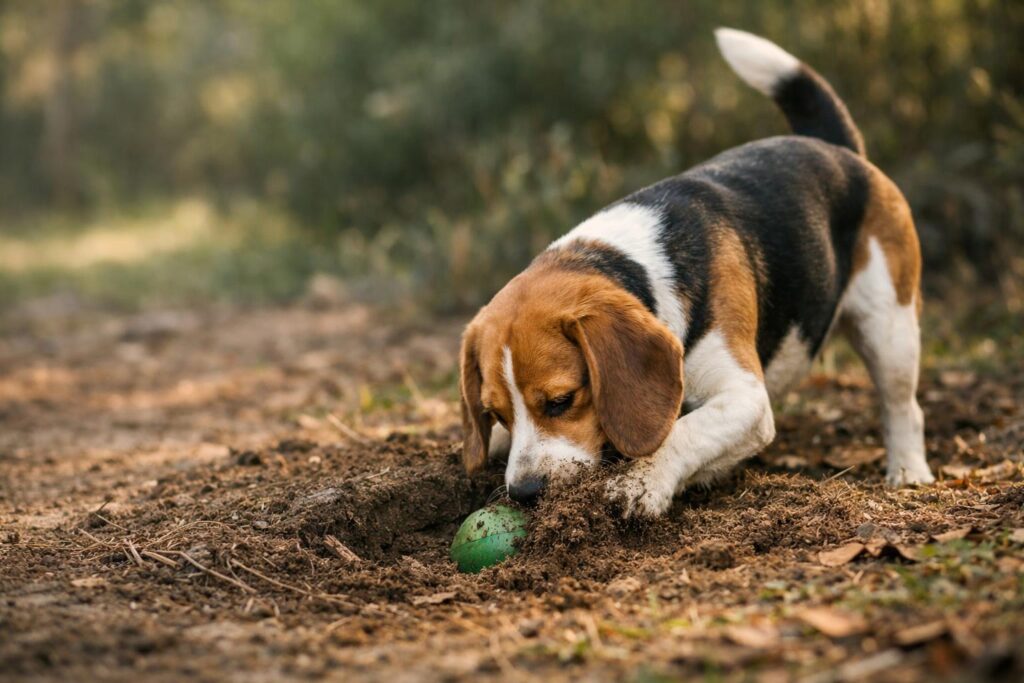
Caching is the instinct dogs inherited from their wolf ancestors, who buried extra food in cool dirt to save it for days when prey was scarce. Think of it as nature’s refrigerator. The dirt kept food fresh longer and out of reach of other scavengers, which helped wolves survive unpredictable feast-or-famine cycles.
Your beagle isn’t going hungry. But that ancient wiring is still very much switched on. As researchers and animal behaviorists explain, this behaviour in modern dogs is an instinctual leftover from their evolutionary past. They’re not consciously worried about their next meal. The drive to stash simply runs deep.
Dogs actually practise what’s called scatter hoarding, hiding items in multiple different spots rather than one central location. That way, if one stash gets raided, they haven’t lost everything. Tyler’s three separate bone hiding spots? Classic scatter hoarder behaviour.
Why Are Beagles Especially Likely to Hide Things?
Beagles hide food and toys more often than many other breeds because they were bred as scent hounds with a powerful prey drive. Their instinct is to track, pursue, and possess. Hiding a high-value item is just an extension of that same “secure the prize” thinking.
Beagles have around 225 million scent receptors in their nose, compared to just 5 million in humans. That nose is a massive part of why they’re so good at finding things. It’s also why they’re brilliant at remembering where they hid something. Dogs rely on a mix of scent memory and spatial memory to locate their cached items, which means Tyler always knew exactly where those calcium bones were, even when I had no clue.
As JustFoodForDogs notes, breeds like beagles that were bred to hunt small prey tend to display caching behaviour more often. It’s part of their natural drive. Terriers, dachshunds, and basset hounds are all in the same boat, but beagles are particularly notorious for it because of just how nose-driven they are.
Think about it from Tyler’s perspective. He smells a calcium bone. His brain lights up. He grabs it, treats it like prey, and his instinct says “secure this, protect it.” So he does.
It’s Not Just Food: Why Toys Go Missing Too
Beagles hide toys for the exact same reason they hide food. Toys count as high-value resources in a beagle’s mind, and anything that feels valuable gets the same treatment.
Purina’s pet behaviour team notes that dogs who want to keep toys away from other pets or even from their owners will bury or hide them. It can also just be a form of play, like setting up a private scavenger hunt. Some dogs hide things that smell like their owner too, socks, slippers, old t-shirts, because those items carry a scent they find comforting.
Tyler has disappeared with a few socks in his time. I used to think it was mischief. Now I’m pretty sure he just liked having them around.
If your beagle hides toys and then forgets where they went, that’s normal too. Not every cached item gets retrieved. Sometimes the act of hiding it is the whole point.
When Anxiety or Stress Can Drive the Hiding
Not every case of hiding food or toys comes from pure instinct. Sometimes it’s a sign your beagle is feeling stressed or unsettled.
Changes in routine can trigger it. A new pet in the house, a move, a shift in your work schedule, even something as small as rearranging furniture can make a dog feel less secure. When that happens, hiding objects becomes a self-soothing activity. It gives them a sense of control when things feel unpredictable.
Dogs with a difficult past, especially rescues who experienced food scarcity or had to compete with other animals for resources, can be more prone to stress-driven hiding. Even in a safe, loving home, that old anxiety can linger and show up as hoarding behaviour.
If you have multiple dogs and one of them has recently started hiding food more aggressively, check the household dynamics. The ASPCA points out that competition between pets, even subtle competition, can ramp up resource-guarding instincts quickly. Feeding your dogs separately in their own spaces can make a big difference.
Boredom and Attention-Seeking: Two More Reasons Your Beagle Hides Things
If your beagle isn’t getting enough mental stimulation, hiding food becomes its own entertainment. A bored beagle will create games. Stashing a calcium bone, then sniffing it out later, is genuinely fun for a dog with a working nose and not enough to do.
JustFoodForDogs puts it plainly: if a beagle doesn’t have enough outlets for mental engagement, it may channel that energy into hiding kibble or bones around the house. Beagles need their brains switched on, not just their legs.
Attention-seeking can also factor in. If hiding things has ever caused you to chase your beagle around the house, shout, or laugh, your dog noticed. Even negative attention is attention. If that behaviour reliably gets a reaction from you, they’ll keep doing it.
I’ll be honest. The first time Tyler disappeared with a calcium bone and I started searching under cushions for it, he watched me with genuine interest. Lesson learned.
When Should You Actually Be Concerned?
Most of the time, a beagle hiding food or toys is completely harmless. But there are a few situations worth paying attention to.
Overfeeding. If you’re regularly giving your beagle more food or treats than they can finish in one sitting, the excess will get cached. That’s not a behaviour problem, that’s just a full dog doing what full dogs do. MasterClass’s dog behaviour guide recommends consistent meal portions on a regular schedule to reduce this.
Spoiled food. If your beagle is hiding perishable food and not retrieving it, that food can go off and become a health risk. Keep an eye out for hidden treats, especially soft chews or wet food.
Nausea. In some cases, dogs who feel nauseous will try to “bury” their food or cover their bowl with a blanket, because they don’t want to smell or see it. MasterClass’s dog behaviour guide flags this as one of the less common but worth-knowing triggers. If it comes alongside vomiting, lethargy, or other symptoms, a vet visit makes sense.
Aggressive resource guarding. Hiding food is one thing. Growling, stiffening, or snapping when you approach a hidden item is another. The ASPCA describes food guarding as existing on a spectrum, from harmless running away with an item all the way to aggressive defence of it. If your beagle is showing the latter, it’s worth talking to a vet or a force-free trainer.
What You Can Do About It
Here’s the good news. You don’t need to eliminate this behaviour entirely. You just need to manage it sensibly.
Stick to regular mealtimes. A consistent feeding schedule helps your beagle feel secure about when food is coming. When meals are predictable, there’s less urgency to stash them. MasterClass recommends this as the simplest first step for reducing caching.
Give them a designated stash spot. Some beagles won’t stop hiding things no matter what you do. That’s fine. Give them a specific basket, box, or corner where it’s allowed. Channel the instinct rather than fighting it.
Add enrichment. Puzzle feeders, snuffle mats, and scent games give a beagle’s nose a proper workout. Animal behaviour experts recommend regular mental stimulation as one of the best ways to reduce boredom-driven caching. A tired beagle brain is less likely to invent its own entertainment.
Don’t punish it. Punishing a dog for hiding food doesn’t work. It stems from instinct, and the ASPCA advises that punishment can actually increase anxiety, which makes the behaviour worse. Redirect calmly if you need to, but don’t scold.
If you need to take something away, trade for it. Offer a treat of equal or greater value in exchange. Beagles respond well to this and it keeps the interaction positive.
Final Thoughts
Tyler’s calcium bone collection didn’t mean he was anxious, neglected, or confused. It meant he was being exactly the dog he was bred to be. A nose-driven, instinct-led, deeply food-motivated beagle doing what beagles have done for generations.
Once I understood the caching instinct, I stopped being puzzled by it and started working with it instead. I gave him a spot he was allowed to stash things. I made sure his meals were consistent. I added a snuffle mat to his routine. The random bone-behind-the-sofa moments became much rarer.
If your beagle hides food or toys, relax. You’ve got a perfectly normal beagle. Understanding why they do it is half the battle, and now you know. If you want to go deeper on beagle quirks, my guide to common beagle behaviour problems is a good next read.
Frequently Asked Questions
Is it normal for beagles to hide food and toys?
Yes, completely. Beagles are scent hounds with a strong prey drive and an inherited caching instinct passed down from wolf ancestors. Hiding high-value items like calcium bones, toys, or treats is a natural beagle behaviour. It isn’t a sign of neglect or a problem in most cases.
Why does my beagle hide food but not always go back for it?
Sometimes the act of hiding something is the point, not retrieving it. Beagles, like their wild ancestors, practise scatter hoarding, stashing items in multiple locations. Not every hidden item gets revisited. As long as you’re not leaving perishable food to spoil, this is normal.
Should I take hidden items away from my beagle?
Only if the item is dangerous or forbidden. For normal toys or bones, VCA Animal Hospitals trainers recommend trading the item for a treat of equal value rather than simply taking it. Snatching things away can increase anxiety and reinforce guarding behaviour over time.
Can hiding food be a sign my beagle is sick?
It can occasionally be a sign of nausea. Dogs who feel unwell sometimes cover their bowl or try to “bury” food to get it out of sight and smell. If this behaviour comes with vomiting, lethargy, changes in appetite, or other symptoms, contact your vet.
How do I stop my beagle from hiding food and toys?
You can reduce the behaviour but rarely eliminate it entirely since it’s instinctual. The most effective steps are: feeding consistent portion sizes on a regular schedule, providing mental enrichment like puzzle feeders and snuffle mats, giving your beagle a designated “stash spot,” and avoiding punishment. If anxiety appears to be driving the behaviour, speak to your vet.