You call your beagle’s name. They hear you. You can see their ears twitch. And then they carry on doing exactly what they were doing.
If you’ve owned a beagle for more than a week, you know that moment. It’s not stubbornness in the way people think. It’s not your beagle being difficult. It’s centuries of selective breeding doing exactly what it was designed to do.
Training and behaviour in beagles is a topic that trips up a lot of owners, not because beagles are unintelligent (they’re not), but because most training advice was written for breeds that want to please their owners. Beagles were bred to please their noses. That’s a very different starting point.
This guide breaks down what you actually need to know. Why beagles behave the way they do, when to start training, what commands to focus on, which behaviour problems are coming your way, and why separation anxiety hits this breed so hard. Each section links to a deeper guide when the topic warrants it.
Start here. Then go wherever you need to.
Why Are Beagles So Hard to Train?
Beagles are challenging to train because they were never designed to look to a human for direction. They were bred to track scent independently, work ahead of hunters, and follow a trail to its end without being called back. That independence isn’t a personality flaw. It was the whole point. But it does make standard obedience training genuinely harder with this breed than most others.
The science backs this up. A landmark study cited on Wikipedia placed a mouse in a one-acre field and timed how long different breeds took to find it. Beagles located it in under a minute. Fox Terriers took 15 minutes. Scottish Terriers failed entirely. That nose is extraordinary, and it’s also the main reason your beagle stops listening the moment something interesting drifts past on the breeze.
According to The Smart Canine, beagles carry around 220 million scent receptors in their noses compared to roughly 5 million in humans. When a beagle catches a trail, their brain prioritises that olfactory input over everything else, including your voice. They’re not ignoring you. They’re genuinely processing something at a level you can’t compete with unless you come prepared.
MasterClass notes that beagles also have an independent streak rooted in their hunting history, where they led the chase rather than followed handler cues. This means food rewards consistently outperform verbal praise with this breed. Telling a beagle “good boy” while they’re mid-scent does very little. A piece of chicken usually does more.
Add a short attention span and high energy levels, and you’ve got a dog that needs shorter, more frequent training sessions rather than long formal ones. Ten minutes twice a day beats thirty minutes once a day every time with beagles.
Understanding all of this doesn’t make training easy. But it changes how you approach it, and that shift makes a real difference.
When Should You Start Training a Beagle?
Start the day you bring them home, usually around 8 weeks old. The socialisation window between 8 and 16 weeks is the single most important developmental period in your beagle’s life. What they learn to accept as normal during this stretch will shape their confidence and behaviour for years.
The AKC, citing National Beagle Club Approved Mentor Lori Norman, puts it clearly: a beagle puppy begins as a blank slate and builds behaviour based on owner approval or disapproval. Every experience during those early weeks teaches them what’s safe and what isn’t. New people, sounds, surfaces, dogs, environments — all of it shapes how they respond to the world as an adult.
A lot of owners wait until vaccinations are complete before taking their puppy out, which typically lands at around 16-18 weeks. The problem is that by then, the prime socialisation window has already closed. Dr. Jen’s Dog Blog references the American Veterinary Society of Animal Behavior (AVSAB) position, which states that the behavioural risks of under-socialisation outweigh the disease risks when socialisation is done thoughtfully. That means avoiding dog parks and high-traffic public areas, but still getting your puppy out to meet people, experience environments, and build confidence.
You don’t need to do everything at once. Two or three new positive experiences a day is plenty. The goal is a puppy that finds the world interesting, not one that finds it frightening.
For everything you need to do in those early weeks, read the full guide here: Beagle Puppy Training Guide
The Essential Commands Every Beagle Needs
There are five commands that make living with a beagle significantly easier: sit, stay, come, leave it, and down. None of these are optional. But one of them, recall (the “come” command), is a different level of challenge with this breed and deserves special attention.
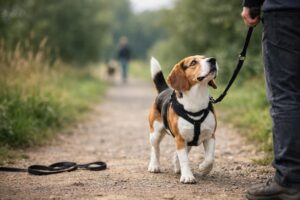
Recall fails in beagles most often because owners train it in low-distraction environments and then expect it to hold up in the field. It doesn’t. Blog.petworks.com recommends using a long-line leash of 15 to 30 feet for what they call “simulated” off-leash freedom. Your beagle gets to sniff and explore. You maintain a safety net. Over time, you practice recall on that long line with gradually increasing distractions before ever considering true off-leash work, and even then, only in fully secured spaces.
The other key to reliable commands is treat quality. Your average dry biscuit won’t outcompete a rabbit trail. Small pieces of real chicken, cheese, or other high-value rewards are what get a beagle’s attention outdoors. Save the premium treats specifically for high-distraction training so they retain their value.
Zigzag’s breed-specific training guide uses a “push, drop, stick” method to progressively raise difficulty once a command is established. Once your beagle performs a behaviour reliably in a calm environment, you push by increasing the challenge (more distraction, greater distance, longer duration). If they succeed, push again. If they struggle, drop back to the easier version and build confidence before trying again. This method works particularly well with beagles because it avoids the frustration that comes from jumping too far ahead too fast.
Keep sessions to five to ten minutes. End on a success. And practice every single day.
For the full breakdown of each command: Teaching Beagles Basic Commands
The Behaviour Problems Beagle Owners Hit Most
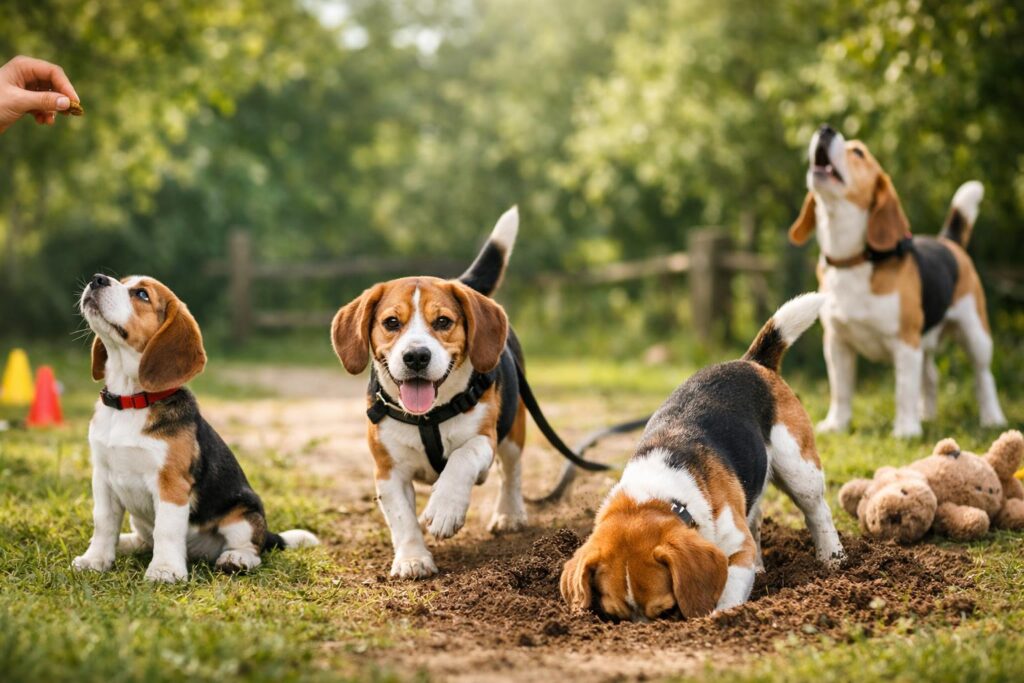
The most common beagle behaviour problems are excessive barking and howling, pulling on the lead, digging, and biting or nipping in young puppies. Each one connects directly back to instinct. Understanding that connection changes how you approach fixing it.
Barking and howling is the one that catches new owners most off guard. Beagles were bred to vocalise on a trail, howling to signal the pack that they’d found something. That instinct doesn’t switch off at home. A dog that bays at every sound, or howls when left alone, isn’t being badly behaved. They’re communicating in the only language their breeding gave them. Consistent training can reduce it significantly, but you’re working against thousands of years of genetic instruction.
Pulling on the lead is similarly instinct-driven. A beagle on a walk has their nose pointed at the ground and their brain processing a constant stream of scent information. The idea of walking calmly at your heel while all of that is happening is genuinely counterintuitive to them. Leash training takes patience and needs to start early.
Digging is another hunting breed trait. Beagles dig because their prey historically went underground. A beagle with unmet mental and physical needs will dig more, not less. Exercise and enrichment are as important as direct training here.
Biting and nipping in puppies is normal bite inhibition development, but it needs to be redirected early so it doesn’t continue into adulthood. Pets4Homes recommends keeping training sessions short and incorporating scent-based games to engage a beagle’s natural instincts rather than working against them. A beagle that gets to use its nose in structured ways is a calmer, more focused training partner.
Understanding Beagle Separation Anxiety
Beagles are pack dogs. They were never bred to be alone, and when you leave, many of them genuinely struggle. Separation anxiety in beagles is not a training problem. It’s a fear response rooted in their genetics, and treating it like bad behaviour is one of the most common mistakes owners make.
The beagle was bred to hunt in packs, always surrounded by other dogs and handlers. Dogster explains that this pack heritage means beagles form strong bonds and become most comfortable in groups. When that companionship disappears, they don’t simply settle down. Many of them experience genuine distress, which shows up as howling, destructive chewing, pacing, and accidents in the house, even in dogs that are otherwise fully house-trained.
The important distinction is between boredom and true anxiety. A bored beagle chews because they have nothing to do. An anxious beagle chews because chewing is one of the few ways they can cope with a fear response they have no control over. The fix for each is different, and applying the wrong approach makes things worse, not better.
Hepper notes that adult beagles over 18 months should generally not be left alone for more than 6 hours. Puppies shouldn’t be left for more than 2 hours. If your routine exceeds those limits, building a support structure, such as a dog walker, a trusted neighbour, or doggy day care, is part of the solution, not a sign of failure.
Beagle Welfare recommends a consistent pre-departure routine that includes exercise about 30 minutes before you leave, a short brain game session, and a long-lasting chew or enrichment item to occupy them as you get ready. The routine itself becomes a signal that being alone is manageable, rather than something to panic about. This takes time to build but it works.
For the full guide on tackling this: Beagle Separation Anxiety
Training a Beagle: What Actually Works
Positive reinforcement is the only reliable method with this breed. It’s not a soft option or a preference. It’s what the evidence and the experience of beagle owners consistently points to. Punishment-based training makes beagles anxious, shuts down their willingness to engage, and damages the trust you need to make any training stick.
What positive reinforcement looks like in practice: you reward the behaviour you want, immediately and consistently, with something your beagle actually values. For most beagles, that’s food. For recall especially, it needs to be high-value food. Verbal praise alone won’t cut it when there’s a squirrel forty metres away.
Hooman’s Friend notes that many beagle owners report it taking close to a year of consistent effort to feel like they have a well-behaved dog. That’s not a failure. That’s the breed. Managing your expectations from the start makes the process less frustrating and keeps you more consistent, which is ultimately what gets results.
A few things that genuinely make a difference with beagles specifically:
Every person in your household must follow the same rules. A beagle will identify the weakest link almost immediately and work with it. Consistency across all family members is non-negotiable.
Short, frequent sessions outperform long ones every time. Five to ten minutes, twice a day, is more effective than a single 30-minute session. Beagles lose focus and start sniffing around, and once that happens, the training session is effectively over.
Scent-based games are a genuine training tool, not just enrichment. Hiding treats for your beagle to find, teaching them to locate a specific toy by scent, or running simple tracking exercises, all of these fulfil the instinct rather than fighting it. A beagle that gets structured sniffing time is calmer, more focused, and more responsive when you do ask them to follow a command.
Finally, keep your sense of humour about it. Beagles are not going to become robots. There will always be a squirrel that wins. The goal is a dog you can live with comfortably, not a dog that passes a military obedience test.
Conclusion
Training and behaviour in beagles gets easier the moment you stop expecting them to respond like other breeds. They’re not labradors. They’re not border collies. They’re scent-driven, pack-bonded, independently-minded dogs that were built for a very specific job, and that job wasn’t listening to their owner.
The three things that matter most: start early (the 8 to 16 week window is real and you can’t get it back), understand the instinct behind the behaviour before trying to change it, and be more consistent than your beagle is clever. They are very clever.
If you’ve read this far and you know exactly which problem you’re dealing with, head straight to the relevant guide below:
- New puppy? Start here: Beagle Puppy Training Guide
- Working on commands? Read this: Teaching Beagles Basic Command
- Dealing with being left alone? This one’s for you: Beagle Separation Anxiety
- Beagle acting up? This covers it: Common Beagle Behaviour Problems
Frequently Asked Questions
Are beagles easy to train for first-time owners?
Beagles are not the easiest breed for first-time owners, but they’re absolutely manageable. The challenge is that they don’t respond well to the methods that work on more biddable breeds. They need shorter sessions, higher-value rewards, and an owner who understands their scent-driven nature. First-time owners who go in with realistic expectations and consistent routines do well with beagles.
How long does it take to train a beagle?
Most owners find it takes six months to a year before their beagle responds reliably to basic commands in everyday situations. Puppies between 8 and 16 weeks absorb foundational lessons quickly, but the teenage phase from around six to eighteen months often means revisiting a lot of what you taught. Consistency over time is what gets results, not intensity in short bursts.
Why does my beagle ignore me when I call them?
Because their nose is almost always winning. Beagles have roughly 220 million scent receptors and were bred to follow trails independently without handler input. When they catch an interesting scent, their brain genuinely prioritises that input over the sound of your voice. The fix is practising recall with high-value treats in progressively more distracting environments, starting from a long-line leash rather than off-lead.
Can you train a beagle to stop howling?
You can reduce howling significantly, but it’s unlikely to disappear completely. Howling is deep instinct for this breed, built in through centuries of hunting work where vocalising on a trail was essential. Identifying and addressing the trigger, such as boredom, separation anxiety, or attention-seeking, is more effective than trying to suppress the howling directly. Consistent redirection and enrichment make the biggest difference.
At what age should I start training my beagle?
The day you bring them home, which is typically around 8 weeks old. Basic house rules, crate introduction, and socialisation should begin immediately. Formal command training can start from 8 weeks too, with very short sessions of two to five minutes. The socialisation window between 8 and 16 weeks is too important to waste, even if your puppy hasn’t completed their vaccination course yet.