TL;DR: Leash training a beagle is hard because most advice was written for breeds that want to follow you. Beagles were bred to work independently and follow scent, not people. The fix isn’t stricter correction. It’s making yourself the most rewarding thing on the walk. Below: the right gear, the stop-and-wait method, how to use sniff breaks as rewards, and an honest timeline of what to expect.
The first time I took Tyler out on a leash, I thought it would be a nice walk. Five minutes in, he had his nose glued to the pavement, yanking left, yanking right, and had completely forgotten I existed.
I tried the usual advice. “Be the pack leader.” “Use a firm voice.” “Show him who’s in charge.” None of it made a dent.
What I eventually figured out is that leash training a beagle isn’t a discipline problem. It’s a competition problem. You’re competing with the most stimulating environment your dog has ever experienced. And most training advice never tells you how to actually win that competition.
Here’s what worked for us.
Why Generic Leash Training Advice Fails Beagles
I spent the first few weeks with Tyler convinced I was doing something wrong. The advice I’d read made sense on paper. Stop when he pulls. Reward good behaviour. Be consistent. I was doing all of it. He still walked like he was trying to escape a fire.
What nobody told me is that most leash training advice was built around dogs that actually want to follow you. Retrievers, spaniels, shepherds — these breeds were developed to watch their owner and take direction. A beagle was bred to do the opposite. They were designed to work far ahead of any human, make their own decisions, and follow a scent trail wherever it led. Listening to you wasn’t part of the job.
That’s not a character flaw. That’s centuries of selective breeding doing exactly what it was supposed to do. Beagles carry around 225 million scent receptors compared to a human’s 5 million, and as Wag! explains, that urge to follow a scent can override all existing training regardless of how well-behaved your beagle is at home.
Once I understood that, I stopped trying to out-discipline Tyler and started figuring out how to make myself worth paying attention to. That’s a completely different problem, and it has a completely different solution.
What Age Should You Start Leash Training a Beagle?
As early as you can. Ideally the first week they’re home. Not because puppies learn faster necessarily, but because you’re shaping habits before pulling becomes the thing they’ve always done on a walk.
If you’ve got an older beagle who already drags you down the street, don’t worry. It’s not too late. It just takes a bit longer because you’re unpicking something established rather than building from scratch.
With Tyler, I started by simply putting his collar on during play sessions indoors. No leash. No pressure. Just getting him comfortable with the feeling before we added anything else. Dogster recommends this same approach: let them sniff the collar, put it on gently, then go back to playing. The goal is that the collar feels like nothing before the leash enters the picture.
Once the collar was normal, I clipped on the leash during mealtimes. He got used to the weight and jingle of it while focused on something he loved. By the time I asked him to walk with me, the gear wasn’t the issue anymore.
If you have a puppy, Wag! advises keeping sessions under 15 minutes. Puppies have short attention spans and you want to finish on a positive note every time. Stop before they get frustrated.
The Right Gear Makes the Whole Process Easier
I wasted the first month using the wrong setup. A regular collar and whatever leash came in the starter kit from the pet shop. Here’s what actually makes a difference.
Skip the collar-only setup if your beagle pulls. Regular collars put pressure directly on the throat and neck when a dog pulls forward. Over time, this can cause real discomfort. More importantly for training purposes, it doesn’t actually redirect the pulling. It just creates resistance, which most beagles will lean into harder.
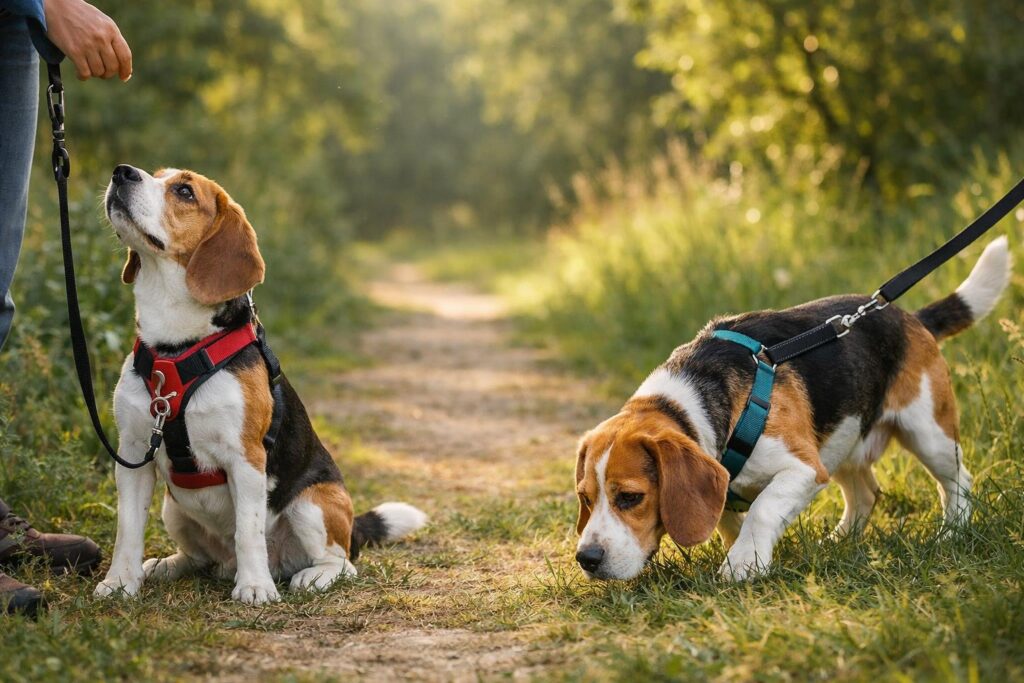
A front-clip harness is the better starting point. As Best Friends Animal Society explains, front-clip harnesses work by redirecting the dog to the side when they pull forward, rather than allowing them to lean into pressure and drag you along. The leash attaches at the chest rather than between the shoulder blades.
When fitting any harness, Ruffwear’s general rule is two fingers between the harness and your dog’s body: snug enough to stay put, loose enough to be comfortable.
Canine Journal notes that beagles have a deceptively broad chest for their size, so always measure before you buy. A harness that fits a dog of the same weight from another breed may not fit your beagle correctly.
One more thing worth mentioning: put the retractable leash away during training. It feels like it gives your dog more freedom, but retractable leashes actually reward pulling because every time your dog pulls, the leash extends. You end up training the exact opposite of what you want. A fixed 5 to 6-foot leash keeps things clear for both of you.
How Do You Train a Beagle to Stop Pulling?
The single most effective method I found with Tyler is called the stop-and-wait method. It works because it makes pulling pointless rather than painful. Tyler worked this out within a few sessions. Once the penny dropped, walks changed completely.
The moment your beagle’s leash goes tight, you stop completely. Become a statue. Don’t pull back, don’t say anything, just stop all forward movement. Petzooie describes this clearly: wait until your dog turns toward you, the leash goes loose, or they return to your side. The moment that happens, say “yes” and walk forward again.
That’s the whole method. Your beagle learns one clear rule: a tight leash stops progress. A loose leash gets you where you want to go.
Summer Brook Goldens, who have trained close to 100 dogs this way, make an important point about consistency: don’t allow your dog to pull forward even an inch. If you give any ground while the leash is tight, you’ve rewarded the pull. If maintaining your balance is hard, take two or three steps backward to reset.
The second part of the method is rewarding actively. When Tyler walked nicely beside me with a loose leash, I’d treat him right at my side. iHeartDogs recommends building this into a game: try to drift away from your beagle in the house and see if they follow you. Reward the check-in. You’re making yourself interesting, not just correcting the bad behaviour.
One critical thing: every person in the house has to follow the same rules. If one family member lets the pulling slide, your beagle will have a harder time learning. Petzooie flags this directly: mixed messages across handlers is one of the most common reasons training stalls.
Should You Let a Beagle Sniff on Walks?
Yes, and you should be using it deliberately.
A lot of owners try to keep their beagle moving and treat sniffing as a distraction to correct. I did the same thing early on. It backfired. Tyler got more frustrated, more fixated on every smell, and pulled harder. Trying to suppress something that instinctive just creates tension.
The smarter move is to make sniffing a controlled reward. Wag! notes the urge to follow a scent is deeply instinctual and not something you can train away. So stop fighting it and start using it. When Tyler walks with a loose leash and checks in with me, I say “go sniff” and give him 30 to 60 seconds on a patch of ground. Barklopedia specifically names sniffing as a valid walk reward, just as effective as a treat for a lot of beagles.
This completely changes the walk dynamic. Your beagle realises that walking nicely earns sniff time, rather than pulling being the only way to get to the good stuff. Tyler figured this out faster than I expected. Once he connected those two things, he started checking in with me more regularly on his own.
Common Mistakes Beagle Owners Make During Leash Training
Most of these I discovered the hard way with Tyler.
Moving to outdoor environments too soon. I took Tyler outside before he really had the indoor version of loose leash walking nailed. New smells, new sounds, new dogs. It was too much too fast. He regressed immediately. Petzooie recommends a strict progression: indoors first, then the back garden, then quiet streets, then busier areas. Don’t move to the next level until the current one is solid.
Sessions that run too long. Training sessions should be short and positive. End before your dog gets bored or frustrated. A five-minute session that ends with both of you winning is worth more than a twenty-minute session that ends in chaos.
Collar corrections. Yanking the leash when Tyler pulled was my first instinct. It did nothing except make him more anxious on walks. DogBizness notes that beagles respond to positive reinforcement, not aversive corrections. An anxious beagle is actually more reactive to smells, not less. You’re making the problem worse.
Not varying your route once training is going well. Once Tyler had loose leash walking reasonably consistent in one environment, I kept using the same route. That’s a mistake. Acme Canine recommends introducing new terrains: parks, different streets, busier areas. Each new context needs its own reinforcement until the behaviour generalises.
How Long Does It Take to Leash Train a Beagle?
I’ll give you the honest version rather than the cheerful one.
For basic loose leash manners on a familiar, quiet route: two to three weeks of daily practice is realistic. Most people see a real shift in that window if they’re consistent every day.
For walks that hold up near other dogs, busy streets, or anywhere with a lot going on: that’s several months. Petzooie is direct about this: basic manners take weeks, reliable behaviour in distracting environments takes months. That’s not a failure timeline. That’s just the breed.
There will be setbacks. Tyler went backwards when he hit adolescence around six months. Scent drive ramps up during that phase and he started pulling again on routes he’d been walking well. The answer was to go back to basics: shorter sessions, higher-value treats, full consistency. He came good again within a week.
The progress isn’t always linear. But it does happen.
Conclusion
If there’s one thing I’d tell someone just starting out, it’s this: leash training a beagle isn’t about getting control. It’s about building a deal. You become interesting enough to pay attention to, and in return your beagle gets access to the things they love. The stop-and-wait method creates that deal. The front-clip harness makes it physically manageable. The sniff breaks seal it.
Tyler is not a perfect walker. He still has days where something catches his nose and everything I taught him temporarily disappears. But most walks now are genuinely enjoyable, and he checks in with me regularly on his own.
Keep sessions short, start indoors, and don’t rush the environment progression. Tyler took longer than I expected and I still wouldn’t trade the process. Walks with a beagle who actually checks in with you feel completely different from being dragged around on a tight leash.
For more help with beagle-specific training, including recall, basic commands, and common behaviour fixes, take a look at our essential beagle training commands.
Frequently Asked Questions
Why does my beagle pull so hard on the leash?
Beagles were bred as scent hounds, designed to track trails independently for long stretches. When they pick up an interesting smell, their instinct is to follow it regardless of what else is happening around them. According to Wag!, this urge can override even well-established training. Pulling isn’t defiance. It’s the breed doing exactly what it was built to do. The goal of leash training is to teach your beagle that staying connected to you is the fastest route to the things they want.
Should I use a harness or collar for leash training my beagle?
For a beagle that pulls, a front-clip harness is the better option. Regular collars concentrate all pressure on the throat and neck when a dog pulls forward, which can cause discomfort and doesn’t redirect the pulling. Best Friends Animal Society explains that front-clip harnesses redirect the dog sideways when they pull forward, making it physically harder to drag you along. Keep the collar on for ID tags, but clip the leash to a front-attach harness during training walks.
My beagle ignores me completely on walks. What should I do?
This is a competition problem, not a respect problem. You’re competing with one of the most scent-rich environments your dog has ever been in, and you’re losing. The fix is to make yourself more rewarding. iHeartDogs recommends working on a focus cue like saying your dog’s name and rewarding any eye contact during walks. Carry high-value treats, not regular kibble. And use sniff breaks as a controlled reward when your beagle does check in with you. Over time, they’ll learn that paying attention to you is what unlocks access to the good stuff.
Can you leash train an adult beagle?
Yes, absolutely. It takes longer because you’re working against an established habit rather than building a new one, but adult beagles learn well with consistent positive reinforcement. Go back to basics: introduce the harness indoors, work on loose leash walking in the house before going outside, and build up through quiet environments before busier ones. Petzooie notes that setbacks are completely normal even mid-training, so don’t interpret any regression as evidence it won’t work. Stay consistent and progress will come.
How long should leash training sessions be for a beagle?
Keep sessions short, especially with puppies. Wag! recommends no longer than 15 minutes per session, and even 5 to 10 minutes is plenty when you’re starting out. The goal is to end on a win, while your dog is still engaged and happy. Short sessions done every single day will get you much further than long occasional ones. Once good habits are more established, normal walks can double as training sessions, which removes the pressure to schedule formal training separately.