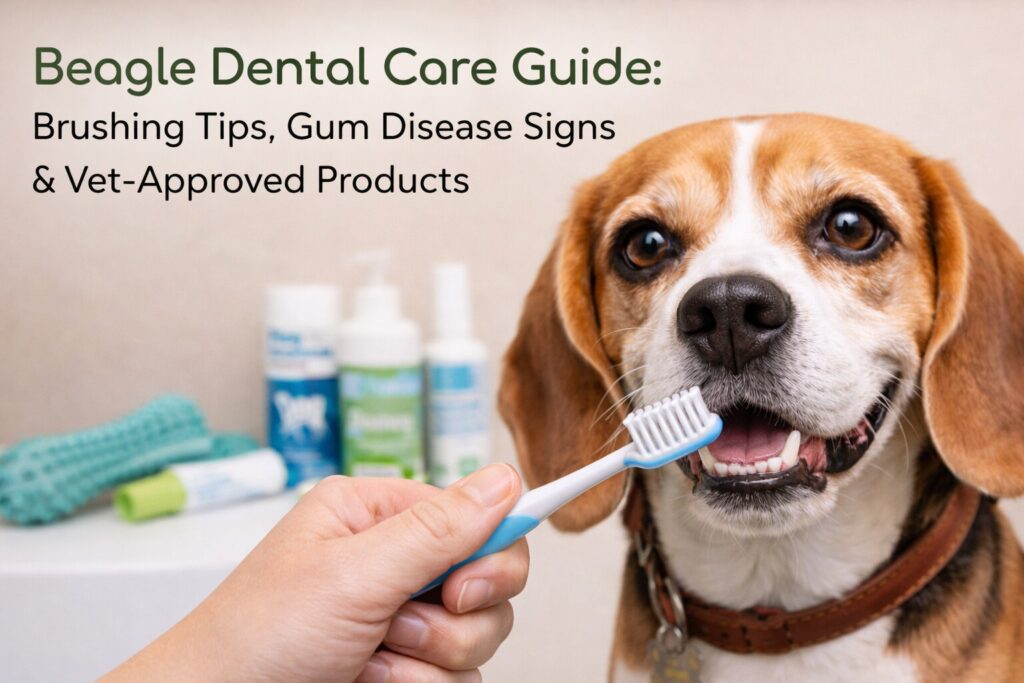
TL;DR: Most beagles have some degree of gum disease by the time they are three years old, and most owners have no idea it is happening. The good news is that a consistent home care routine makes a genuine difference. This guide focuses on exactly that: how to build a daily brushing habit with your beagle, which products are actually worth buying, how to keep sessions short and stress-free, and what to watch for so you catch problems early.
Note from Adrian: I am a beagle owner sharing what I have researched and what has worked for me with Tyler, not a veterinary professional. This guide is for informational purposes only. If you have concerns about your beagle’s dental health, your vet is always the right first call.
Brushing Tyler’s teeth is now part of our evening routine. It takes about two minutes and he barely notices it anymore. Getting to that point took a few weeks of patience, the right toothpaste flavour, and picking a consistent time of day. It was not difficult once I stopped treating it as optional.
I started taking dental hygiene seriously after reading about what actually happens inside a dog’s mouth when plaque is left to build up unchecked. The numbers are not reassuring. Most beagles already have some level of gum disease by age three, and the majority of owners would have no idea because the early stages produce no obvious signs. By the time bad breath or visible tartar appears, the damage has usually been building for months.
Dental hygiene is one of those things that is very easy to build into a routine and very easy to never start. Here is what works for us, and why it matters more than most people realise.
Why Dental Health Matters More Than Most Owners Realise
The statistic that stopped me in my tracks: Cornell University College of Veterinary Medicine reports that 80 to 90% of dogs over the age of three have some component of periodontal disease. Not some dogs. Most dogs. And in the majority of cases, the owners have no idea it is happening, because the disease progresses silently before it produces obvious signs.
Here is what actually happens. Cornell explains the process clearly: plaque, a sticky bacterial film, forms on the surface of teeth every single day. Within 24 hours, minerals in saliva begin hardening that plaque into tartar (also called calculus), which cannot be removed by brushing. The bacteria in plaque and tartar cause gum inflammation (gingivitis), which if untreated progresses to periodontitis: infection of the deeper structures around the tooth, bone loss, and eventually tooth loss.
But the damage does not stop at the mouth. The American Animal Hospital Association (AAHA) is direct about this: periodontal bacteria do not limit themselves to the mouth. Left untreated, the infection enters the bloodstream and damages the heart, kidneys, and liver. This is not rare. It is a documented consequence of advanced, untreated dental disease in dogs.
iHeartDogs specifically notes that beagles are more prone to dental problems than some other breeds. The combination of their jaw structure and genetic predisposition makes consistent dental care more important for this breed, not less.
What Are the Signs of Dental Disease in a Beagle?
Bad breath is usually the first thing owners notice, and it is also the first thing they dismiss. Most people assume dogs just have bad breath. They do not. A healthy dog’s breath is not minty, but it should not be strong enough to make you turn your head away. If it is, that is a signal.
The American Veterinary Medical Association (AVMA) lists the signs to watch for:
- Bad breath that goes beyond normal doggy odour
- Yellow or brown tartar buildup on the teeth, particularly around the gum line
- Red, swollen, or bleeding gums
- Excessive drooling or drooling more than usual
- Difficulty chewing, dropping food, or reluctance to eat hard food
- Pawing at the mouth or face
- Loose or visibly missing teeth in an adult dog
- Behavioural changes, particularly increased irritability
The challenge is that many dogs, including beagles, are very good at hiding oral discomfort. AAHA notes that many pets with dental disease show no obvious signs, which is precisely why regular vet check-ups and proactive home care are essential. By the time the pain is obvious, the disease is usually advanced.
Is Brushing Really That Important?
Yes, and the evidence is consistent across every major veterinary body. The AVMA states that regular brushing is the single most effective thing you can do to keep your dog’s teeth healthy between professional cleanings. Daily is best. Several times a week still makes a meaningful difference. Once a week is better than nothing but will not keep pace with how quickly plaque mineralises into tartar.
The reason brushing works is mechanical. Toothpaste helps, but the bristles physically disrupting the plaque biofilm before it hardens is what prevents the bacterial cycle from taking hold. Cornell describes plaque as an invisible bacterial slime that is laid down both above and below the gum line, and it is the below-gum-line plaque that drives the most serious disease. Regular brushing addresses the above-gum-line accumulation and slows the overall bacterial load considerably.
The good news, if you have a resistant beagle: the outer surfaces of the teeth are the most important to reach. WebMD Pets notes that the dog’s tongue naturally helps keep the inner surfaces cleaner, so if you can only manage the outsides, you are still doing the most important part.
How to Build a Brushing Routine Your Beagle Will Actually Tolerate
The mistake most people make is introducing the toothbrush too fast. Your beagle does not understand what you are doing or why, and something being pushed around inside their mouth with no warning is not going to land well. The approach that works is slower than it feels necessary, but it means you end up with a dog that sits calmly for brushing rather than one you have to chase around the house.
Tyler took a few weeks to settle into it. The turning point was picking chicken-flavoured toothpaste and doing it at the same time every evening, right before his last walk. He started associating the routine with something he was looking forward to, which helped a lot. Here is the progression, adapted from guidance by Beagle Pro and the AKC’s step-by-step brushing guide:
Week 1 and 2: Touch only. Pick a consistent time of day. Sit with your beagle calmly, run a finger along their gums and teeth for 20 to 30 seconds, and give a treat afterward. No brush, no paste. You are just building tolerance for mouth handling. Do this every day.
Week 3: Introduce the toothpaste. Let your beagle lick dog toothpaste directly off your finger. The point is to associate the smell and flavour with something positive. Most dog toothpastes come in chicken, beef, or peanut butter flavours, which helps enormously. Never use human toothpaste. It contains xylitol and other ingredients that are toxic to dogs and cannot be swallowed safely.
Week 4: Finger brush with paste. Wrap a piece of damp gauze around your finger or use a rubber finger brush. Apply a small amount of dog toothpaste and gently rub the outside surfaces of all the teeth. Keep it under a minute. Reward well.
Week 5 onwards: The actual toothbrush. Let your beagle sniff and lick the brush before you use it. Then brush in small, circular motions at a 45-degree angle where the tooth meets the gum line, which is where plaque accumulates most. Start with the front teeth and work back. Aim for two minutes total across all surfaces. Reward every single session.
Consistency matters more than perfection. Beagle Pro emphasises picking the same time every day so it becomes part of the routine your dog expects rather than a surprise. For us it is evening, every day, same spot. Tyler now sits for it without drama, and the whole thing takes about two minutes.
If your beagle is deeply resistant and stays resistant, do not force it. Forcing mouth handling creates lasting anxiety around the whole process and makes future attempts harder. Instead, pivot to the alternatives below and discuss the situation with your vet.
Dental Products Worth Using (and How to Tell If They Actually Work)
The pet dental product market is enormous and largely unregulated when it comes to effectiveness claims. The way to cut through the noise is simple: look for the VOHC Seal.
The Veterinary Oral Health Council (VOHC) is an independent body that reviews submitted data from product manufacturers and awards a Seal of Acceptance only to products that demonstrate genuine efficacy for plaque and tartar control in clinical trials. Products displaying this seal have actually been tested. Products without it have not been held to the same standard.
Useful VOHC-approved product categories include:
Dog toothpastes. These do the most work when combined with brushing. Choose an enzymatic toothpaste where possible, as enzymes help break down plaque between brushing sessions. Always use dog-specific formulations.
Dental chews. The chewing action mechanically scrapes plaque from tooth surfaces. Beagle Pro notes that Greenies hold the VOHC Seal and are the most widely veterinary-recommended dental chew. One chew per day used consistently makes a measurable difference. Size matters: always choose the size appropriate to your beagle’s weight to avoid choking risk, and give chews when you are present to supervise.
Water additives. These are added to your beagle’s drinking water and help reduce bacterial load in the mouth. They are not a replacement for brushing but are a useful supplement, particularly for dogs who will not tolerate brushing at all.
Dental diets. Some prescription kibble formulations have a specific texture designed to scrape the tooth surface as the dog chews. The Merck Veterinary Manual notes that while the common belief that dry kibble prevents plaque does not necessarily hold true for standard food, specifically formulated dental diets are a different matter. Ask your vet whether a dental diet is appropriate for your beagle.
One thing to avoid: bones and very hard chew toys. The Merck Veterinary Manual specifically warns that items hard enough to crack teeth, including bones and hooves, should be avoided. The rule of thumb from veterinary dentists is the “thumbnail test”: if you press your thumbnail into a chew and it does not give, it is too hard for your dog’s teeth.
What Happens at a Professional Dental Clean?
Home care is essential, but it is not sufficient on its own. Professional dental cleanings are a different procedure entirely, and the reason they cannot be replaced by brushing is simple: they clean below the gum line, where the most damaging disease activity occurs, and where no toothbrush can reach.
AAHA explains that professional dental cleanings must be performed under general anaesthesia to be genuinely effective. Without anaesthesia, the veterinary team cannot safely probe the gum pockets, take full-mouth dental X-rays, or clean below the gum line. Anesthesia-free dental cleanings may improve the cosmetic appearance of teeth temporarily, but they do not address the underlying disease.
Cornell describes what a full professional clean involves: the vet takes pre-anaesthetic bloods and conducts an awake oral exam first, then places the dog under anaesthesia with continuous monitoring by a trained veterinary technician. The mouth is rinsed with antiseptic. Tartar is removed above and below the gum line using both ultrasonic and hand scalers. Gum pockets are probed and measured. Full-mouth dental X-rays are taken to assess bone levels and tooth root health. Teeth are polished to remove the microscopic abrasions left by scaling, which would otherwise attract bacteria more quickly. If teeth need to be extracted, this happens during the same procedure.
AAHA recommends most dogs receive a professional dental cleaning every one to two years, though smaller dogs and breeds prone to dental disease may need them more frequently. Your vet will advise based on what they find during the awake oral exam at your annual check-up. The more consistent your home care, the less likely that tartar and disease will accumulate quickly between professional cleans.
When to Book a Dental Check Between Annual Visits
Your vet will examine your beagle’s mouth at every annual appointment, but certain signs should prompt you to book a specific dental check rather than waiting.
Contact your vet sooner if you notice: persistent bad breath that seems to have worsened, visible red or bleeding gums, yellow or brown tartar that has built up significantly, any tooth that appears loose, your beagle dropping food they would normally eat easily, or any pawing at the mouth. These signs suggest disease may have progressed past the early gingivitis stage and needs assessment.
Do not wait until the next annual visit if something looks or smells clearly wrong. Dental disease progresses, and earlier treatment almost always means simpler, less expensive treatment.
Conclusion
Tyler’s dental routine is not complicated. It is two minutes in the evening, a VOHC-approved chew a few times a week, and a check at every annual vet visit. That is genuinely it. His teeth are healthy and his vet has not flagged anything of concern. The routine built itself over a few weeks and now it just happens.
The thing I want any beagle owner to take away is that this is much easier to maintain than it is to start from scratch with an adult dog who already has tartar buildup or gum disease. Starting early, staying consistent, and using products that are actually verified to work gives your beagle the best chance of getting through life without dental problems becoming a bigger issue.
If you want to keep reading about beagle health, the article on common beagle health conditions covers the other things worth knowing about as an owner.
Frequently Asked Questions
How often should I brush my beagle’s teeth?
Daily brushing is the gold standard recommended by every major veterinary body. The AVMA states that daily brushing is best and may reduce the frequency or even eliminate the need for periodic professional cleanings. Brushing several times a week still makes a meaningful difference if daily is not realistic. The key is consistency: an irregular or occasional routine allows plaque to reharden between sessions and the bacteria cycle continues. If you truly cannot manage more than once a week, supplement with VOHC-approved dental chews and water additives to reduce the bacterial load between brushing sessions.
My beagle absolutely refuses to let me brush his teeth. What are my options?
First, check with your vet that the resistance is not being caused by existing oral pain from inflamed gums or a dental problem. If your beagle is healthy but simply resistant, the slow desensitisation approach is the most reliable method: weeks of finger-touching the gums before any brush is introduced, with heavy treat rewards at every step. Wag! advises trying different toothpaste flavours, different brush types, and keeping every session very short until tolerance builds. If brushing genuinely remains impossible after a sustained attempt, the practical fallback is a combination of daily VOHC-approved dental chews, a water additive, and more frequent professional cleanings than the average dog would need.
Are dental chews enough on their own if I can’t brush?
Dental chews are genuinely useful and are better than nothing, but they are not a full substitute for brushing. Chewing mechanically removes plaque from tooth surfaces, but chews cannot reach below the gum line and do not address the areas between teeth as thoroughly as a brush can. The VOHC recommends daily oral hygiene with brushing as the gold standard, with chewing activities as a complementary tool. If chews are your primary dental care method, prioritise VOHC-approved products, use them consistently, and ensure your beagle receives professional cleanings at least annually, possibly more frequently depending on what your vet finds.
Do professional dental cleanings require anaesthesia and is that safe?
Yes, proper dental cleanings require general anaesthesia, and for good reason. AAHA explains that without anaesthesia, it is not possible to safely clean below the gum line, take dental X-rays, probe gum pockets, or keep the dog still enough for precision work. Anaesthesia-free cleanings only address the visible tooth crown and create a false sense that the dog’s dental health is being managed when the damaging below-gum disease goes untouched. As for safety: modern veterinary anaesthesia with pre-anaesthetic blood work, continuous monitoring by a trained technician, and appropriate pain management is very safe for healthy adult dogs. Your vet will discuss any individual risk factors specific to your beagle beforehand.
What age should I start brushing my beagle’s teeth?
As early as possible, ideally from puppyhood. Young dogs learn to tolerate mouth handling more readily than adults who have never experienced it, and starting early means you are preventing disease from getting a foothold rather than catching up with existing tartar. That said, it is never too late to start. Beagle Pro notes that the desensitisation training approach works for adult beagles too, it simply requires more patience because you may be working against an existing aversion to mouth handling. If your adult beagle has visible tartar buildup already, book a professional clean first to reset the baseline, then build the home care routine from there.