TL;DR: Beagle puppies bite. It’s normal, it’s temporary, and it’s fixable. Most biting comes down to teething, play instinct, or overstimulation — not aggression. The key is teaching your puppy early that teeth on skin ends the fun. Stay consistent, redirect to toys, and the phase passes. If biting is still a problem past six months, it’s worth getting a trainer involved.
Almost every new beagle owner goes through the same thing. The puppy arrives, everything is wonderful, and then within a few days, those tiny teeth are everywhere. Your hands, your ankles, your sleeves, your children’s fingers. It hurts more than expected, and it doesn’t seem to stop.
The good news is that biting and nipping in beagle puppies is completely normal. It’s not a sign of a bad dog or bad ownership. It’s just what puppies do, especially at certain ages. Understanding why it happens makes it a lot easier to handle.
This guide covers the reasons behind the biting, what works, what makes it worse, and when to take it more seriously.
For a full overview of what to focus on in your puppy’s first weeks, the beagle puppy training guide covers everything in one place. This article focuses specifically on biting and nipping.
Why Do Beagle Puppies Bite So Much?
Beagle puppies don’t bite to be difficult. There are a few clear reasons it happens, and most of them are just part of normal puppy development.
Teething. Puppy teeth start coming through at around 4 months and the process runs until about 6-7 months. During this time, beagles chew on everything they can find because it relieves the discomfort in their gums. [According to PetMD, puppy biting tends to peak around 12-13 weeks](https://www.petmd.com/dog/training/puppy-biting) when adult teeth start pushing through. This isn’t intentional — the puppy is just trying to feel better.
Play instinct. Before puppies come home, they spend their first weeks biting their brothers and sisters. That’s how they play. The ASPCA explains that puppies learn through this rough-and-tumble play, and biting is a completely natural part of how they interact with the world. When they arrive in a new home, they don’t automatically know that human skin is different. They just do what they’ve always done.
Overstimulation. A tired or overexcited puppy bites more. If biting is worse in the evenings or after long play sessions, this is usually why. [Beagle Welfare notes that mouthing behaviours are often worst between 12-16 weeks, and that overstimulation or lack of sleep is frequently the cause rather than any kind of aggression.
Exploration. Puppies use their mouths the same way humans use their hands. Everything gets investigated with teeth. Shoes, chair legs, fingers, trouser hems. It’s curiosity, not hostility.
What Is Bite Inhibition and Why Does It Matter?
Bite inhibition is a dog’s ability to control how hard they bite. It’s one of the most important things a puppy learns, and the window to teach it properly is relatively short.
The ASPCA describes bite inhibition as the difference between a dog that mouths gently and one that bites down hard enough to break skin — even in situations that aren’t aggressive, like being startled or scared. A dog who learned bite inhibition as a puppy is far safer in those moments than one who didn’t.
Puppies normally start learning this from their mother and littermates. When a puppy bites a sibling too hard, the sibling yelps and stops playing. That immediate consequence teaches the biter that too much pressure ends the fun. According to the AKC, this is how puppies develop a “soft mouth” — through repeated feedback from other dogs during play.
When a puppy comes home at 8 weeks, that education is still very much in progress. The job of teaching bite inhibition passes to the owner.
How to Stop Beagle Biting and Nipping
There is no single trick that works overnight. It’s a combination of consistent responses over several weeks. Here’s what actually helps:
Stop the game immediately when teeth touch skin. The moment a puppy bites during play, the interaction ends. Put your hands away, turn your back, go quiet. No yelling, no fuss. Just the abrupt removal of attention. The AKC recommends turning away and tucking hands into armpits the instant biting occurs — the puppy learns quickly that biting makes the game disappear.
A calm, firm noise can help signal that the bite was too hard. A short, sharp “ow” or “ouch” followed by going still gives the puppy the same feedback a littermate would have given. The ASPCA notes that this mimics the natural yelp response puppies are already familiar with from their time with their siblings. Be aware that for some puppies this can increase excitement rather than pause it — if that’s the case, silent withdrawal works better.
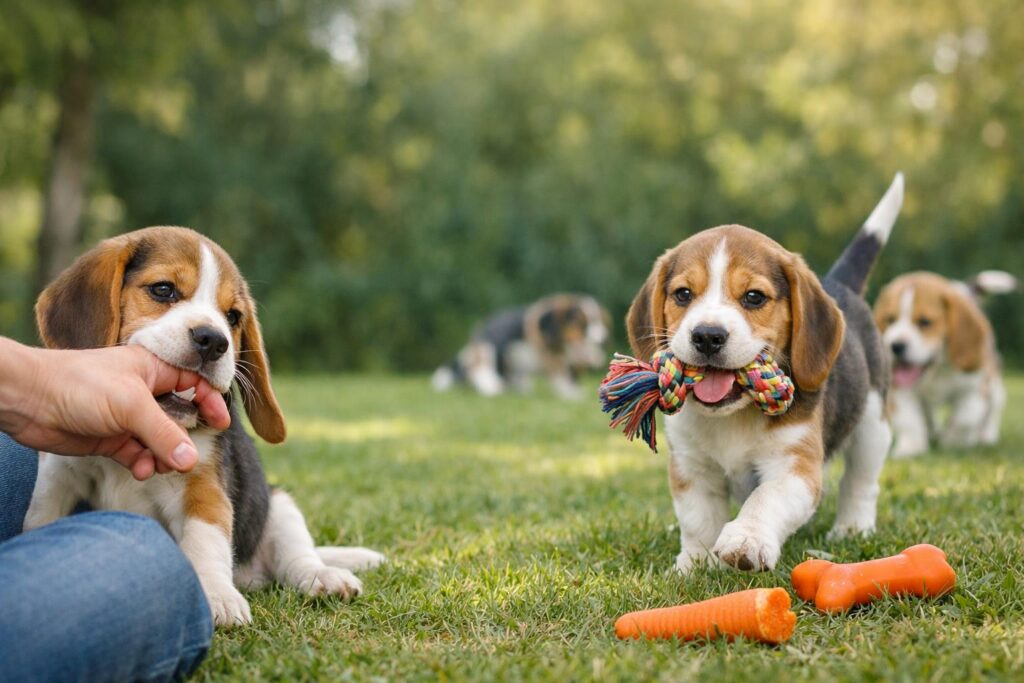
Redirect to a chew toy, not your hand. Keep toys within reach during play so there’s always something appropriate to offer. The goal is to give the puppy something they’re allowed to bite, not just remove the thing they’re biting. [Beagle Welfare suggests rotating through natural chews like hooves, ears, and braided chews to keep things interesting and give puppies a proper outlet.](https://www.beaglewelfare.org.uk/puppy-biting/) Frozen carrots also work well for sore gums.
Use a short time-out when needed. If the puppy won’t settle after a redirection, a brief calm separation helps. A minute or two away from the action in a puppy-proofed space lets them calm down without it feeling like punishment. The AKC recommends using the crate gently for this purpose — never in frustration, just as a reset.
Watch for tiredness. An overtired beagle puppy is a nippy one. Puppies up to 6 months need around 18-20 hours of sleep a day according to Beagle Welfare. If biting is consistently worse at certain times, a nap often fixes it faster than any training technique.
What Makes Beagle Biting Worse
Some common reactions actually make the biting problem harder to resolve. These are worth knowing about.
Rough play and tug games. These wind puppies up and blur the line between acceptable and unacceptable contact. If biting is a problem, avoid any game that involves your hands being close to the puppy’s mouth in an exciting way. Fetch and scent games are far better alternatives at this stage.
Pushing the puppy away or shouting. Physical reactions and loud voices are often read as excitement or engagement, not correction. Beagle Welfare points out that negative attention — including “no,” “ah ah,” or pushing the puppy — is still attention, which can actually reinforce the behaviour. Stillness and withdrawal are more effective than any noise or gesture.
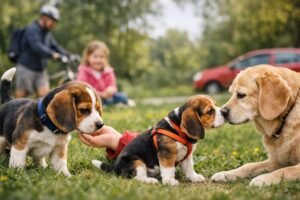
Letting small children interact with the puppy unsupervised. Children move unpredictably, squeal, and pull away when nipped — all of which looks like a game to a puppy. Every unsupervised session where biting produces an exciting reaction teaches the puppy that biting children is fun. Interactions between young children and beagle puppies should always be supervised.
Inconsistency. If biting is ignored sometimes and corrected other times, the puppy learns nothing clear. Everyone in the house needs to respond the same way, every single time. One person finding the biting cute and letting it slide undoes a lot of work.
Is It Aggression or Just Normal Puppy Behaviour?
Most beagle puppy biting is not aggression. It’s play, exploration, or teething discomfort. The AKC’s Chief Veterinarian Dr. Jerry Klein notes that play biting does not mean a puppy is vicious. Beagles are not an aggressive breed, and true aggression in a well-socialised beagle puppy is rare.
There are a few signs that distinguish normal play biting from something that needs more attention:
- The puppy growls in a low, warning tone rather than a playful one
- The body is stiff and the eyes are hard rather than soft and wiggly
- The biting happens when the puppy is handled, not just during play
- The biting is getting harder over time rather than softer
- The puppy guards food, toys, or spaces with biting
If any of these apply, especially in a puppy older than 12-14 weeks, it’s worth speaking to a vet or a positive reinforcement trainer. Fear-based biting and resource guarding both respond well to early professional input.
When Does the Biting Phase End?
For most beagle puppies, the worst of the biting passes by around 5-6 months when the adult teeth are fully in and the teething discomfort eases. With consistent training, many puppies stop biting on people well before that.
The AKC recommends consulting an experienced dog trainer or animal behaviour specialist if biting hasn’t improved by 6 months old. That’s not a sign of failure — it just means the behaviour has become a habit rather than a phase, and a professional can help break the pattern.
The biting does stop. It just needs consistent handling to get there faster.
Frequently Asked Questions
Is it normal for my beagle puppy to bite so hard?
Yes, especially in the early weeks. PetMD notes that puppy biting peaks around 12-13 weeks when adult teeth start coming through. The force tends to reduce as bite inhibition develops — as long as owners are responding consistently and not letting hard bites go uncorrected.
My beagle puppy bites my ankles when I walk away. Why?
This is a chase instinct. Movement triggers the same response in puppies that it does in young dogs playing with their littermates. When you walk away, you become an interesting moving target. The fix is to stop moving the moment biting starts — freezing removes the excitement entirely. Keep a toy in your pocket and offer it as you move instead.
Should I use punishment to stop the biting?
No. The ASPCA strongly advises against physical correction for puppy biting, including tapping the nose or scruffing. These responses often increase fear or excitement and make the problem worse. Removing attention consistently is safer and more effective.
My beagle is 8 months old and still biting. What should I do?
At this age, biting has usually moved from a puppy phase to a learned habit. Redirection and attention withdrawal still apply, but progress tends to be slower. The AKC recommends working with a certified dog trainer if biting is still causing problems past 6 months. A professional assessment can identify whether the biting is play-based, anxiety-based, or something else, and give a clear plan to address it.
How do I stop my beagle from biting children?
Children move and react in ways that can make biting worse. Supervise all interactions closely and teach children to freeze and be still the moment the puppy starts to nip — no squealing, no pulling away. Adults should step in calmly and redirect the puppy to a toy. PetMD advises never encouraging puppies to chase hands or feet, as what seems harmless at 8 weeks becomes a problem when the puppy is bigger and the bite is stronger.