
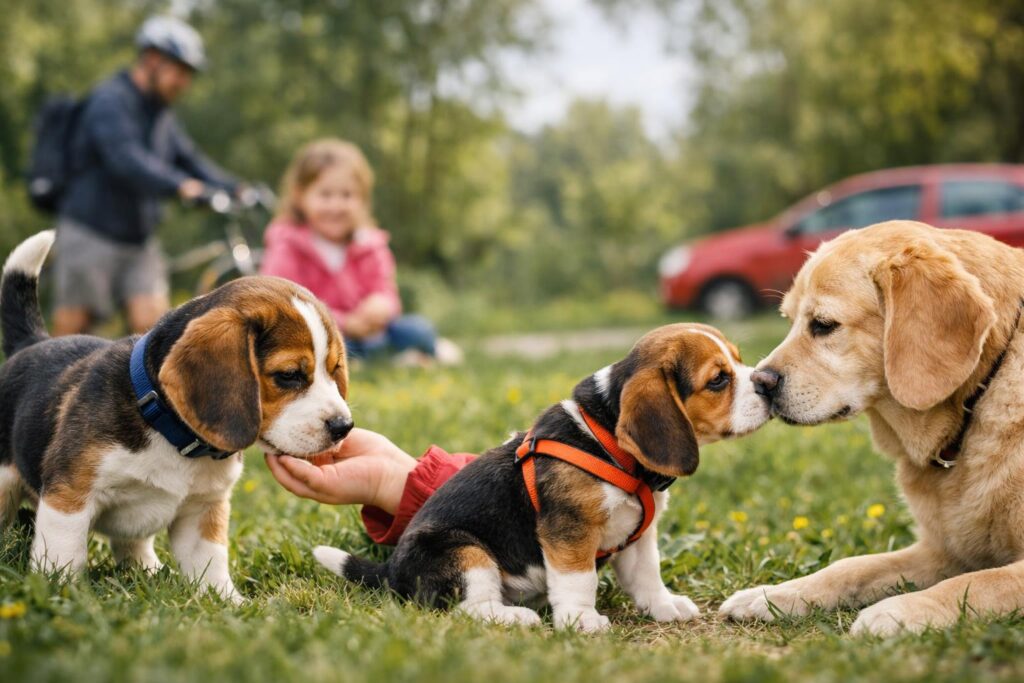
TL;DR: The socialisation window for beagles closes around 16 weeks. The goal isn’t to expose your puppy to everything at once. It’s to create enough positive experiences that the world feels normal and safe to them. Get it right during that window and you’ll have a confident adult dog. Skip it and you’ll spend years dealing with anxiety that was preventable.
When I brought Tyler home, potty training and the crate were the priority. Socialisation could wait until he’d settled in and had his vaccines done.
That turned out to be the wrong call.
Socialisation doesn’t wait. It’s already happening from the moment your puppy arrives. Every experience in those first weeks is quietly shaping how they’ll respond to the world as an adult. Miss the window and you don’t get it back.
This guide covers what socialisation actually means, when the window is, what to do during it, and what to do if you’ve already missed some of it.
For everything else you need to cover in your puppy’s first weeks, our beagle puppy training guide covers it all in one place. This article focuses on socialisation specifically because it deserves more than a few bullet points.
What Does Socialisation Actually Mean?
Socialisation isn’t just letting your puppy meet other dogs. It means positive exposure to the full range of things your beagle will encounter in adult life. Different people, sounds, surfaces, environments, vehicles, children, other animals. The aim is that none of it triggers fear later, because they’ve already seen it in a calm, safe context.
For beagles this matters a lot. They’re independent by nature, which is fine. But without early grounding, that independence can tip into anxiety. A beagle who wasn’t exposed to much in their first months often becomes a dog who’s cautious of strangers, reactive to sudden sounds, or unsettled in new places. Not because there’s anything wrong with them, but because their brain never had the chance to process those things as ordinary.
Socialisation teaches a puppy that the world is predictable. That’s really all it is.
The Window Is Shorter Than You Think
The critical socialisation period runs from around 3 weeks to 14-16 weeks of age. After that, the brain becomes naturally more cautious. The AKC’s National Beagle Club Approved Mentor Lori Norman confirms that between 8 and 16 weeks, puppies should be learning socialisation skills including different people, sounds, shapes and sights. Once that window closes, it doesn’t reopen.
The reason this window exists is neurological. During these weeks, puppies are wired to accept new experiences as normal. They’re curious, resilient, and far less prone to fear responses than they’ll be even a few weeks later. The UC Davis School of Veterinary Medicine describes this as the period when puppies are most accepting, least cautious, and most curious about their environment.
Dogs who don’t get adequate socialisation during this period often develop fear-based behaviours and anxiety that take significant work to address as adults. It’s not impossible to fix, but it’s far harder than preventing it in the first place.
Most beagles come home at around 8 weeks old. That gives you roughly 6-8 weeks to do the most important socialisation work of your dog’s entire life.
Do You Have to Wait Until Vaccines Are Done?
No. And waiting that long often means missing the window entirely.
The American Veterinary Society of Animal Behavior states that it should be standard practice for puppies to receive socialisation before they are fully vaccinated. Their reasoning is clear: behavioural problems, not infectious diseases, are the leading cause of death in dogs under three years of age.
The practical guidance is this. Puppies can start socialisation classes from around 7-8 weeks old, provided they’ve had at least one set of vaccines at least 7 days prior and show no signs of illness. The risk of keeping a puppy completely isolated until full vaccination is complete is, in their view, greater than the risk of controlled early exposure.
Safe options before vaccines are complete include:
- Puppy classes that require proof of vaccination and maintain clean facilities
- Visiting known, vaccinated adult dogs in a private garden
- Car rides to new places where your puppy isn’t put down on unknown ground
- Friends and family coming to your home and giving treats calmly
- Quiet outdoor spots away from areas with high dog traffic
Avoid dog parks, busy pet store floors, and any area where groups of unknown dogs have been. Those are the high-risk environments. Most socialisation doesn’t happen there anyway.
VCA Animal Hospitals recommends taking your puppy to new places at least twice a week during this period. Always start at a comfortable distance from anything new and let your puppy tell you when they’re ready to move closer.
What to Actually Expose Your Beagle Puppy To
The goal is variety, and every experience should be positive. Here are the areas worth covering:
Different types of people. Men with beards. Children who move unpredictably. People in hats, helmets or uniforms. Elderly people who move slowly. People carrying bags, umbrellas, bicycles. Every calm, positive interaction with a new type of person is useful.
Sounds. Traffic from a safe distance. The vacuum running in the next room. Doors closing firmly. A television on loudly. Rain on windows. If you can find a thunder recording, play it quietly while your puppy eats. VCA Animal Hospitals notes that habituation happens through repeated exposure at levels that don’t cause fear — always start quiet and build slowly.
Different surfaces. Grass, gravel, wet pavement, tiled floors, carpet, stairs. Puppies that have only ever walked on one surface can be surprisingly unsettled by a change.
New environments. The car. A quiet outdoor café area. A park bench where you sit and watch the world go by. The vet surgery for a visit with no procedure — just walk in, let staff give a treat, and walk back out. Doing this a few times before any actual appointment makes a real difference later.
Other animals. Calm, vaccinated adult dogs you know well. Cats, if your household has them or likely will. Always controlled, always positive.
Tyler’s first car journey was short and ended with food. That was it. By the end of the month he was jumping in on his own.
How to Know When Your Beagle Has Had Enough
This is where most owners go wrong. Pushing through fear doesn’t build confidence. It does the opposite.
VCA Animal Hospitals describes the early signs of an overwhelmed puppy as lip licking, yawning out of context, turning the head away, looking for an escape route, and freezing. A tucked tail and lowered body posture are also clear signals. These signs are quiet. They come well before the louder ones.
When you see them, increase the distance between your puppy and whatever is causing the response. Give them space to settle. If they take a treat and start looking around calmly, you can try moving closer again. If they won’t take a treat at all, the session is done for the day. A puppy that won’t eat is a puppy too stressed to take anything in.
The session should end before it goes bad, not after. End while your puppy is still relaxed and curious.
I took Tyler to a busy market at around 11 weeks. Too much, too soon. He stopped walking, sat down and stared at the floor. I tried to get him moving. He didn’t move. I carried him back to the car. That was the day I understood what overwhelmed actually looked like, and I didn’t repeat it.
What If You’ve Already Missed the Window?
If your beagle is past 16 weeks without much exposure, it’s harder. It’s not hopeless.
The AKC confirms that adult dogs can still learn to associate unfamiliar situations with positive experiences, though it takes more time and patience than early socialisation. The method is the same: slow introductions, positive associations, never forcing. The difference is that some things may always feel difficult for a dog who missed the window. Working with where your dog actually is, rather than where you hoped they’d be, is the honest approach.
For an older beagle with specific anxieties, a positive reinforcement trainer with experience in hound breeds is worth finding. The work is the same, it just takes more of it.
It Doesn’t Have to Be Complicated
Three things matter more than anything else: start before you feel completely ready, go at your puppy’s pace, and treat every calm new experience as a win.
You don’t need dramatic outings or packed schedules. A friend coming over for a cup of tea counts. A drive to the supermarket car park counts. Sitting on the front step while traffic goes by counts. Consistent and calm beats ambitious and overwhelming every time.
A beagle who’s seen enough of the world in those early weeks is a genuinely different dog to one who hasn’t. Easier to take places, more settled with new people, more adaptable when things change. That’s what you’re building during this window.
For the full picture on everything else in your puppy’s first weeks, including crate training, potty training and basic commands, our beagle puppy training guide has it all together.
Frequently Asked Questions
At what age should I start socialising my beagle puppy?
From the day they come home, usually around 8 weeks. The critical window runs from roughly 3 weeks to 14-16 weeks, and the earlier you begin, the more of it you use. Home visitors, short car trips and new sounds all count from day one.
Can I socialise my beagle before their vaccinations are complete?
Yes. The American Veterinary Society of Animal Behavior recommends socialisation before vaccination is finished, provided your puppy has had at least one set of vaccines beforehand and you avoid high-risk areas. Puppy classes with vaccination requirements, visits to known healthy dogs, and quiet outdoor spots are all reasonable options during this period.
My beagle seems scared of a lot of things. Is it too late?
Not too late. It takes longer with an older dog and the process needs to be slower, but the approach is the same. Positive associations at a comfortable distance, no forcing, and gradual progress. The AKC recommends pairing new or uncomfortable experiences with treats and praise over time. For significant anxiety, a positive reinforcement trainer is the right next step.
How many new experiences should my beagle puppy have each week?
VCA Animal Hospitals suggests visiting new places at least twice a week during the socialisation period. Every home visitor, car trip and new sound adds to that. Three calm positive experiences are worth far more than one overwhelming one.
What is the difference between socialisation and training?
Training teaches your beagle to respond to cues. Sit, stay, come. Socialisation teaches them that the world is safe. Both matter, but socialisation has a time limit that training doesn’t. You can teach a five-year-old beagle a new command. You can’t give them back the experiences they should have had at eight weeks.