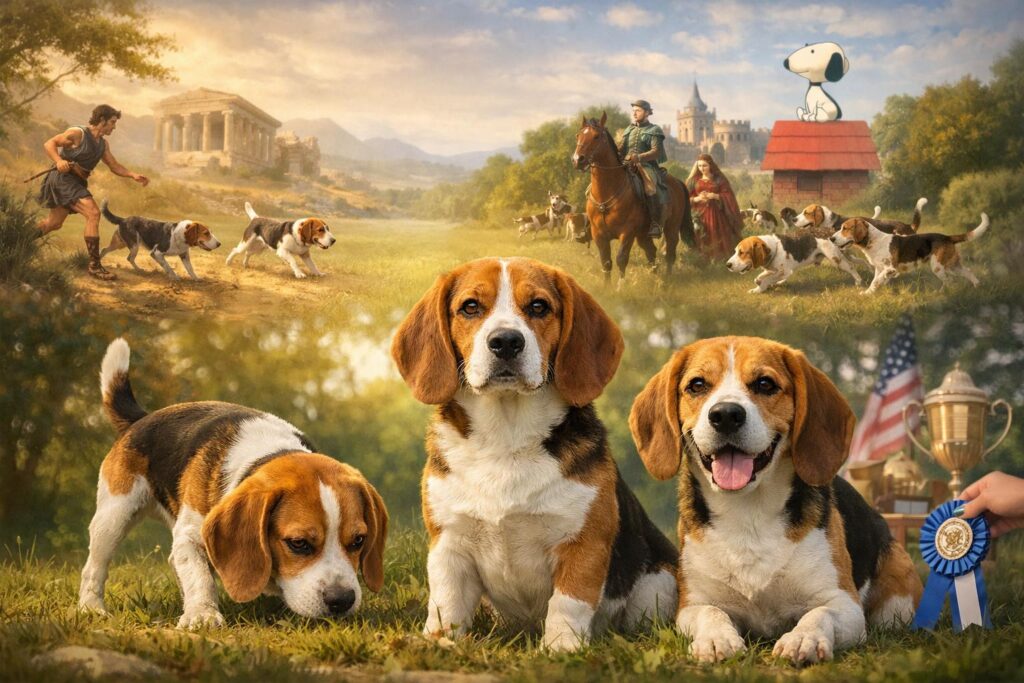
TL;DR: The beagle is one of the oldest scent hound breeds, with roots tracing back to ancient Greece around 400 BC. The modern breed was developed in 19th century England, formally standardised in the 1840s, and recognised by the American Kennel Club in 1885. From royal hunting packs to Norman Rockwell paintings to Snoopy, the beagle has been a constant in human history for good reason.
Few dog breeds carry as much history as the beagle. This small, determined hound has been tracking game, accompanying royalty, and living in family homes for centuries. Understanding where the beagle comes from helps explain why the breed behaves the way it does today. That nose, that bay, that relentless curiosity; none of it is accidental. It is the product of thousands of years of selective breeding for a very specific purpose.
Here is the full story of how the beagle became the breed it is today.
Ancient Roots: Greece and Rome
The earliest references to beagle-type dogs date back to around 400 BC in ancient Greece. According to the American Kennel Club, the fifth-century BC Greek historian Xenophon documented small hounds used for hunting hares in his treatise on hunting. These dogs were followed on foot rather than on horseback, a detail that closely matches how beagles were used for centuries afterward.
The National Beagle Club of America confirms that references to small beagle-type dogs hunting hare and followed on foot date back to 400 BC in Greece and to 200 AD in ancient Britain. When the Roman legions invaded Britain, they brought small hunting hounds with them. Interbreeding between those Roman hounds and the indigenous British hounds most likely occurred, laying some of the earliest genetic foundations for what would eventually become the beagle.
Medieval England: The Talbot Hound and the Norman Conquest
The next significant chapter in beagle history begins in 1066, when William the Conqueror brought the Talbot Hound to England during the Norman Conquest. The AKC notes that modern beagles are thought to have descended from these large white scenthounds. The Talbot Hound had an exceptional nose but was a slow runner. To improve speed, English breeders crossed it with the Greyhound, producing a faster dog known as the Southern Hound, which is considered a direct ancestor of the modern beagle.
The name “beagle” itself first appeared in English literature in 1475. The AKC records that the word was mentioned by literary figures including Chaucer and Shakespeare. In Shakespeare’s Twelfth Night, Sir Toby Belch declares “She’s a beagle, true-bred, and one that adores me.” The exact origin of the name is debated. The leading theories suggest it derives from the Old French word “beegueule,” meaning open throat, a reference to the breed’s distinctive baying voice, or from the Celtic word “beag,” simply meaning small.
The Pocket Beagle: A Royal Favourite
During the reigns of Edward II (1307 to 1327) and Henry VII (1485 to 1509), extremely small beagles known as Glove Beagles became popular. These tiny hounds were reportedly small enough to be held in a gloved hand.
Queen Elizabeth I (1533 to 1603) kept packs of what she called Pocket Beagles, standing only eight to nine inches tall. The AKC describes these dogs as also known as “singing beagles” for their melodious voices. According to historical accounts, Elizabeth I entertained guests at the royal table by letting her Pocket Beagles wander among the plates and cups. The Pocket Beagle variety is now extinct, though the name is still occasionally misused by unethical breeders marketing undersized dogs.
18th Century Decline and Survival
By the middle of the 18th century, hare hunting with beagles as an aristocratic sport was largely replaced by fox hunting with larger, faster hounds. The English Foxhound became the preferred breed of the landed gentry. The National Beagle Club of America notes that fortunately, hare hunting with packs of beagles remained popular with farmers and small landholders in the southern counties of England, as well as in Wales and Ireland. This kept the breed alive during a period when it might otherwise have disappeared entirely.
The 19th Century: Building the Modern Beagle
The foundation of the modern beagle was laid in the 1830s by Reverend Phillip Honeywood, who established a pack in Essex, England. According to the AKC, Honeywood’s primary goal was to produce dogs with excellent hunting skills rather than a standardised appearance. His dogs were small, reportedly around ten inches tall, and purely white. The Honeywood pack became the most respected hunting pack of its time and is considered the direct foundation of today’s breed.
Thomas Johnson, a fellow English breeder, later refined Honeywood’s work. Johnson focused on producing beagles that were both capable hunters and more uniform in appearance. His programme produced two strains: one with a rough coat and one with a smooth coat. The rough-coated variety survived into the early 20th century but is now extinct. The smooth-coated variety is what we recognise as the modern beagle.
By the 1840s, a relatively standard beagle type had emerged. The National Beagle Club of America records that by 1887 only 18 packs remained in England. The Beagle Club was formed in 1890 and the first written breed standard was established. The following year the Association of Masters of Harriers and Beagles was formed. Both organisations worked toward producing one consistent type of beagle. By 1902 the number of packs had risen from 18 to 44.
The Beagle Arrives in America
Scent hounds accompanied early English settlers to America, though little is documented about those earliest beagles. Beagle-like dogs were present in the United States before the Civil War, but the breed was not firmly established until the 1870s and 1880s.
A key figure in American beagle history is General Richard Rowett of Illinois. The National Beagle Club of America notes that around 1870, Rowett improved the appearance of the beagle by importing hounds from several excellent British packs. His beagles became the models for the first American breed standard. The American Kennel Club officially recognised the beagle as a breed in 1885. The AKC records that the first beagle registered was a dog named Blunder. In the 1890s, the newly formed National Beagle Club of America held its first field trials.
One notable feature of the American standard was the division of the breed into two size varieties: those under 13 inches at the shoulder and those between 13 and 15 inches. Both varieties remain recognised by the AKC today.
The 20th Century: From Hunting Dog to Cultural Icon
By the mid-20th century, the beagle had transitioned from a working hunting hound to one of America’s most beloved family pets. Their friendly temperament, manageable size, and expressive faces made them a natural fit for domestic life.
The breed’s rise in popular culture was accelerated significantly by cartoonist Charles M. Schulz. According to the AKC, Snoopy made his debut on October 4, 1950, two days after the first Peanuts comic strip was published. The Peanuts comics eventually reached more than 355 million readers in 75 countries. In 1953, three years after Snoopy’s debut, the beagle surpassed the Cocker Spaniel to top the AKC popularity charts. As a tribute, the AKC made an exception to its rule that only real dogs can be registered, giving Snoopy the honorary number Beagle-1.
The beagle’s presence in the White House also drew public attention to the breed. President Lyndon B. Johnson owned beagle littermates named Him and Her, born in 1963. Their high-profile existence in Washington kept the breed in the national conversation throughout the 1960s.
The Beagle Today: Companion, Detector, and Show Dog
The modern beagle occupies several roles simultaneously. In the home, they are affectionate, social, and energetic family companions. In working environments, their nose remains one of their most valuable assets.
The AKC notes that beagles are used as detection dogs at airports and border crossings worldwide, sniffing out prohibited agricultural items and contraband. The United States Department of Agriculture uses what it calls the Beagle Brigade to inspect luggage for food items that could carry pests or disease into the country. Their non-threatening appearance and reliable temperament make them ideal for working in crowded public spaces.
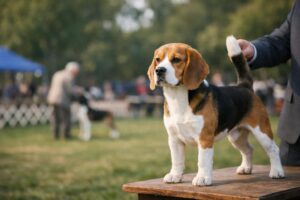
In the show ring, beagles have earned top honours. A beagle won Best in Show at the Westminster Kennel Club Dog Show for the first time in 2008, and the breed has consistently ranked among the most popular in the United States for decades.
The beagle remains one of the most recognised dog breeds in the world. That consistency across centuries, from the hunting packs of ancient Greece to the family homes of today, reflects a breed that has always known how to make itself indispensable.
Frequently Asked Questions
Where did the beagle breed originate?
The beagle’s earliest ancestors can be traced to ancient Greece around 400 BC, where small hounds were used to hunt hares on foot. The modern breed was developed in England, with significant breeding programmes established in the 1830s. The breed was formally standardised in the 1840s and recognised by the American Kennel Club in 1885.
What does the word “beagle” mean?
The exact origin of the word is uncertain. The leading theory is that it derives from the Old French word “beegueule,” meaning open throat, a reference to the breed’s loud baying voice during a hunt. Other theories point to the Celtic word “beag,” meaning small, or the Old English “begle,” which described a small hound.
Who developed the modern beagle breed?
Reverend Phillip Honeywood is widely credited as the father of the modern beagle. In the 1830s, he established a pack in Essex, England, focused on hunting ability. Thomas Johnson later refined the breed to improve both appearance and performance. In America, General Richard Rowett of Illinois imported English beagles in the 1870s and his dogs became the foundation for the first American breed standard.
When were beagles first recognised by the AKC?
The American Kennel Club officially recognised the beagle as a breed in 1885. The first beagle registered by the AKC was named Blunder. The National Beagle Club of America was formed in the late 1880s and held its first field trials in the 1890s.
What were beagles originally bred for?
Beagles were originally bred as scent hounds for hunting hares and rabbits. They were specifically developed to be followed on foot rather than on horseback, making them accessible to hunters who could not afford horses. Their exceptional nose, stamina, and pack mentality made them highly effective for this purpose across centuries of use.