
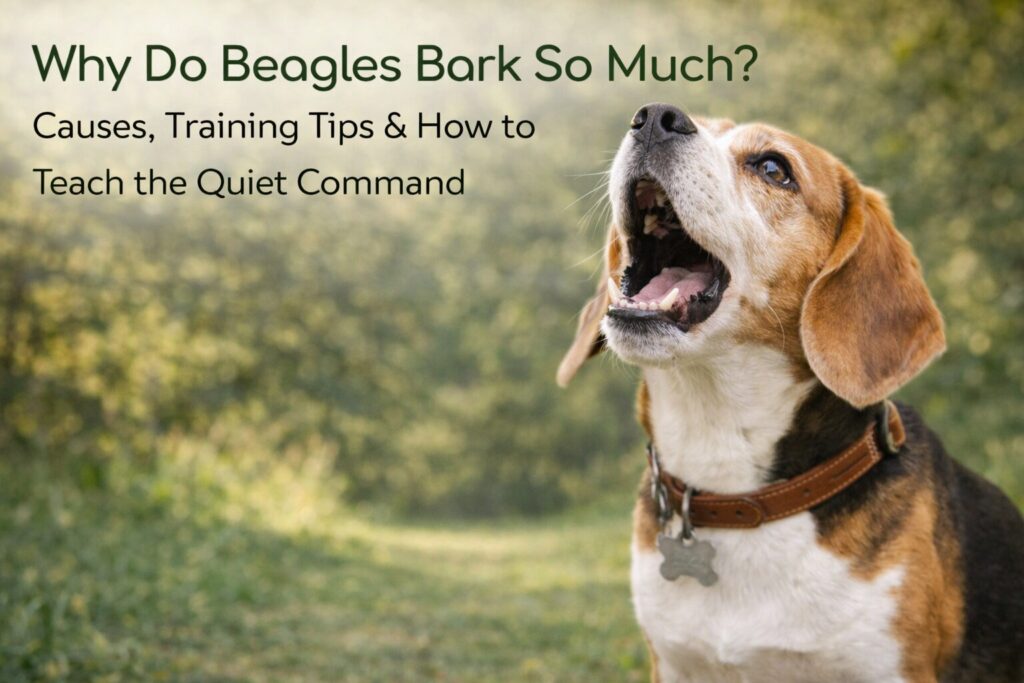
Living with a beagle means accepting a certain level of noise. That’s just the reality. Beagles were bred as pack hunting dogs, and their voice was their most useful tool on the trail. A beagle who picked up a scent would bay to alert the rest of the pack. That instinct doesn’t switch off because they’re now living in a semi-detached house in the suburbs.
But there’s a difference between a beagle who barks occasionally and one who barks at everything, all day, for no clear reason. The first is just a beagle being a beagle. The second is a beagle with an unmet need, a learned habit, or both. This guide covers the difference, the causes, and what actually helps.
Barking is one of the most common behaviour problems in beagles. If you want context on the full range of things this breed tends to do and why, the guide to common beagle behaviour problems covers all of them together. This article focuses specifically on barking.
The Three Sounds a Beagle Makes
Not all beagle noise is the same. Understanding the difference helps you figure out what’s going on and how to respond.
The bark. The standard short, sharp sound most people associate with dogs. Beagles use this for alerts: someone at the door, an animal in the garden, something that caught their attention. It’s the everyday sound and usually the easiest to manage.
The bay. A deeper, drawn-out sound somewhere between a bark and a howl. Baying is a distinctive beagle sound used to communicate excitement, especially when they’ve picked up a scent or spotted something interesting. On a hunting trail, a baying beagle was signalling the rest of the pack. At home, it tends to mean something has grabbed their attention and they want everyone to know.
The howl. The long, mournful sound that carries a long way. Beagles howl for several reasons: loneliness, boredom, hearing other dogs, or responding to high-pitched sounds like sirens. It’s the one that tends to concern neighbours most.
All three are normal beagle behaviour. The question isn’t how to eliminate them entirely. The question is whether the frequency and timing are working for the household.
Why Is Your Beagle Barking?
Barking always has a reason. Finding the reason is the first step. Trying to train the noise away without addressing the cause rarely works for long.
Boredom and lack of stimulation. This is the most common cause of excessive barking in pet beagles. A beagle who hasn’t had enough exercise, sniff time, or mental engagement will find other outlets for that energy. Barking is one of them. The AKC notes that for dogs barking out of boredom, providing something more constructive to do is often the most effective solution. A tired beagle is a quieter beagle.
Alert barking. Beagles are naturally alert to changes in their environment. Movement outside the window, a knock at the door, a car pulling in. This type of barking usually stops once the trigger passes. It’s instinctive and very difficult to eliminate, but it can be managed with the quiet command so it doesn’t go on indefinitely.
Attention seeking. Some beagles learn quickly that barking produces a response from their owner. Even a negative response, like being told off, is still attention. If barking has ever been rewarded, even accidentally, it can become a learned habit that’s hard to break without consistent training.
Separation anxiety. A beagle left alone who barks, howls, or bays throughout the day is usually struggling with being by themselves. This is a specific type of problem that needs a specific approach. Managing general barking and managing separation-driven barking are not the same thing, and conflating them wastes time.
Responding to other dogs or sounds. Beagles who hear other dogs bark or howl will often join in. Sirens and high-pitched sounds can trigger the same response. This is an instinct rooted in their pack history and is difficult to train away entirely, though it usually reduces with age and a calm home environment.
Scent-triggered excitement. A beagle who catches an interesting smell through a gap in the fence or on a walk can bay quite enthusiastically. This is the hunting instinct in action. Regular outlets for scent work, like sniff games in the garden or controlled sniff time on walks, can reduce how often this energy gets redirected into noise.
What Does Not Work
Before covering what helps, it’s worth being clear on what makes barking worse, because several instinctive responses actually reinforce the problem.
Shouting at a barking dog. From the beagle’s perspective, their owner is now also making noise. This often increases excitement rather than reducing it. A calm, quiet response is far more effective than a raised voice.
Giving the dog what they want when they bark. If your beagle barks for attention and you pet them, talk to them, or let them out, you’ve taught them that barking works. Doing this once is enough to reinforce the behaviour. Any attention, including being told off, counts as a reward in this context.
Punishing the barking without addressing the cause. If a beagle is barking because they’re bored, correcting the bark without providing stimulation just creates a frustrated, confused dog who will find another outlet for the same energy.
Inconsistency. Responding to barking one day and ignoring it the next confuses the dog and slows down any progress significantly. Everyone in the household needs to respond in the same way, every time.
Teaching the Quiet Command
The quiet command is the most practical tool for managing beagle barking. It doesn’t eliminate barking, but it gives you a reliable way to end it once it starts. Here is how to teach it properly.
Start by letting them bark. When your beagle starts barking, let them bark two or three times. This is important. You’re not rewarding the barking. You’re setting up the contrast between barking and quiet.
Bring a treat to their nose. Hold a high-value treat close to their nose. A dog cannot bark and sniff at the same time, so bringing a treat to their nose naturally interrupts the barking. The moment they pause, say “quiet” in a calm, clear voice and give the treat.
Build duration gradually. At first, reward any pause in barking, even just a second or two. Over time, wait a little longer before giving the treat. The dog learns that staying quiet, not just pausing, is what produces the reward.
Practise with the actual triggers. Once the command is solid in a calm environment, practise it with the things that actually set off the barking: the doorbell, a knock, someone walking past. Set these situations up deliberately so you can train through them with the treat ready.
Be consistent every session. Keep training sessions short, five to ten minutes. End on a success. The more repetitions you get in the early weeks, the faster the command becomes reliable.
Excessive barking is one of several behaviour problems beagles are known for. If you’re dealing with digging, chewing, jumping, or escaping alongside the noise, the guide to common beagle behaviour problems covers each one in the same practical format.
Reducing Barking Through Exercise and Enrichment
Teaching the quiet command handles barking in the moment. But if the underlying cause is under-stimulation, training alone won’t solve the frequency. A beagle needs their nose engaged and their body tired every day.
Practically, this means at least one proper walk per day, long enough that they come home genuinely tired. Sniff time on walks rather than rushing through them. Let them stop and investigate. This is mentally exhausting for a beagle in the best possible way.
Sniff games at home help too: hiding treats around the garden or in a snuffle mat, scatter feeding in the grass, simple find-it games indoors. Puzzle feeders instead of a standard food bowl at mealtimes give them something to work for.
It’s also worth looking at where your beagle spends their day. If they spend hours watching the street from the sofa and barking at everything that passes, moving their resting spot away from the window removes the trigger entirely. A beagle who has sniffed, walked, and been mentally engaged each day barks significantly less than one who hasn’t. This isn’t a quick fix, but it’s the most sustainable one.
Alert Barking at the Door
This is one of the most common specific complaints. The postman, a delivery, a visitor, a knock. The beagle erupts. It’s embarrassing when you have guests and disruptive throughout the day.
A few things help here. First, accept that some barking at the door is fine. It’s natural alerting behaviour and not worth trying to eliminate entirely. What you want to teach is that two or three barks is enough, and that quiet follows a command.
Second, teach your beagle an incompatible behaviour. Going to a mat or bed on command gives them something to do with the energy that isn’t barking. A beagle who has been trained to go to their mat when the doorbell rings isn’t barking at the door because they’re occupied elsewhere.
Third, practise the scenario repeatedly. Have someone ring the doorbell or knock. Work through the quiet command or the mat command every time. The more repetitions you get in a structured setting, the more reliable the behaviour becomes when it’s a real delivery rather than a training session.
Barking When Left Alone
If your beagle only barks when you’re not home, this is a different problem from general barking. It’s usually separation anxiety or boredom in the absence of company. A beagle left alone for long stretches without enough to do will make noise.
Practical steps that help include leaving a food-stuffed toy that takes a while to work through, leaving background noise like a radio or television, and building up alone time gradually rather than expecting a puppy or newly homed dog to cope with several hours immediately.
If the barking when alone is severe, persistent, and accompanied by other signs like destructive behaviour or toileting indoors despite being house trained, that points to separation anxiety rather than simple boredom. These are handled differently and it’s worth addressing the anxiety specifically rather than just the noise.
When to Get Help
Most beagle barking is manageable with consistent training and adequate exercise. But some situations benefit from professional input.
If barking is accompanied by growling, stiff body posture, or snapping, that’s a different type of problem and needs to be assessed properly. If your beagle is barking for most of the day regardless of how much exercise they get and how much training you do, a veterinary check is a reasonable first step in case there’s an underlying health or anxiety issue. And if separation anxiety is severe, a positive reinforcement trainer with experience in hound breeds can make the process significantly faster and less stressful for the dog.
Frequently Asked Questions
Is it normal for a beagle to bark this much?
Yes, beagles are naturally vocal dogs. They bark, bay, and howl, and all three sounds serve a purpose rooted in their hunting history. Younger beagles under two years old tend to be particularly vocal and often settle as they mature. Some level of barking is normal and expected with the breed. What isn’t normal is barking that goes on for hours without interruption or that seems to have no identifiable trigger.
Why does my beagle bark at nothing?
They’re almost certainly not barking at nothing. Beagles have significantly better hearing and smell than humans. They may be reacting to a scent from outside, a sound you can’t detect, or a movement that caught their eye. What looks like unprovoked barking usually has a trigger that simply isn’t obvious to the owner.
Will the quiet command actually work on a beagle?
Yes, with consistent training it does. Beagles are food motivated, and the quiet command uses that motivation directly. The key is consistency and starting the training in low-distraction environments before moving to the actual triggers. It takes several weeks of regular short sessions to become reliable, but it does become reliable with repetition.
Should I use a bark collar to stop my beagle barking?
Aversive bark collars, including shock collars, are not recommended. They suppress the behaviour without addressing the cause and can increase anxiety, which often leads to other problems. The goal is to teach the dog what you want, not to punish what you don’t want. Positive training methods take longer but produce more lasting results and don’t damage the relationship between the dog and their owner.
My beagle only barks when I’m not home. What do I do?
Start by providing more to do during your absence: a food-stuffed toy, background noise, and a comfortable resting space away from windows. Build up alone time gradually rather than leaving for long periods immediately. If the barking is severe and consistent despite these adjustments, it’s worth speaking to a vet or behaviourist as this level of distress often indicates separation anxiety that needs structured support.