TL;DR: Clicker training uses a small device that makes a sharp click sound to tell your beagle the exact moment they did something right. It’s one of the best training methods for beagles because they’re highly food-motivated. This guide walks you through every step, from setting up your first session to phasing the clicker out once your beagle has learned a behavior. If you’re just getting started, this is the place to begin.
If you’ve ever tried training a beagle with just your voice and a treat, you know how that usually goes. You say “sit.” Your beagle looks at the treat in your hand. You say “sit” again, a little louder. Your beagle sniffs the floor. Eventually, maybe, they sit. But did they sit because of your command, or just because they got bored standing?
That’s the problem with standard training for this breed. Beagles are smart dogs, but they’re also scent hounds. Their brains are wired to follow smells and explore. Keeping their attention long enough to teach a command takes more than just a treat in your hand.
Clicker training for beagles cuts through that confusion. It gives your dog an instant, clear signal that says “yes, that exact thing you just did is right.” And because beagles are so food-motivated, they learn to love the game fast.
Here’s everything you need to know to get started from scratch.
What Is Clicker Training, and Why Does It Work So Well for Beagles?
Clicker training is a method where you use a small handheld device to mark the exact moment your dog does something right. The click sound acts as a bridge between the behavior and the treat that follows. Your beagle quickly learns that a click means a reward is coming.
The method is rooted in a concept called operant conditioning, developed by psychologist B.F. Skinner. According to Best Friends Animal Society, Skinner found that animals repeat actions with good outcomes and avoid actions with bad ones. The clicker puts that principle to work in a very precise way.
What makes it so effective for beagles specifically comes down to two things.
First, beagles are extremely food-motivated. As Positively.com explains, food is one of the strongest motivators for dogs because it’s a basic need. Beagles take this to another level. They will work hard for a small piece of chicken or cheese. That drive makes them ideal students for reward-based methods.
Second, the click is faster than a treat and faster than praise. MasterClass notes that a clicker marks the exact moment the behavior happens, which eliminates guesswork for your dog. When your beagle’s bottom hits the floor, you click that instant. Your beagle learns “sitting is what caused the click,” not “something I did in the last few seconds caused the click.”
That precision matters a lot with beagles. Their attention shifts fast. A click cuts through before their nose takes over.
What You Need Before You Start
You don’t need much. Here’s what to gather before your first session.
A clicker. Basic box clickers are available at most pet stores for a few dollars. Some dogs are sensitive to loud sounds. If your beagle seems startled by the click, try a softer clicker or muffle the sound by clicking inside your pocket.
High-value treats. These need to be small, soft, and something your beagle finds exciting. Karen Pryor Clicker Training recommends using something really good at the start, like small pieces of cooked chicken, rather than regular kibble. Your beagle needs to care about the reward enough to stay focused.
Keep treats pea-sized or smaller. You’ll be giving a lot of them in a session, and you don’t want your dog filling up in the first five minutes.
A quiet space. Pick a room with no other pets, no people walking in and out, and no TV on in the background. You want your beagle’s full attention, and even a small distraction can pull a beagle’s nose away from the task.
Short sessions. Plan for 5 to 10 minutes at most. Beagles have a shorter attention span than many other breeds. Several short sessions throughout the day will get you much further than one long session.
Step 1: Charge the Clicker First
Before you teach any commands, your beagle needs to understand what the click means. This step is called “charging the clicker,” and it’s the foundation of everything that follows.
Charging the clicker means teaching your dog that click equals reward. Every time they hear the click, something good is coming.
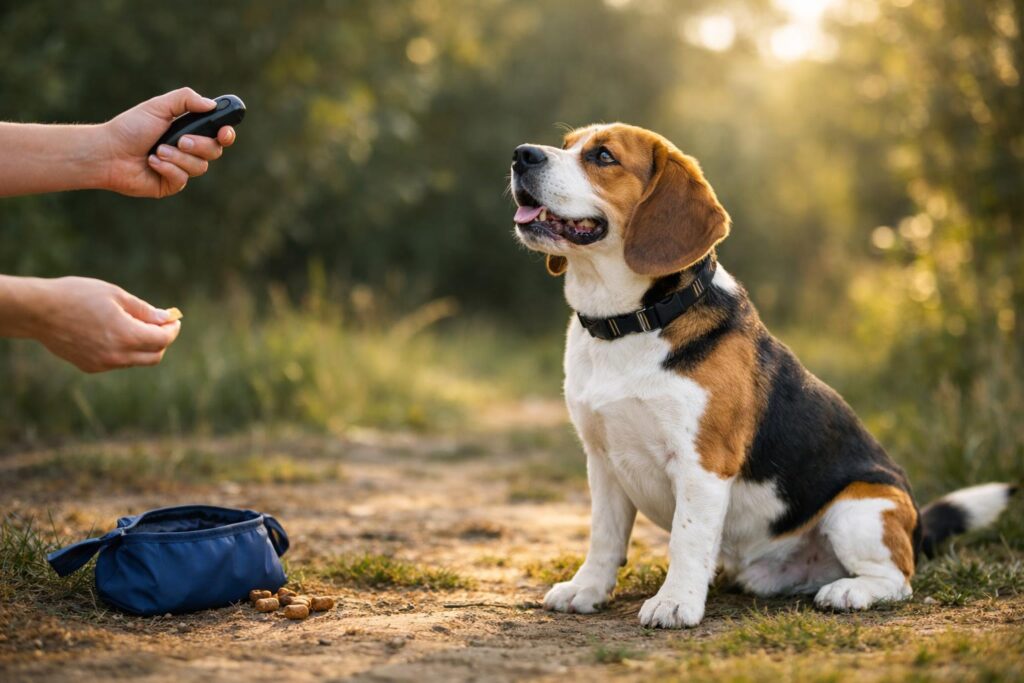
Here’s how to do it. Stand or sit near your beagle in your quiet space. Hold treats in one hand and the clicker in the other. Click once, then immediately give a treat. Your beagle doesn’t need to do anything. Just click, then treat. Repeat this 10 to 15 times.
Best Friends Animal Society compares this to a can opener. The first time a cat hears an electric can opener, the sound means nothing. After a few times hearing that sound followed by a bowl of food, the cat comes running at the sound alone. That’s the same association you’re building with the clicker.
Watch your beagle’s reaction after a few repetitions. If they perk up, look at you, or seem alert when they hear the click, the association is forming. That’s your green light to move to the next step.
One important rule that applies from day one: if you click, you must give a treat. Every single time. As Karen Pryor Clicker Training explains, even if you click by accident, give the treat anyway. The click is a promise. Breaking that promise confuses your dog and weakens the whole system.
Step 2: Teach Your First Command
Once your beagle understands the click, it’s time to put it to use. Start with something simple. “Sit” is the most common first command for a good reason. It’s easy to get the behavior, and it’s easy to time the click.
Here’s the step-by-step process.
Hold a small treat just above and behind your beagle’s nose. Move it slowly back over their head. As their nose follows the treat upward, their bottom will naturally lower toward the floor. The moment their rear touches the ground, click once and give the treat.
Repeat this several times. Don’t say any words yet. You want the behavior to happen reliably before you attach a word to it.
VCA Animal Hospitals emphasizes that timing of the reward is critical. Your dog needs the signal right after they do what you want. Even a short delay can leave them unsure which behavior earned the reward. The click handles this for you, as long as you click at the right moment.
After your beagle is sitting consistently every time you move the treat, start saying “sit” just before you lure them. You’re now pairing the word with the behavior. Once they’re sitting reliably after hearing the word, you can begin to reduce the lure and let the verbal cue do the work.
The same approach works for other commands. “Down” and “come” are natural next steps after “sit.” Just work on one command per session. Don’t try to teach two new behaviors at the same time. Your beagle will get confused, and both behaviors will suffer.
The Most Common Beginner Mistakes
Clicker training is simple in concept, but most new owners make the same few mistakes at the start. Knowing these ahead of time saves a lot of frustration.
Clicking too late. This is the most common one. Pedigree notes that even half a second too late can reinforce the wrong behavior. Think of the click like taking a photo. You’re capturing the exact moment the behavior happens, nothing before or after.
Using the clicker to get your beagle’s attention. The clicker is not a remote control. Clicking to get your dog to look at you tells them that being distracted is the correct behavior. Only click when your dog is doing something you want repeated.
Clicking without treating. Every click must be followed by a treat, especially early on. If you click and nothing happens, your beagle will stop trusting the click. The system falls apart.
Sessions that run too long. Keep sessions to 5 to 10 minutes. Once your beagle starts losing focus or making repeated errors, stop. End on a behavior they know well so the session finishes with a click and a treat.
Expecting fast results. Some behaviors come together in a few sessions. Others take longer. Beagles learn on their own timeline. Frustration from your end comes through in your body language and tone, and it makes training harder for both of you. If you feel yourself getting annoyed, put the clicker away and come back later.
When and How to Phase Out the Clicker
The clicker is a teaching tool, not a permanent part of your routine. Once your beagle reliably performs a behavior on a verbal cue, you can begin moving away from the click-and-treat cycle.
Chewy explains the transition well. Start by pairing the click with verbal praise at the same time, so your dog begins to associate praise with the same positive feeling as the click. Then reduce how often you use the clicker, replacing it with a clear, bright “yes!” as a verbal marker. Eventually, verbal praise alone becomes the reward.
Guide Dogs for the Blind recommends waiting until the behavior is consistent across multiple sessions before beginning the phase-out. For a simple behavior like “sit,” that might happen after a few days. For more complex behaviors, it takes longer.
Once behaviors are learned, switch to rewarding on a variable schedule. Instead of treating every single time, reward sometimes with a treat and sometimes with praise. This actually strengthens the behavior. Your beagle keeps trying because they never know when the treat is coming, which makes them more consistent, not less.
One thing to never do during this phase: click without giving a treat. The clicker should always predict a reward. If you use the clicker but stop following through, it loses its meaning and can’t be used effectively for new behaviors later.
You can always pick the clicker back up when teaching something new. It’s a great tool for any trick or skill you want to start fresh.
Conclusion
Clicker training is one of the most straightforward, science-backed ways to teach a beagle. It works because it communicates clearly, rewards fast, and takes full advantage of how food-motivated this breed naturally is.
Here are the three things to take away from this guide. Charge the clicker before you do anything else. Get your timing sharp, because the click has to land at the exact right moment. And keep sessions short, because 10 focused minutes beats 30 distracted ones every time.
It will feel a little awkward in the first session. That’s completely normal. Coordination between the clicker, the treat, and your dog’s behavior takes a few tries to find your rhythm. Stick with it, and you’ll start to see your beagle paying attention in a way that feels different from anything else you’ve tried.
If you want a fuller picture of beagle training beyond the clicker, including how to handle common behavior problems and build a training plan from start to finish, check out The Complete Training and Behaviour Guide for Beagle Owners.
Frequently Asked Questions
At what age should I start clicker training my beagle?
You can start as early as 8 weeks old. Puppies at this age are in a prime learning window and pick up the clicker association quickly. Keep sessions to 3 to 5 minutes for young puppies. If you have an older beagle, don’t worry. Clicker training works at any age. Older dogs may take a little longer to build the association, but the method works just as well with patience and consistency.
How many times a day should I do clicker training sessions?
Two to three short sessions per day is a solid starting point. Each session should be 5 to 10 minutes long. Spreading sessions throughout the day works better than doing one long block of training. Short, frequent repetition is how dogs build strong, reliable behaviors.
My beagle ignores the clicker. What am I doing wrong?
The most likely reason is that the charging step wasn’t repeated enough. Go back to basics. Click and treat 15 to 20 times in a row with no commands involved. Also check your treats. If your beagle isn’t very excited by what you’re offering, try something higher value like small pieces of cooked chicken or cheese. The treat needs to be worth their attention.
Can I use a word instead of a clicker?
Yes. A short, sharp verbal marker like “yes!” works in the same way. The main advantage of the clicker is that it sounds exactly the same every time, unlike your voice which changes based on your mood or energy. But if your beagle is very sensitive to sounds, or if you simply prefer not to use a clicker, a verbal marker is a perfectly good option as long as you use it consistently.
Do I have to use the clicker forever?
No. The clicker is a learning tool for new behaviors. Once your beagle can perform a behavior reliably on a verbal cue, you phase the clicker out and replace it with praise and occasional treats. You can always bring it back when you start teaching something new. Think of it as a tool you pick up when you need it, not something you carry around for the rest of your dog’s life.