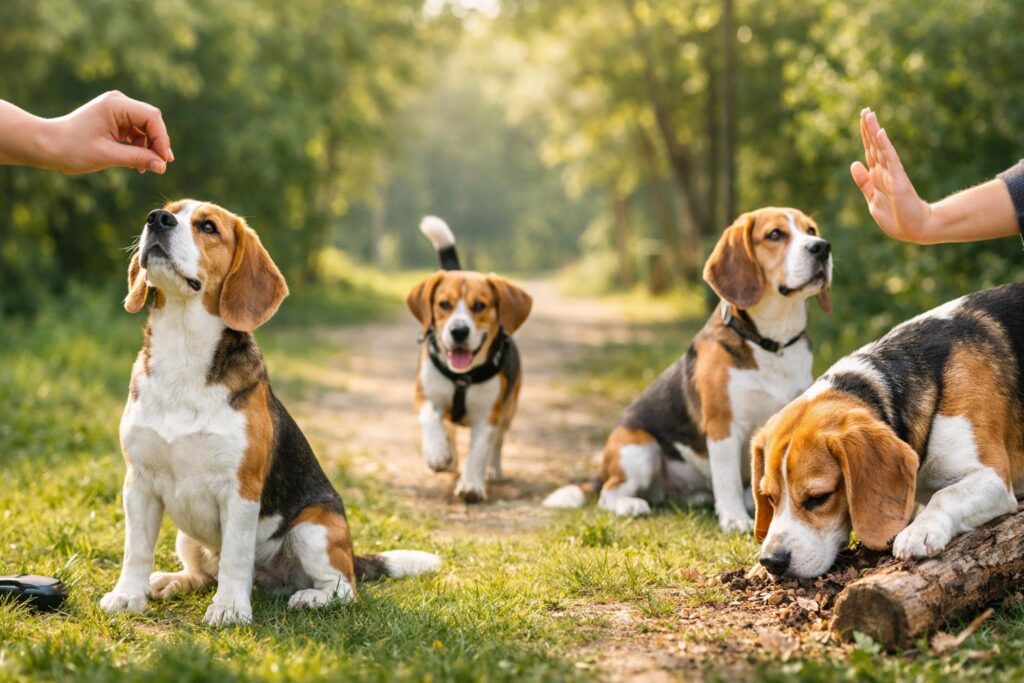
I spent the first few months with Tyler trying to train him the way I’d seen other people train other dogs. Arm out, firm voice, treat in hand. It worked fine in the kitchen. The moment we went anywhere interesting, it was like we’d never trained a day in our lives.
The problem wasn’t Tyler. It was that beagles have a nose that overrides everything else when something more interesting turns up. Getting a beagle to respond reliably to commands is less about obedience and more about making yourself more compelling than the environment. Once that clicked, the training actually started working.
This guide covers the commands every beagle should know, how to teach them in a way that accounts for the breed, and what to do when specific behaviour problems need their own dedicated approach.
Why Commands Work Differently with Beagles
Beagles aren’t people-pleasers. They don’t have the same built-in drive to earn approval that you get with breeds like labradors or collies. What they do have is a powerful food drive and genuine intelligence. Those two things are your tools.
The AKC notes that beagles respond best to positive reinforcement and consistency, and that boundaries taught through repetition rather than correction stick better with the breed. In practice this means rewards that actually compete with the environment. Dry biscuits won’t cut it outdoors. Small pieces of chicken, cheese, or strong-smelling training treats will.
A few things that apply to every command you’ll ever teach a beagle:
Keep sessions under 10 minutes. Beagles have short attention spans for anything that isn’t a scent trail. A focused 10-minute session beats a 40-minute session where they’ve mentally checked out after the first quarter. Two short sessions a day is far more effective than one long one.
Train before meals, not after. A beagle who has just eaten has no reason to work for food. Train when they’re hungry and the treats mean something.
Start indoors. The garden is full of competing information. Get each command solid in a quiet environment before you take it anywhere interesting. This isn’t a sign of failure. It’s just how the breed works.
One command per session. Trying to teach multiple things at once confuses any dog. Pick one command, repeat it until they’re getting it right consistently, then stop on a win.
Same word, every time, from everyone. If one person says “come” and another says “here,” the beagle learns that recall is optional. Every person in the household needs to use the same word for the same command. Inconsistency is the fastest way to undo progress.
The Essential Commands
These are the five commands that form the foundation for everything else. Get these working reliably before moving on to anything more specific.
Sit. Usually the first command to teach and the easiest to get reliable. Hold a treat just above your beagle’s nose and slowly move it back over their head. As their nose follows the treat upward, their bottom naturally lowers. The moment they sit, say “sit” clearly and reward immediately. Timing matters: the treat needs to land within a second or two of the behaviour or the connection blurs. Once solid on sit, most other commands become easier to build.
Stay. Start from a sit. Hold your hand out like a stop sign, say “stay,” and take a small step back. If they hold the position, return to them and reward. The key mistake is adding too much distance too quickly. Build one second at a time, one step at a time. Tyler’s version of “stay” for the first month was “sit for two seconds and then go see what’s happening over there.” Build the duration slowly and it does become reliable.
Come. The most important command for a beagle and also the hardest to make reliable. Start in a low-distraction environment on a long line. Call once, use a high-value treat, and celebrate every single recall like it’s the best thing they’ve ever done. Never punish a slow recall or a beagle who eventually comes back after ignoring the first call. You want coming to you to always feel like the right choice.
Recall deserves more than a paragraph. Because it’s the command that keeps a beagle safe, and because it breaks down differently in this breed than in most others, there’s a dedicated guide that goes through the full process: Recall Training for Beagles. Work through that alongside this guide.
Reliable recall is also the foundation for eventually working off lead. A beagle that comes back consistently in low-distraction environments is the starting point for building off-leash confidence safely. Off-Leash Training for Beagles covers how to get there and what realistic off-leash freedom looks like for this breed.
Down. Hold a treat in front of your beagle’s nose and slowly lower it to the floor. Their nose follows, and most will naturally fold into a down position as the treat reaches the ground. Say “down” the moment their elbows touch the floor and reward immediately. This command is useful for keeping a beagle settled when you need them calm.
Leave it. One of the most practically useful commands for beagle owners. Show your beagle a treat in your open hand. When they go to take it, close your fist. Wait. The moment they back away or look up at you, say “leave it” and reward from your other hand, not the one they were investigating. This teaches them that leaving something alone produces a better outcome. It applies to food on the ground, items they shouldn’t chew, and a hundred other situations.
When Specific Behaviours Need Their Own Approach
Basic commands give you the foundation. But beagles develop specific behaviour problems that go beyond just needing to know “sit.” Each one has a root cause and a method that works. Here’s what’s happening with the most common ones and where to find the full guide for each.
Barking and howling. Beagles bark, bay, and howl for different reasons. Some of it is instinct, some is boredom, some is a learned habit that got reinforced accidentally. The quiet command is the practical tool for managing it, but the cause determines the fix. The full beagle barking guide covers all three types of noise, why each happens, and how to teach the quiet command step by step.
Pulling on the lead. A beagle on a lead is a beagle following their nose. Pulling is instinctive and starts young. The good news is it responds well to consistent training, but it takes weeks of patience rather than a single session. A proper harness makes the process significantly easier and prevents neck strain while they’re learning. Leash Training for Beagles covers the method, the right equipment, and how to build loose lead walking from scratch.
Stubbornness and not listening. When a beagle seems to be ignoring commands they know, it’s almost always one of three things: the distraction is stronger than the reward, the command hasn’t been generalised to that environment yet, or the training happened when the beagle was full. True stubbornness, where a beagle flat-out refuses a command they know well in a low-distraction environment, is relatively rare. How to Handle Beagle Stubbornness separates these situations and gives a clear approach for each one.
Digging. Beagles dig for the same reason they do most things: something smelled interesting underground, or they have energy to burn and the garden is available. Digging isn’t a command failure. It’s a breed instinct being expressed without a better outlet. The beagle digging guide covers how to redirect it, what actually reduces it, and why telling a beagle off for digging rarely helps long-term.
Escaping. A beagle who escapes the garden is following a scent trail. The fence is not a barrier to them. It’s an obstacle course. Preventing escapes is partly about physical management and partly about recall being reliable enough that they choose to come back when called. The guide to preventing beagle escapes covers the practical steps for both.
Hyperactivity. A hyperactive beagle is almost always an under-stimulated beagle. Commands training helps because it gives the brain something to do, but exercise and nose work need to happen first. Trying to train a wound-up beagle is like trying to teach someone arithmetic when they’re mid-sprint. The hyperactive beagle guide covers the order of operations and what actually takes the edge off.
Territorial marking. Marking indoors is a behaviour problem that commands alone won’t fix. It’s driven by instinct and sometimes by insecurity. The guide to territorial marking in beagles covers why it happens, how to interrupt it consistently, and what the training approach looks like alongside the management steps.
Destructive chewing. Puppies chew because they’re teething. Adult beagles chew because they’re bored or anxious. Neither is a training failure, and both respond to the right combination of outlets and redirection. The guide to fixing destructive chewing covers what to give them instead and how to make “leave it” apply to furniture and household objects, not just food.
Jumping up. Beagles jump on people because it works. It gets attention, contact, and a reaction. Training it out requires every person in the household to stop rewarding it, which is harder than it sounds when a small, enthusiastic beagle launches itself at a visitor. The guide to stopping jumping in beagles covers the consistent approach that actually makes a difference.
What to Work on First
If your beagle is a puppy or you’re starting from scratch, the order matters. Doing too much at once is the fastest way to make no progress at all.
Start with sit. It’s the quickest win and it gives you a foundation for everything else. Once sit is reliable indoors, add down. Then stay, building duration slowly. Come should be woven into every session from day one, even if it’s just calling them across the room for a treat. Leave it can start once sit is solid.
Work on lead training from the first walk. The longer pulling is allowed, the more ingrained it becomes.
Barking, jumping, chewing, and the other specific problems should be addressed as they appear, alongside the foundation commands rather than instead of them. The foundation gives you tools. The specific guides help you use those tools in the right situations.
It takes longer with beagles than with some other breeds. That’s just honest. But they do get there, and a beagle who responds reliably to commands is a genuinely different dog to live with. The effort is worth it.
Frequently Asked Questions
At what age should I start teaching my beagle commands?
From the day they come home, which is usually around 8 weeks. Puppies at this age are forming habits quickly and the earlier commands are introduced the better. Keep sessions very short at first, two or three minutes, and build up gradually. The AKC recommends starting basic commands as soon as a puppy begins connecting the dots from repetition, which typically begins around 12 weeks. That doesn’t mean waiting until 12 weeks. It means the repetition you do in weeks 8 to 12 is building the foundation for what clicks later.
My beagle knows the commands indoors but ignores them outside. Why?
This is the most common training frustration with beagles. A command learned in one environment hasn’t automatically been learned in all environments. The outdoor world is full of scents, sounds, and movement that compete with your reward. The fix is to practise the same command in progressively more distracting environments, always making sure your reward is high-value enough to compete. Start in the garden, then a quiet street, then a busier area. Each new environment is essentially a new training challenge. If this is a persistent problem across multiple commands and environments, What to Do When Your Beagle Won’t Listen goes deeper into the specific reasons this happens and how to work through each one.
How long does it take to get reliable commands from a beagle?
It varies, but most owners see reliable sit and down within two to four weeks of daily short sessions. Stay and leave it take longer, usually six to eight weeks before they’re consistent. Come is the one that never truly stops needing practice. The key word is reliable, meaning the command works even in distracting environments. Getting there takes months, not days. The owners who stick with it get there.
Should I use a clicker for beagle training?
Clicker training works well with beagles because the timing of the marker is very precise. The instant the beagle does the right thing, the click tells them exactly what they’re being rewarded for. If you’re already comfortable with a clicker it’s worth using. If you’re not, a clear short word like “yes” works just as well. The most important thing is timing, not the specific tool. If you want to use a clicker properly rather than just as a noise-maker, Clicker Training for Beagles covers the full method and how to introduce it correctly from the start.
My beagle only listens when I have a treat visible. How do I get past this?
This is a common stage in training and it’s fixed by fading the lure gradually rather than removing it suddenly. Keep the treat in your pocket rather than in your hand. Ask for the command, then reward after they comply. Over time, vary when you reward so the beagle is working without knowing for certain whether a treat is coming. A beagle who has been rewarded unpredictably for a command will actually try harder than one who knows a treat appears every single time.