The term “bench beagle” has three different meanings, and most people only know one of them. It can refer to a beagle bred for the conformation show ring, the smaller 13-inch size variety of the breed, or a beagle with a specific front leg defect caused by poor breeding. This article breaks down all three definitions, where they come from, and what they actually mean for someone who owns or is thinking about getting a beagle.
If you searched “bench beagle” and ended up more confused than when you started, you’re not alone. The term gets used in very different ways depending on who’s saying it. Dog show people use it one way. Hunters use it another. And some breeders use it to describe a physical flaw they really shouldn’t be proud of.
Here’s a breakdown of all three.
Where Does the Word “Bench” Come From?
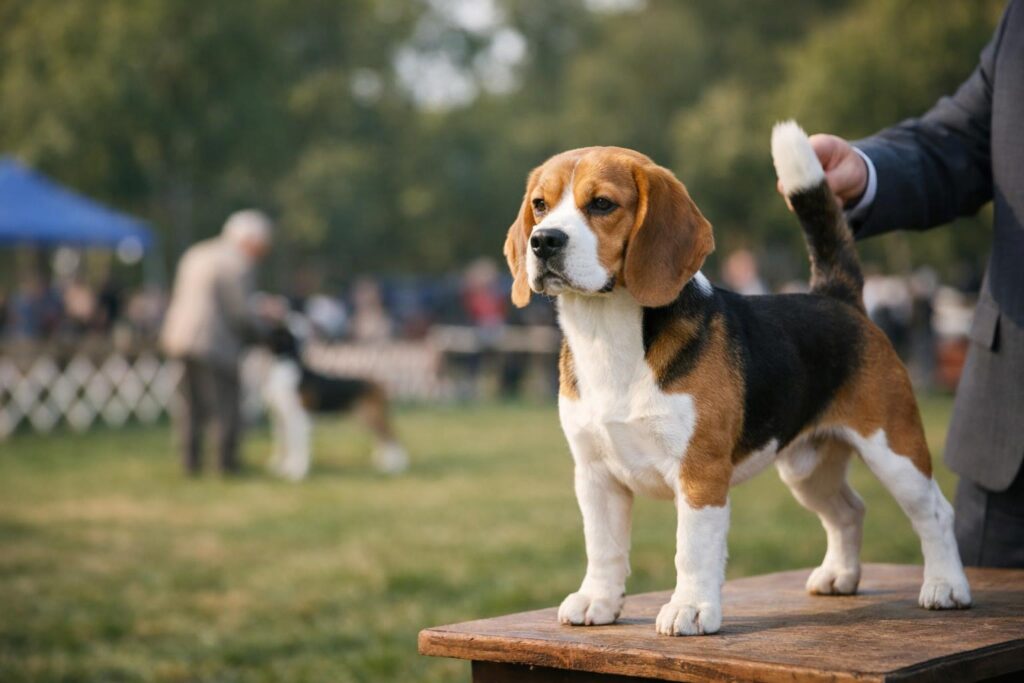
In the dog show world, “bench” refers to conformation showing. The word comes from an older tradition where dogs at shows were required to sit on assigned wooden benches or stands for the entire event, so that spectators and breeders could observe them up close. According to Wikipedia’s entry on dog shows, among field trial participants, the term “bench show” still means any conformation show today. Westminster Kennel Club is one of the last surviving benched shows in the United States.
That’s where the “bench” in bench beagle comes from when used in a show context. It has nothing to do with the dog’s size or legs. It just means the dog was bred for the show ring rather than the field.
Meaning One: A Bench Beagle Is a Show-Line Beagle
A bench beagle in this sense is a beagle selectively bred to match the official conformation standard rather than for hunting performance. The AKC beagle breed standard covers everything from head shape to leg structure to how the tail is carried. Height is the only disqualification in the standard. Breeders who show their dogs work toward that written description above everything else.
What a show-line beagle looks like in practice: straighter legs, higher tail set, shorter back, well-rounded bone structure, and a head that matches the AKC description closely. The dog is judged on how well it conforms to that standard, not on how fast it can track a rabbit.
The National Beagle Club of America notes that early American beagles were “dual purpose,” meaning they could win in the show ring and perform in the field. As urbanization increased and open hunting land decreased, the two paths split. Most beagles today are either show/conformation dogs or field dogs, not both. Dual champions exist but are rare.
How Bench Beagles Differ From Field Beagles
Field beagles are bred entirely for hunting performance. The breeders care about nose quality, stamina, tracking ability, and drive. How the dog looks is secondary. Show beagles are bred to match a written physical description. How well they actually hunt is secondary.
Those priorities produce noticeably different dogs over generations. Field beagles often have looser conformation, longer bodies, and more raw energy. Bench beagles tend to be more compact, physically consistent, and according to breed temperament guidance from Canna-Pet, beagles from show lines often tend to be slightly calmer than those from active hunting lines.
Neither is better for a pet owner. A field-bred beagle needs more exercise and mental stimulation than most people expect. A bench beagle is still a beagle, which means the same nose, the same vocal tendencies, and the same stubborn streak. The difference shows up most clearly at the extremes: a dog from a dedicated hunting kennel versus a dog whose parents have been show champions for three generations.
- Bench beagles are bred to match the AKC physical standard for the show ring.
- Field beagles are bred for hunting performance: nose, stamina, and drive.
- Most pet beagles today come from show or mixed lines, not dedicated hunting kennels.
- Both are the same breed with the same core temperament.
- Dual champions (field and show) exist but are genuinely rare.
Meaning Two: Bench Beagle as the 13-Inch Size Variety
This is the oldest and least common use of the term. Years ago, “bench beagle” was sometimes used informally to refer to the smaller 13-inch variety of the breed.
The AKC standard officially recognizes two size varieties: the 13-inch, for hounds not exceeding 13 inches at the shoulder, and the 15-inch, for hounds between 13 and 15 inches. The National Beagle Club explains that the two size classes were created so smaller hounds weren’t competing against larger ones in field trials, where size gives a clear speed advantage. The bench show classes were then set to match those same divisions.
You don’t hear “bench beagle” used this way much anymore. Most people just say 13-inch beagle. But if you come across the term in older articles or breeder conversations, this is what they mean.
Meaning Three: Bench Leg Beagles (the Defect)
A bench leg beagle has front legs that curve outward at the top and then back inward toward the paws, similar to being bow-legged. This is a conformation defect, not a feature. It is caused by poor breeding practices, often seen when breeders try to produce undersized beagles by breeding dogs that are smaller than the standard allows. These are often marketed as pocket beagles, which are not a recognized breed and come with their own set of health concerns. The AKC considers this a fault, and any beagle with this leg structure would not meet the breed standard.
The problem goes beyond appearance. Beagles are an active breed. Britannica describes the beagle as a dog that generally excels at sustained hunting activity and needs regular vigorous exercise. Curved front legs put stress on joints and limit how far and how comfortably the dog can move. A beagle that can’t run properly is a beagle that can’t burn energy the way the breed needs to. That leads to frustration, boredom, and behavioral problems that have nothing to do with the dog’s character and everything to do with an unmet physical need.
Some breeders advertise bench leg beagles as if the trait is desirable or rare. It’s neither. If you’re looking at a puppy and the front legs show this outward-then-inward curve when you look at the dog straight on, that’s a red flag about the breeder, not a feature to pay extra for.
Which Type Is a Typical Pet Beagle?
Most pet beagles today come from show or conformation lines rather than dedicated field hunting kennels. If your beagle came from a breeder who shows dogs, you likely have a bench beagle in the show sense. If your beagle came from a working hunting kennel, you likely have a field beagle. Most rescue beagles have mixed or unknown lineage, which is the case for a lot of dogs and doesn’t tell you much about how they’ll behave day to day.
For most people, the distinction between bench and field lines matters less than they think. The beagle temperament, nose, energy level, and vocal tendencies are consistent across both. What changes is the degree. A dedicated field beagle from hunting stock will have a stronger drive and need more stimulation than a show-line beagle. But both are beagles, and both will follow a scent off a cliff if you give them the chance.
If you’re not sure which line your beagle comes from, that’s completely normal. Most pet owners don’t know and it doesn’t change how you care for the dog.
- Pocket Beagle vs Standard Beagle: Size, Temperament and Health Differences Explained — if the 13-inch variety caught your attention, this covers everything about undersized beagles, how they’re bred, and the health risks involved.