
Note from Adrian: I’m a beagle owner, not a vet. Everything here is based on my own research and experience with Tyler. If your beagle has persistent bad breath or you notice any of the warning signs mentioned in this article, please see your vet. Don’t use this as a substitute for professional advice.
I noticed it a few weeks ago when Tyler climbed up for his usual morning greeting. Something was off. Not sharp, not chemical, just this dull, stale smell that hit me before he even got close to my face. I thought maybe it was something he’d eaten. But it kept showing up.
That’s when I started paying attention. Tyler gets his teeth brushed regularly, so I wasn’t expecting a dental problem. But the more I looked into beagle bad breath, the more I realized that brushing is just one piece of a much bigger picture. I’ve got a vet appointment booked for this Sunday to get a proper look, but in the meantime, I went deep on the research. Here’s what I found.
Is Bad Breath in Beagles Actually Normal?
No. A beagle’s breath should have a mild, mostly neutral smell. A persistent odor that you notice from a distance, or that greets you every time your dog comes close, is a sign that something is off.
The phrase “dog breath” gets thrown around a lot, and I used to assume it was just part of owning a dog. But it’s not. Research from Cornell University’s College of Veterinary Medicine shows that 80 to 90% of dogs over the age of three have some form of gum disease. That’s a staggering number. And one of the earliest signs of gum disease is exactly the kind of stale, musty smell I noticed on Tyler.
So no, it’s not just “dog breath.” It’s a signal. The good news is that most of the time it’s something you can actually do something about.
What’s Usually Causing That Stale Smell?
A stale smell on your beagle’s breath almost always comes back to plaque and bacteria in the mouth. Plaque is a sticky, invisible film that forms on the teeth after eating. It’s made up of food particles, saliva, and bacteria. When it sits on the teeth and along the gum line without being cleaned away, the bacteria multiply and start producing sulfur compounds. Those compounds are what you’re smelling.
According to VCA Animal Hospitals, the most common cause of bad breath in dogs is periodontal disease that comes directly from plaque and tartar buildup. If plaque isn’t cleaned off regularly, it hardens into tartar. Tartar is rough and porous, which means it traps even more bacteria. At that point, the smell gets noticeably worse, and brushing at home can’t fully remove it.
The stale smell Tyler has is consistent with early-stage plaque buildup. Not necessarily full-blown gum disease yet, but enough bacteria sitting on those teeth to make things unpleasant.
What Different Smells on Your Beagle’s Breath Actually Mean
Not all bad breath is the same, and the type of smell can actually tell you a lot about what’s going on.
Stale or musty: This is the most common type and almost always points to dental issues. Plaque, tartar, and early gum disease all produce this kind of smell. It’s not pleasant, but it’s usually the most manageable cause.
Sweet or fruity: This one’s worth taking seriously. PetMD notes that a sweet or acetone-like smell on a dog’s breath can be a sign of diabetes. A diabetic dog’s body starts breaking down fat for energy, producing molecules called ketones. Those ketones create that distinctive sweet smell.
Ammonia or urine-like: If your beagle’s breath smells like ammonia, that can point to kidney problems. When the kidneys aren’t filtering waste properly, a compound called urea builds up in the bloodstream and shows up on the breath.
Foul and rotten, with other symptoms: If the bad breath comes alongside vomiting, yellowing of the gums or eyes, or loss of appetite, that could indicate a liver issue. This combination of symptoms needs a vet visit quickly.
Tyler’s breath smells stale, not sweet or chemical, which points to a dental cause rather than something systemic. But knowing these differences is useful for any beagle owner.
Why Brushing Alone Might Not Be Enough
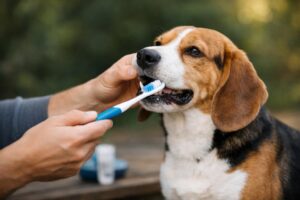
Brushing is the single best thing you can do for your beagle’s teeth. But here’s the part that surprised me when I dug into the research: even with daily brushing, plaque starts forming again on the tooth surfaces within 24 hours of cleaning. Research cited in Today’s Veterinary Practice confirms that a lack of home care for just one week can lead to gingivitis in some dogs.
That’s the gap Tyler has been falling into. He gets brushed, but I haven’t been doing anything else. No dental chews, no water additives, no real attention to what’s happening along the gum line.
Brushing handles the visible surfaces of the teeth, but bacteria collect in the small gaps between teeth and along the gum line where a toothbrush can’t always reach. Dental chews help by scraping away plaque through the chewing motion itself. Zoetis Petcare recommends looking for products with the Veterinary Oral Health Council (VOHC) Seal of Acceptance, which means they’ve been tested and shown to actually reduce plaque and tartar.
Water additives are another option. You add a small amount to your beagle’s water bowl each day, and they help reduce bacteria in the mouth without your dog needing to do anything extra. It’s the easiest addition to make.
A Few Other Causes Worth Knowing About
While dental issues are by far the most common cause, a few other things can lead to bad breath in beagles.
Food residue stuck in the teeth: Dry kibble can mix with saliva to form a paste that gets stuck in the crevices of your beagle’s teeth. It doesn’t always wash away with water, and it can start to smell over time. Making sure the food is fresh and stored in an airtight container helps, and timing brushing for after meals makes sense.
Foreign objects in the mouth: Beagles love to sniff and chew on things they find outside. Thin wood splinters or small debris can get wedged between teeth or puncture the inner cheek. Bacteria grow quickly around those objects, and that can cause a sudden, sharp change in breath smell. If your beagle’s breath went from fine to noticeably bad very quickly, this is worth ruling out.
Coprophagia: Some dogs eat poop. Beagles are food-motivated and curious, so it’s not unheard of. If your beagle’s breath smells like feces and you’ve left them unsupervised in the yard, that might be what happened.
When Should You See a Vet About Your Beagle’s Breath?
You should see a vet when the bad breath is persistent and doesn’t improve with better dental care at home, or when the smell matches one of the warning types mentioned above.
PetMD recommends a vet visit any time you notice a change in your dog’s breath that you can’t easily explain. Specifically, see a vet if:
- The breath smells sweet, fruity, or chemical
- The breath smells strongly of ammonia or urine
- The bad smell comes with other symptoms like vomiting, loss of appetite, weight changes, or unusual drinking and urination
- You can see yellow or brown buildup on the teeth, or the gums look red and swollen
- The bad breath has been going on for more than a few weeks without improving
For me, Tyler’s stale smell has been consistent for a few weeks now. It’s not getting worse, but it’s not going away either. That alone is reason enough to get it checked out.
What I’m Doing for Tyler Before Sunday
I didn’t want to just sit on this until the appointment, so I’ve made a few changes this week.
First, I picked up dental chews with the VOHC Seal. Tyler has never had them before, and I was honestly a little surprised at how quickly he went for it. He treated it like a regular treat. The chewing action works against the plaque on his teeth while he enjoys it, so it’s a pretty easy addition to his daily routine.
I’m also looking into a water additive. Tyler already drinks less than he should, which I’ve mentioned before, so I want to make sure whatever I use doesn’t change the taste enough to put him off. Most of them are flavorless, so I think it’ll be fine.
I’ve also been checking his gums. No visible redness, no swelling, no loose teeth. His gums look healthy from the outside, which is reassuring. But a lot of gum disease hides below the surface, which is exactly why the vet needs to take a proper look.
I’ll update once I know more from Sunday’s visit. But if your beagle is in the same boat right now, don’t wait too long to get it checked. The earlier you catch a dental issue, the easier and cheaper it is to deal with.
The Bottom Line on Beagle Bad Breath
Stale breath on a beagle is usually a dental problem. It doesn’t mean your dog is in serious trouble, but it does mean something needs attention. Brushing is a solid foundation, but on its own it won’t always be enough. Dental chews, water additives, and regular vet checkups fill in the gaps that a toothbrush can’t reach.
The smell type is your best clue. Stale or musty usually means dental. Sweet, ammonia-like, or foul with other symptoms means get to the vet sooner rather than later.
Tyler goes in this Sunday. I’ll know more then. In the meantime, if you’re dealing with the same thing, you’ll find plenty more on keeping your beagle healthy over on the blog.
Frequently Asked Questions
Why does my beagle’s breath smell stale?
A stale smell on a beagle’s breath is usually caused by plaque and bacteria building up on the teeth and along the gum line. As bacteria multiply, they produce sulfur compounds that create that musty odor. Daily brushing helps, but dental chews and water additives are also useful for tackling the bacteria that a toothbrush can’t always reach.
Is bad breath in beagles normal?
No. A beagle’s breath should have a mild, mostly neutral smell. Persistent bad breath is a signal that something is going on, most commonly plaque buildup or early gum disease. Cornell University’s College of Veterinary Medicine reports that 80 to 90% of dogs over three have some form of gum disease, so it’s common, but it’s not something to just accept and move on from.
Can brushing fix my beagle’s bad breath on its own?
Brushing is the most important thing you can do, but it has limits. Plaque starts forming again within 24 hours of cleaning, and bacteria can collect in spots the toothbrush doesn’t fully reach. Pairing brushing with dental chews that carry the VOHC Seal of Acceptance and a daily water additive gives you much better coverage across your beagle’s whole mouth.
What does it mean if my beagle’s breath smells sweet or like ammonia?
A sweet or fruity smell can be a sign of diabetes, where the body breaks down fat for energy and produces ketones. An ammonia-like smell can point to kidney problems, where waste products build up in the bloodstream and show up on the breath. Both of these require a vet visit right away. These smells are quite different from the typical stale or musty smell caused by dental issues, so they’re usually noticeable.
How often should a beagle get a professional dental cleaning?
Most vets recommend a professional dental cleaning once a year, though some dogs may need it every six months depending on how quickly plaque builds up. A professional cleaning is done under anesthesia, which allows the vet to clean below the gum line where home care can’t reach. VCA Animal Hospitals notes that dental disease is one of the most commonly seen conditions in dogs, and that regular cleanings play a big role in preventing it from advancing.