TL;DR: Beagles aren’t just greedy. There’s real science behind their obsession with food. The breed’s hunting history hardwired them to always be on the lookout for calories, and some dogs genuinely can’t feel full the way other breeds can. This post explains why your beagle acts like they’re starving even right after dinner, and gives you six practical ways to manage it without overfeeding them.
Tyler finished his dinner in under a minute. Then he sat in front of his empty bowl and stared at me like I’d served him nothing but air. He didn’t move. He didn’t blink. He just stared. This is every single evening in our house.
If you have a beagle, you know this look. The dramatic slump onto the floor the moment you close the treat cupboard. The way they materialize from nowhere the second you open the fridge. The begging that starts before you’ve even sat down to eat your own dinner.
For a long time, I assumed I was doing something wrong. Maybe Tyler wasn’t getting enough food. Maybe he was bored. Maybe I’d accidentally trained him into it somehow. But the more I looked into it, the more I realized the answer was simpler and more interesting than any of that.
Research shows that 40 to 50 percent of dogs are overweight, and obesity is particularly common in beagles compared to other breeds. That stat stopped surprising me once I understood why. Your beagle isn’t broken. They’re just built this way.
Here’s what’s actually going on.
Is Your Beagle Actually Hungry, or Does It Just Feel That Way?
Most beagles feel genuine hunger more intensely and more often than other dogs. It’s not a behavior problem. It’s a combination of deep breed instinct and, for some dogs, a brain chemistry quirk that means the “I’m full” signal arrives late, quietly, or sometimes not at all.
The hunger your beagle shows isn’t performed. They’re not manipulating you (well, not entirely). When Tyler stares at me after finishing his bowl, he genuinely feels like he could eat again. That’s what makes it so hard to ignore, and so important to understand rather than just give in to.
There are two layers to this. The first is evolutionary: beagles were bred for a lifestyle that required them to eat whenever food was available. The second is neurological: some dogs have a brain signaling issue that means fullness doesn’t register the way it should. Both are worth knowing about.
The Hunting Dog Brain That Never Switched Off
Beagles were bred in England as pack scent hounds, built to track small game like rabbits and hares for hours at a time. Alongside the Bloodhound and Basset Hound, the beagle has one of the best developed senses of smell of any dog, and that nose was their entire job. They’d work in packs, follow a scent across fields, and run down prey for hunters on foot.
That kind of work burns enormous energy. And in the wild, food wasn’t guaranteed. A hunting dog that learned to eat whenever the opportunity came along survived better than one that waited until it felt peckish. Over hundreds of years of selective breeding, that drive got locked in. Eat when you can. Always be interested in food. Never turn down a meal.
Some breeds, such as Labrador Retrievers and Beagles, are specifically known for their large appetites, and it’s not coincidence. Both are working breeds with long histories of high-energy output. The food drive that made them excellent at their jobs didn’t disappear when they moved into your living room. It just has nowhere useful to go.
Tyler’s nose leads him to the kitchen every single time someone opens the fridge. It doesn’t matter that he ate an hour ago. His brain is still running the same program it was built to run: find food, pursue it, eat it.
Why Some Dogs Never Feel Full: The Science
Research from the University of Cambridge found that a genetic mutation in a gene called POMC disrupts the brain signals that tell a dog it’s had enough to eat. Dogs with this mutation get hungry between meals faster than dogs without it, and also burn around 25% fewer calories at rest. It’s a double hit: more hunger, less calorie use.
The mutation triggers a starvation signal in the brain that tells the body to increase food intake and conserve energy, even when this is completely unnecessary. The dog isn’t pretending. Their brain is genuinely telling them they need more food.
In a dog with the POMC gene mutation, the brain does not receive fullness signals effectively, and therefore the dog remains hungry even after an adequate meal. The confirmed cases are in Labrador and Flat-Coated Retrievers specifically, where the mutation is well-documented. But the hunger-signaling pathway involved is the same across all dogs.
The deletion disrupts production of two proteins, beta-MSH and beta-endorphin, that are associated with appetite regulation and feelings of satiety. When these proteins are reduced, the “I’m done eating” message either doesn’t get sent or doesn’t get received properly.
For beagles, whether or not a specific mutation is involved, the result looks the same: a dog that finishes a full meal and immediately acts like it never happened. Tyler does this every single night. Now at least I know why.
How Much Should a Beagle Actually Be Eating?
A healthy adult beagle weighing around 20 to 25 pounds typically needs around 700 to 900 calories a day, split across two meals. That’s probably less than you’d guess, especially when your beagle is doing their best impression of a dog who has not eaten in three days.
The quickest way to check if your beagle is at a healthy weight is the rib check. Run your hands along their sides. You should be able to feel their ribs without pressing hard, but you shouldn’t be able to see them. If you can’t feel them at all under a layer of softness, your beagle is likely carrying too much weight. If they’re clearly visible without touching, they may need more food.
I used to fill Tyler’s bowl by feel. A scoop here, a handful there, and a little extra because he was looking at me like that. When I switched to using an actual measuring cup and following the feeding guide on his food, I realized I’d been overfeeding him by about 20%. He was no less hungry. But he was healthier.
One rule worth following with beagles: never free-feed. Leaving food out all day is a guaranteed path to obesity with this breed. They don’t self-regulate. They eat until the food is gone, and then they look for more.
Six Things That Actually Help Manage a Beagle’s Hunger
You’re not going to eliminate a beagle’s food drive. That’s not the goal. The goal is to manage it so your dog isn’t constantly frustrated and isn’t gaining weight. These are the six things that have made the most practical difference for Tyler and me.
Use a slow feeder or puzzle bowl. When a dog inhales their meal in 30 seconds, the brain doesn’t have time to register that food has arrived. Slowing dogs down with puzzle feeders gives their brains time to experience satiety, letting them discern when they’re full and making them far less likely to beg for more. A maze bowl or puzzle feeder stretches a two-minute meal into ten. Same amount of food, but the dog finishes feeling more settled. Cambridge researchers specifically recommend spreading daily food rations using puzzle feeders or scattering food around to extend eating time for dogs prone to hunger-driven overeating.
Split meals into two or three smaller portions. The longer the gap between meals, the more intense the hunger gets. Feeding the same daily amount across two or three smaller meals keeps the hunger level more stable throughout the day. Tyler gets his daily amount split between morning and early evening. On days when the gap feels too long, I’ll hold back a small portion of his morning meal and give it as a midday snack. Same calories, less desperation.
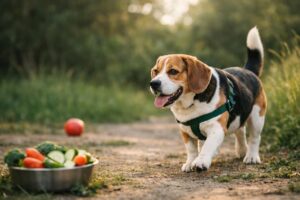
Add low-calorie bulk to meals. Cooked green beans, plain carrot sticks, and cucumber are all low in calories but add volume to the bowl. A beagle whose meal physically looks bigger often does seem more satisfied than one eating the same calorie count in a smaller serving. This isn’t a magic fix, but it’s a practical one. Check with your vet before making regular dietary additions, especially if your beagle has any existing health conditions.
Keep a strict feeding schedule. Predictable feeding times help dogs feel secure, and structure reduces anxiety-driven food-seeking behavior. When Tyler knows food is coming at the same times every day, the frantic energy around mealtimes is noticeably lower than on days when timing varies. Dogs that are unsure when their next meal is coming tend to fixate on food more, not less.
Use a snuffle mat or scatter feed for mental enrichment. Beagles work with their noses. Hiding kibble in a snuffle mat or scattering it across a patch of grass makes them use scent to find food, which is both mentally tiring and slower than bowl eating. Tyler’s snuffle mat is genuinely one of the most useful things I own. It buys at least ten minutes of focused, calm engagement at mealtimes, and he finishes looking more satisfied than he does after a bowl meal.
Never feed from the table. This one sounds obvious but it’s worth saying clearly. Beagles are fast learners. If begging at the table works even once, that behavior gets locked in. Every time you give in, you’re reinforcing that staring and whining produces food. It’s not affection. It’s training your dog to pester you.
When Constant Hunger Might Be a Medical Issue
Beagle hunger is usually just beagle hunger. But there are situations where constant appetite signals something that needs a vet’s attention. The key difference is this: breed-level food obsession is constant and stable. Medical hunger tends to change suddenly or comes with other symptoms.
If your beagle’s appetite has recently increased dramatically, or if the hunger comes alongside weight loss, increased thirst, more frequent urination, or changes in their energy level or coat, it’s worth getting them checked out. Conditions including diabetes mellitus, Cushing’s disease, intestinal parasites, and thyroid issues can all drive abnormal appetite in dogs.
Diabetes causes the body to struggle with glucose regulation, so cells feel starved even when the dog is eating. Cushing’s disease produces excess cortisol, which drives hunger and weight changes. Intestinal parasites steal nutrients, leaving the dog genuinely undernourished despite regular meals. All of these are treatable, but only if they’re caught.
If your beagle has always been food-obsessed and nothing has changed, that’s almost certainly just the breed. If something feels different recently, don’t wait on it.
Wrapping It Up
Tyler is still obsessed with food. That hasn’t changed and it never will. But I’ve stopped feeling guilty about it, because I understand it now. He’s not hungry because I’m a bad owner. He’s hungry because his brain is running software that was designed for a very different life than the one he actually has.
The measuring cup made a difference. The slow feeder made a difference. The snuffle mat made a difference. None of those things changed who Tyler is. They just gave me better tools for working with him.
If your beagle’s food obsession shows up in other ways, like counter-surfing, stealing food, or pushing boundaries at mealtimes, a lot of that comes down to training and managing the environment. I covered the practical side of beagle behavior and training in Beagle Separation Anxiety: An Honest Guide to What Works and What Doesn’t, which gets into how beagle instinct shapes so much of what can feel like stubbornness or neediness.
Frequently Asked Questions
Why does my beagle act hungry right after eating?
Because the “I’m full” signal in their brain either arrives late or doesn’t register strongly. Research shows that in some dogs the brain doesn’t receive satiety signals effectively after a meal, meaning they remain hungry even when they’ve eaten an adequate amount. For beagles specifically, this combines with a deeply bred instinct to eat whenever food is available. The result is a dog that finishes dinner and immediately acts like it never happened. It’s not manipulation. It’s genuinely how they experience hunger.
Is it okay to give my beagle extra food if they seem hungry?
Not based on how they look or act, no. Beagles will always look and act hungry, regardless of how much they’ve eaten. If allowed, most beagles will overeat and seek out any food within reach. Extra food adds calories your beagle almost certainly doesn’t need, and obesity in beagles leads to joint problems, diabetes, and a shorter lifespan. If you genuinely think your beagle isn’t getting enough to eat, check with your vet about portion sizes for their specific age, weight, and activity level.
What low-calorie foods can I add to my beagle’s meals?
Cooked green beans, plain carrots, cucumber slices, and plain cooked sweet potato are all safe, low-calorie options that add volume to a meal without adding many calories. These work best as a way to make portions look larger and extend eating time. Always introduce new foods gradually and in small amounts. Some human foods are toxic to dogs, including grapes, onions, garlic, and anything containing xylitol. If you’re unsure whether something is safe, check with your vet before adding it regularly.
Do beagles ever grow out of being food-obsessed?
No. The food drive in beagles is breed-level instinct, not a puppy phase. It typically stays consistent throughout their life. What does change is how well you learn to manage it. Most experienced beagle owners get better at reading the difference between genuine hunger signals and habitual begging, and at setting up routines and feeding tools that keep the obsession from running the household. The dog doesn’t change. Your systems around the dog get better.
Can I use treats for training if my beagle is already overweight?
Yes, but you need to account for treat calories in their daily total. Treats should only make up around 10% of a beagle’s daily calorie intake. If your beagle is overweight, consider using a portion of their regular daily kibble as training treats rather than adding extra calories on top. You can also use low-calorie options like small pieces of plain carrot or green bean. The size of the treat doesn’t matter to a beagle. They’ll work just as hard for a tiny piece as a big one.