Beagles are built to eat everything in sight and act hungry even when they’re not. If your vet just told you your beagle is overweight, the fix is three things: measure food properly, swap high-calorie treats for low-cal ones, and get more daily movement in. Aim for 1-2 kg per month. Always run the plan by your vet first.
Last month, Tyler stepped on the scale at the vet and hit 21 kg. The vet looked at me, then at Tyler, then back at me. “He’s overweight,” she said. “We need to do something about this.”
I knew Tyler loved food. Every beagle does. But 21 kg felt like a real number staring back at me. According to the American Kennel Club, a healthy adult beagle should weigh somewhere between 9 and 14 kg, depending on their height. Tyler was sitting well above that, and I honestly had no one to blame but myself.
It crept up slowly. A few extra treats here. A slightly fuller bowl there. Tyler’s world-class begging face doing its job every single day. By the time the vet said the word “overweight,” I was nodding along feeling like a terrible dog dad. If you’re in the same spot right now, here’s what I’ve learned about actually getting a beagle’s weight back down.
How Do You Know If Your Beagle Is Overweight?
The easiest check you can do right now is the rib test. Run your hands along the sides of your beagle’s chest. You should be able to feel each rib without pressing hard. If you can feel them clearly without pressing through fat, your beagle is likely fine. If you’re pushing through a squishy layer just to find them, your dog is carrying too much.
VCA Animal Hospitals explain that a dog at a healthy weight should have ribs that are easily felt, a visible waist from above, and an abdomen that tucks up when viewed from the side. Stand behind your beagle and look straight down. A healthy beagle has a visible waist. If the shape is more of a barrel with no taper at all, that’s something to address.
Beyond the rib test, watch how your beagle moves. If he tires out quickly on walks, pants more than usual in cool weather, or can’t groom hard-to-reach spots anymore, those are real signals something is off. When in doubt, your vet can do a Body Condition Score (BCS) check. It’s a simple 1-9 scale where 5 is ideal. Our vet did this with Tyler and it made the problem really clear in a way that the number on the scale alone didn’t.
Why Beagles Gain Weight So Easily
Beagles were bred to follow a scent trail for hours across fields. Their bodies are wired to eat whenever food is available because out in the field, the next meal was never guaranteed. That drive is still fully switched on in Tyler, even if his “hunting” mostly happens around the kitchen counter.
The Association for Pet Obesity Prevention notes that beagles are famously food-motivated, and even a couple of extra pounds can shift their Body Condition Score quickly. They don’t really have an “I’m full, thanks” moment. They’ll eat everything you put in front of them and immediately look at you like you forgot to serve the second course. Add neutering (which slows metabolism), getting older (which means less movement), and the fact that most of us honestly just pour too much in the bowl, and you’ve got a recipe for a chunky beagle.
This is also why Tyler’s constant hunger actually has a real biological reason behind it. If you’ve wondered whether there’s science behind why your beagle acts like it hasn’t eaten in days, I wrote about it here: Why Is My Beagle Always Hungry?
How Much Should You Cut from Your Beagle’s Food?
Start by cutting current portions by 10 to 15%. Don’t switch food cold turkey and don’t go from a full bowl to barely anything overnight. VCA recommends reducing caloric intake gradually and setting a target weight with your vet before changing anything. Slow and deliberate beats drastic every time.
Get a measuring cup and actually use it at every single meal. I know it sounds overly simple, but this one habit made a bigger difference than anything else I tried with Tyler. If you’ve been scooping with a random mug or estimating by eye, that’s probably where things went sideways. Feed twice a day at set times with no food left out between meals. Beagles graze like it’s their job if given the chance.
If your vet recommends switching to a weight-management kibble, mix it in gradually over about a week to avoid stomach issues. Look for food approved by AAFCO (Association of American Feed Control Officials), which confirms it meets full nutritional standards so you’re not cutting calories at the expense of nutrition. For really precise portioning, a cheap kitchen scale beats cups every time since the numbers on food bags tend to be slightly generous.
Treats Are Probably the Hidden Problem
Treats should make up no more than 10% of your beagle’s daily calories. If you’re giving store-bought biscuits during training, sneaking bites at the dinner table, and tossing extra kibble “just because he’s looking at me,” those calories completely cancel out the portion cuts you’re making at mealtimes. This was the biggest problem with Tyler and I didn’t even realize it for weeks.
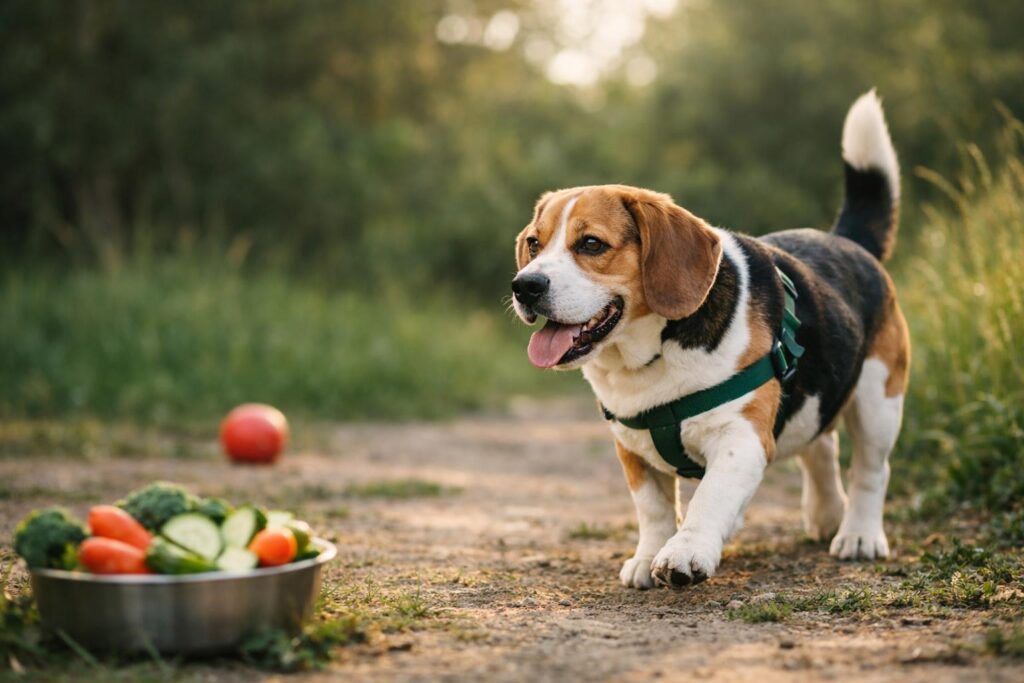
According to the ASPCA, baby carrots are about 4 calories each and green beans are very low in calories with a satisfying crunch, making them genuinely good swaps during a weight loss phase. Tyler was suspicious of carrots at first. Now he loses his mind for them. Plain green beans, blueberries, and apple slices (no seeds, no core) all work well too. A handful of store-bought biscuits can easily run 200+ extra calories a day. Switching to vegetables cuts that to almost nothing.
One thing I started doing: I set aside a small portion of Tyler’s daily kibble in a separate container before putting his bowl down. During our walk or training, he gets a few pieces from that container as rewards. He thinks he’s getting something special. His total daily calories stay the same. It genuinely works.
- Grapes and raisins — toxic, can cause kidney failure
- Onions and garlic — toxic in any form, raw or cooked
- Xylitol — found in some peanut butters and sugar-free foods, extremely dangerous
- Chocolate — toxic at any quantity
The Right Way to Exercise an Overweight Beagle
Don’t start with an hour-long hike. If your beagle has been mostly inactive, jumping straight into intense activity puts serious stress on joints that are already carrying extra weight. AKC Pet Insurance recommends starting with short, low-impact walks and building up gradually. Two 15 to 20-minute walks a day is a perfectly solid starting point. Add 5 minutes every week from there.
Watch your beagle during walks. Excessive panting, lagging behind, or stopping and refusing to move are all signs you’ve done enough for the day. When you see those signs, head home. Don’t push through it. The goal over time is 60 to 90 minutes of daily movement split across two sessions, but getting there gradually is what keeps your dog safe.
Scent work is honestly one of the best options for beagles specifically. Hide pieces of their daily kibble around the house or yard and let them sniff it out. Tyler gets more tired from 20 minutes of nose work than from a casual half-hour walk. It burns mental energy, costs nothing, and taps into exactly what beagles were bred to do. Swimming is another great option if you have access; it’s completely joint-friendly and burns calories efficiently.
The AKC notes that beagles follow their nose first, making off-leash recall very unreliable, so always keep your beagle leashed on walks. When Tyler picks up an interesting scent, I simply do not exist anymore.
What to Do When Your Beagle Acts Like He’s Starving
Even when you’re feeding the correct amount, your beagle will act hungry. That’s just how the breed works. Tyler does his best sad-starving routine regardless of how much he’s eaten. It’s not a sign you’re underfeeding him. It’s just who he is.
A slow feeder bowl makes a real difference. These have ridges and compartments that force your beagle to work for each bite. A meal that took Tyler 40 seconds now takes several minutes. He finishes more calmly and stays more settled afterward. Mixing plain green beans or baby carrots into the kibble also helps a lot. The meal looks and feels bigger without adding meaningful calories, and Tyler doesn’t notice the difference at all.
On the begging front: completely ignoring it is the only thing that works. Every bite of your food handed over is extra calories that aren’t in your plan. Worse, responding to begging even to say no teaches your beagle that the behavior gets a reaction. Tyler’s begging face is world-class. I ignore it anyway.
How Long Will It Take?
A safe, realistic target is about 1 to 2 kg of weight loss per month. The Association for Pet Obesity Prevention recommends gradual weight loss at a pace your vet sets based on your dog’s current condition. Anything faster risks losing muscle mass, not just fat, which makes the overall situation worse.
For Tyler, getting from 21 kg down to a healthy range is going to take months. There’s no shortcut. The first couple of weeks might show almost no change while his body adjusts, and that’s completely normal. Monthly weigh-ins at the vet are worth doing because they keep you accountable without obsessing over daily fluctuations. If the weight isn’t moving after 4 to 6 weeks of a consistent plan, go back to your vet. VCA notes that some dogs have underlying conditions like hypothyroidism that make weight loss genuinely harder, and it’s worth ruling those out early rather than grinding away at a plan that isn’t working.
The Short Version
Tyler’s vet visit was a wake-up call, but the plan isn’t complicated. Measure every meal, fix the treats, move a little more each day. We’re working through it one measured cup and one extra walk at a time. It’s not glamorous. But it’s what actually works.
- Do the rib test right now. Press gently along their sides. You’ll know in 30 seconds if this needs attention.
- Pull out a measuring cup and use it at every meal from today onward.
- Add one extra 15-minute walk to your day, starting tomorrow.
Frequently Asked Questions
The rib test is your best bet. Run your hands along the sides of your beagle’s chest. You should feel each rib clearly without pressing through fat. Also look at your dog from above. A healthy beagle has a visible waist. If the body looks round with no taper, that’s a sign of extra weight. Your vet can confirm with a Body Condition Score check, which takes less than two minutes.
Start with a 10 to 15% reduction and use an actual measuring cup at every meal. Don’t cut drastically all at once. If switching to a weight-management formula, mix it in gradually over 7 to 10 days to avoid stomach upset. Always check with your vet before making significant changes to your dog’s diet.
Absolutely. Baby carrots are about 3-4 calories each and plain green beans are roughly 1 calorie per bean. Apple slices without seeds or core and blueberries also work well. Serve everything plain with no seasoning. Avoid grapes, raisins, onions, and garlic as these are toxic to dogs.
Start with two 15 to 20-minute walks per day and add 5 minutes per week as fitness builds. The long-term goal is 60 to 90 minutes of daily activity. Watch for excessive panting or stopping mid-walk as signs you’ve done enough. Scent work and swimming are great low-impact additions that burn energy without stressing the joints.
Expect around 1 to 2 kg per month on a consistent plan. If your beagle has a significant amount to lose, the full process will take several months. Faster weight loss risks muscle loss rather than fat loss. Weigh your dog monthly at the vet and check back with your vet if nothing is moving after 4 to 6 weeks.